How often should you clean your pool in West Palm Beach? Once a week, every week of the year, with a full service visit. That weekly visit is the core of a good pool maintenance schedule, and a quick look every day or two covers the gaps in between. Stretch the visits further apart and the sun and the summer rain start to win.
It isn’t a sales habit. It comes down to how fast chlorine burns off in our sun, how much rain lands between May and October, and how little time algae needs in warm water.
What one week of South Florida weather does to pool water
Three things work on a pool here between visits, and they overlap.
The sun burns off chlorine fast
Sunlight is the biggest chlorine thief we deal with. In water with no stabilizer, sunlight can burn off half of the free chlorine before an hour is up. Stabilizer, also called cyanuric acid or CyA, shields chlorine from the sun and keeps it working around three to ten times longer. It has no germ-killing power of its own, though. So even a stabilized pool that starts the week in good shape can run low by the weekend in July.
The rainy season runs May 15 to October 15
The National Weather Service in Miami puts South Florida’s rainy season between May 15 and October 15, and 60 to 70 percent of the year’s rain falls in that window. Its normal for West Palm Beach over those five months is 36.30 inches.
Rainwater carries no chlorine, so every heavy storm dilutes what’s in the pool. A downpour can also pull total alkalinity down quickly, and once alkalinity drops, pH stops holding steady. Then there’s hurricane season, which runs June 1 through November 30. A single tropical storm can fill a pool with leaves, grit and roof runoff in one afternoon.
Warm water gives algae a head start
Algae spores blow into every outdoor pool every day. All they need is a gap. With warm water, strong sun and a low chlorine reading, some algae can take a pool from clear to green in under a day. Leaves, fertilizer off the lawn, bird droppings and drowned bugs all feed it. It tends to show up first where the water barely moves, like deep corners and the back of the steps.
A pool maintenance schedule for South Florida pools
This is the pool maintenance schedule we’d give any new owner in Palm Beach County. Some of it takes you two minutes. The rest is the weekly service visit.
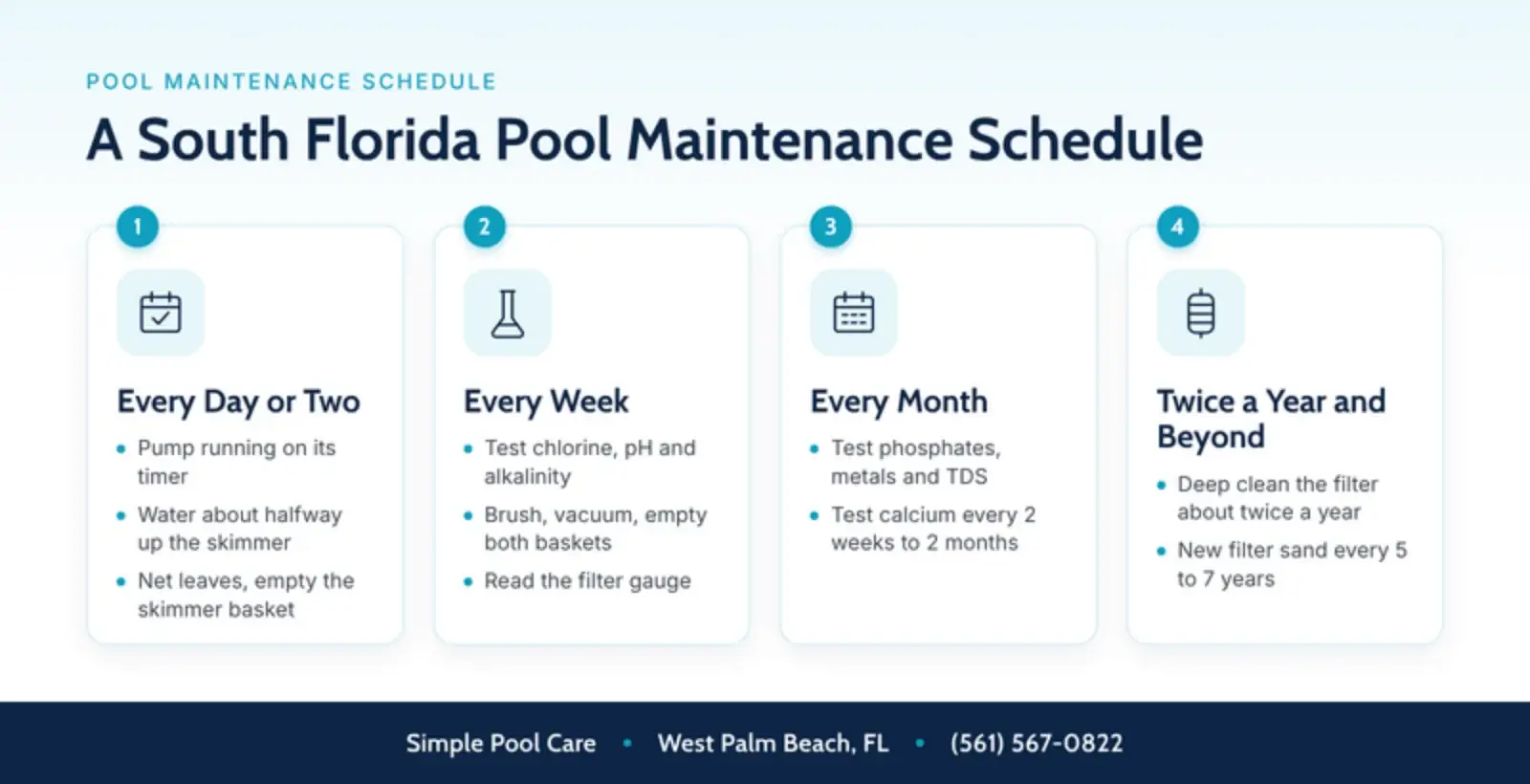
| Task | How often | Why it matters |
|---|---|---|
| Check that the pump runs and the water sits mid-skimmer | Every day or two | Low water lets the skimmer pull air into the pump |
| Net floating leaves, empty the skimmer basket | Every day or two, and after storms | Sunken leaves feed algae and use up chlorine |
| Test free chlorine and pH | Weekly at minimum, more in summer | These two readings move fastest |
| Brush walls, steps and tile line | Weekly | Breaks up algae and biofilm early |
| Vacuum the floor, empty the pump basket | Weekly | Debris on the floor feeds algae |
| Test total alkalinity | Weekly and after heavy rain | Keeps pH steady |
| Check filter pressure | Weekly | Clean or backwash at 8 to 10 psi over clean |
| Test stabilizer (CyA) | Weekly if you use chlorine tablets | Tablets add more every time |
| Test calcium hardness | Every 2 weeks to every 2 months | Depends on your fill water |
| Test phosphates, metals and TDS | Monthly | Catches slow trends |
| Deep clean the filter | About twice a year | Restores flow the gauge has lost |
| Change the sand in a sand filter | Every 5 to 7 years | Old sand wears smooth and traps less |
Every day or two: the two-minute check
This part is yours, and it really does take two minutes. First, make sure the pump is running when the timer says it should be. Then look at the water level, which should sit near the middle of the skimmer mouth. Net out floating leaves before they sink, and empty the skimmer basket after a windy day or a storm.
Some water loss is normal here, since heat and wind evaporate a little every day. A pool cover can cut evaporation losses by 70 percent or more, according to the South Florida Water Management District. If the pool keeps losing noticeably more than that for a week or two, though, call before you blame the weather.
Every week: the full service visit
The weekly visit is where the real work happens. The tech tests the water and balances it, brushes the walls and tile line, vacuums the floor, empties both baskets and reads the filter gauge. Brushing does more than people expect. It scrubs off biofilm, the slime layer bacteria hide in, and it breaks algae loose so the chlorine can reach it.
Our weekly pool service covers all of that, with routine chemicals included in the monthly price. Full-service plans begin at $170 a month. For owners who’d rather do the netting and brushing, chemical-only service begins at $100 and handles just the water.
How often to test pool water
Free chlorine and pH change faster than anything else in the pool, since sun, rain and swimmers all pull on them. Test both at least once a week. In summer, after a pool party or after a heavy storm, two or three tests a week is better. Total alkalinity gets a weekly test too, plus one after every big rain.
Stabilizer needs a weekly check if you use chlorine tablets, because every tablet adds more. Calcium hardness can go two weeks to two months between tests, depending on how hard your fill water is. Phosphates, metals and total dissolved solids only need a monthly look. For the target numbers and how heat moves them, see our guide to chemical balancing during West Palm Beach summer heat.
Monthly, twice a year and longer
The filter gauge tells you when the filter needs attention. Note the reading right after a cleaning. Once the needle sits 8 to 10 psi over that clean number, backwash a sand or DE filter. For a cartridge, hose it off at the same point. A deeper filter cleaning, with cartridges soaked or DE grids pulled apart, is due about twice a year here.
Sand filters get new sand every 5 to 7 years. Pools with salt systems need the salt level checked against the maker’s range, usually 3,000 to 3,500 ppm. The cell also needs a look for scale.
What skipping weeks does to a pool
A pool maintenance schedule only works if it holds. Missed visits don’t hurt all at once, but the damage builds, and in summer it builds fast.
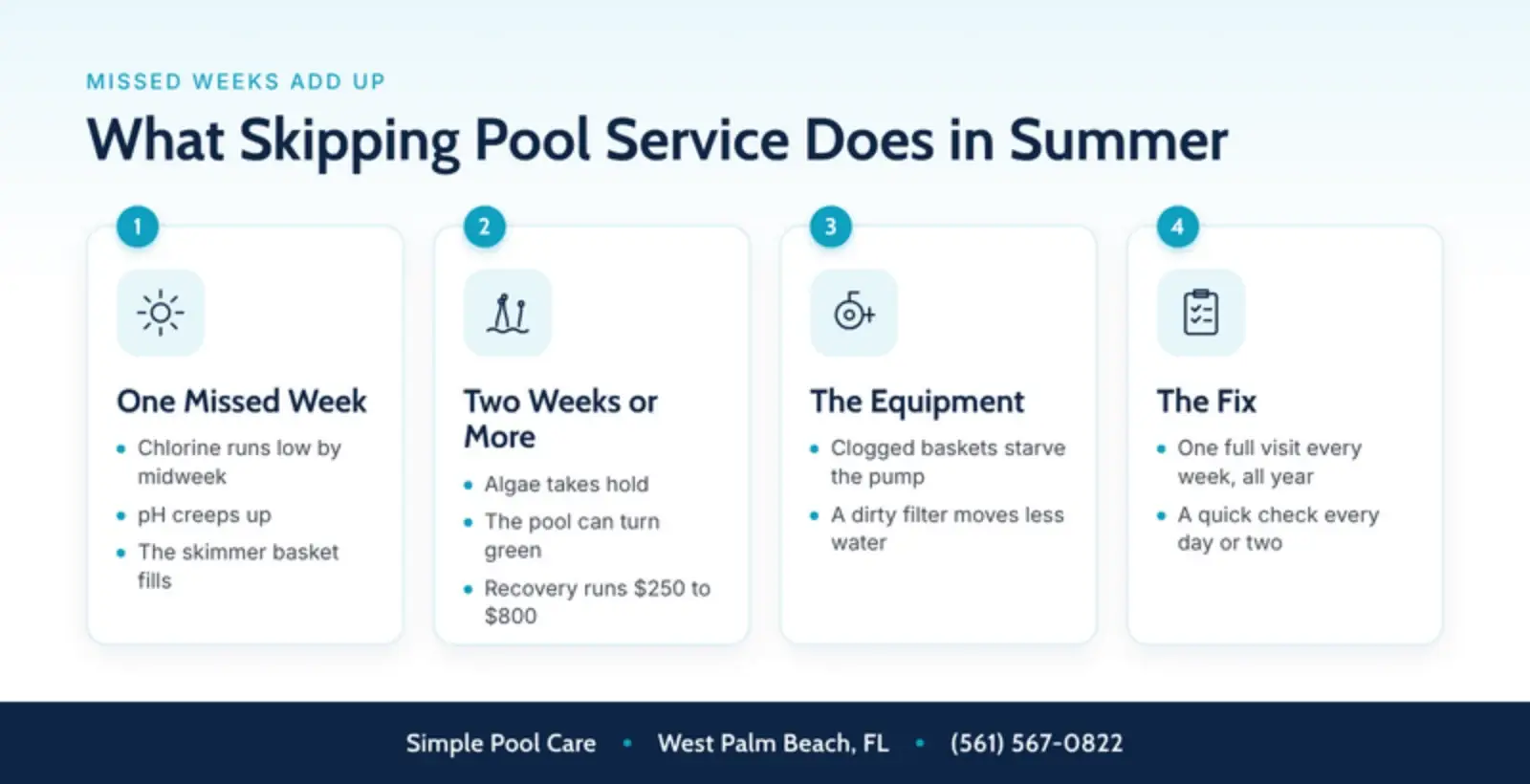
One missed week
One skipped week in January often passes without much trouble. In August it’s a gamble. Chlorine runs low by midweek, and the skimmer basket fills. Meanwhile pH tends to creep up on salt pools and pools fed liquid chlorine. Higher pH weakens the chlorine that’s left, so the water has less protection right when algae spores are landing. You might see nothing at all, or you might find slippery steps and dull corners.
Two weeks or more
Two weeks without care in August is often enough for a green pool. By then the chlorine has been at zero for days, the baskets are full, and debris on the floor is feeding the algae. A regular visit can’t fix that. The pool needs a green to clean recovery, which runs $250 to $800. That’s more than two months of chemical-only service. Within 24 to 72 hours, most green pools are clear enough to swim in, and draining is rarely part of the job.
Green water is also a safety issue, since it hides the floor and anyone on it. For the full list of causes, read what causes a pool to turn green in West Palm Beach.
Equipment pays for skipped visits too
A skimmer or pump basket jammed with leaves chokes off the water the pump needs. That’s called cavitation, and you’ll hear it as a change in the pump’s sound. Run long enough like that, the pump and motor take damage, and then you’re looking at pool pump repair instead of a two-minute basket dump. A filter nobody backwashes also moves less water, so the whole pool circulates less and algae gets more room.
Is every other week ever enough?
Sometimes. A screened pool that sees little use and has nothing growing over it can hold up on visits every other week in the cooler months. That works only if the owner tests and skims in between. Most open pools under palms and oaks can’t manage it. In summer, the chemistry swings too far over 14 days for us to suggest it to anyone.
How often should you clean your pool as the seasons change?
The answer stays weekly all year. What changes with the seasons is how much of the pool maintenance schedule falls to you between visits.
Rainy season and storm weeks
From mid-May to mid-October, keep the weekly visit and add your own check after big storms. Skim out the debris, empty the skimmer basket, and test chlorine, pH and alkalinity. If a storm is coming, don’t drain the pool. When ground water rises, an empty pool can float up and lift out of its hole.
Your pool maintenance schedule in the drier months
From mid-October to mid-May, cooler water slows algae down, and some weeks the readings barely move. It’s tempting to cut back. But the sun is still strong, oaks drop leaves through the spring, and a cold front can blow a week of debris into the pool overnight. Weekly still makes sense in winter. The visits just tend to be quicker.
What you can do yourself between visits
Plenty of owners like to handle part of their pool maintenance schedule themselves, and it helps. These jobs are safe for anyone:
- Netting floating leaves and emptying the skimmer basket
- Keeping the water around mid-skimmer
- Testing chlorine and pH with a good kit or test strips
- Rinsing off before a swim, which keeps sweat, sunscreen and lotion out of the water
- Brushing the steps and corners if you have a spare five minutes
Leave the heavier chemistry to whoever services the pool. Shock only clears combined chlorine when free chlorine gets to about 10 times the combined number, and stopping short wastes the product. Muriatic acid needs careful handling. And no chemical brings high stabilizer or calcium back down. The fix for both is swapping part of the water for fresh fill water, which is a job to plan, not guess at.
Quick troubleshooting between visits
If something looks off before the next visit, start here.
| What you notice | Likely cause | What to do |
|---|---|---|
| Cloudy or dull water | Low chlorine, a loaded filter or a short pump run time | Test chlorine and pH, read the filter gauge, check the timer |
| Strong chlorine smell | Combined chlorine, not too much chlorine | Shock to roughly 10 times the combined number |
| Slippery steps or walls | Early algae or biofilm | Brush hard, test, and raise the chlorine |
| Pump sounds louder or rattles | Clogged basket or low water (cavitation) | Empty the baskets, top up the water, call if it keeps up |
| Filter gauge 8 to 10 psi over clean | Dirty filter | Backwash or clean the filter |
| Water level dropping fast | Possible leak | Do a bucket test, then call |
Frequently asked questions
Short answers to what pool owners here ask us most about timing. Don’t see yours? Call (561) 567-0822.
How often should you clean your pool in South Florida?
Once a week, all year. Brushing, vacuuming, emptying the baskets and testing the water every seven days keeps algae from getting a start in our heat and rain. Between visits, skim leaves and check the water level every day or two. After a big storm, do a quick extra cleanup and test the chlorine.
How often should I test my pool water?
Check free chlorine and pH at least once a week, and two or three times weekly in summer or after heavy rain. Test total alkalinity weekly and after every big storm. Check stabilizer weekly if you use chlorine tablets, calcium every two weeks to two months, and phosphates and metals monthly.
Is it OK to skip one week of pool service?
One missed week in winter usually does little harm, especially in a screened pool. In summer the risk is higher, because chlorine can run out by midweek and algae needs only a short gap. If you skip, net the leaves, empty the skimmer basket and test the chlorine yourself until the next visit.
How fast can a pool turn green?
Faster than most people think. With warm water, strong sun and no chlorine, some algae can take a pool from clear to green in under a day. More often it starts as slippery steps and dull corners a few days after the chlorine runs out. Brushing and steady chlorine are what stop it.
How often should you shock your pool?
Shock when the test calls for it, not on a calendar. That means combined chlorine above 0.2 ppm, a strong chlorine smell, a heavy swim weekend, a big storm, or algae showing up. Breaking down combined chlorine takes free chlorine at roughly 10 times the combined number, or the job stays half done.
How often should you run your pool pump?
Every day. A single turnover, the pump pushing the whole volume of the pool through the filter once, cleans only about 63 percent of the water. Reaching 98 percent takes about four turnovers. In summer, most home pools here run 8 to 12 hours daily to get there.
How often should you drain your pool?
Only when the chemistry calls for it. Letting out part of the water and refilling is the usual fix when stabilizer, calcium or dissolved solids run too high. For dissolved solids, the line is about 1,500 ppm higher than at the first fill. Never empty a pool without a plan, because rising ground water can float an empty one.
Does a screened pool still need weekly service?
Yes, though the visits get easier. A screen keeps out most leaves and bugs, but sun and rain still burn off chlorine, and algae spores still get through. A screened pool can sometimes stretch to every other week in winter. In summer, Simple Pool Care still recommends a weekly visit for chemistry.
Let us keep your pool maintenance schedule
Simple Pool Care runs on this schedule every week, so you never have to track it. We’re licensed, insured and owner-operated. And when the gauge or the pump says it’s time, the people behind Simple Pool Care’s pool service in West Palm Beach take care of repairs and new equipment too. Request a quote online or call (561) 567-0822.