
Pool Service in Greenacres, FL
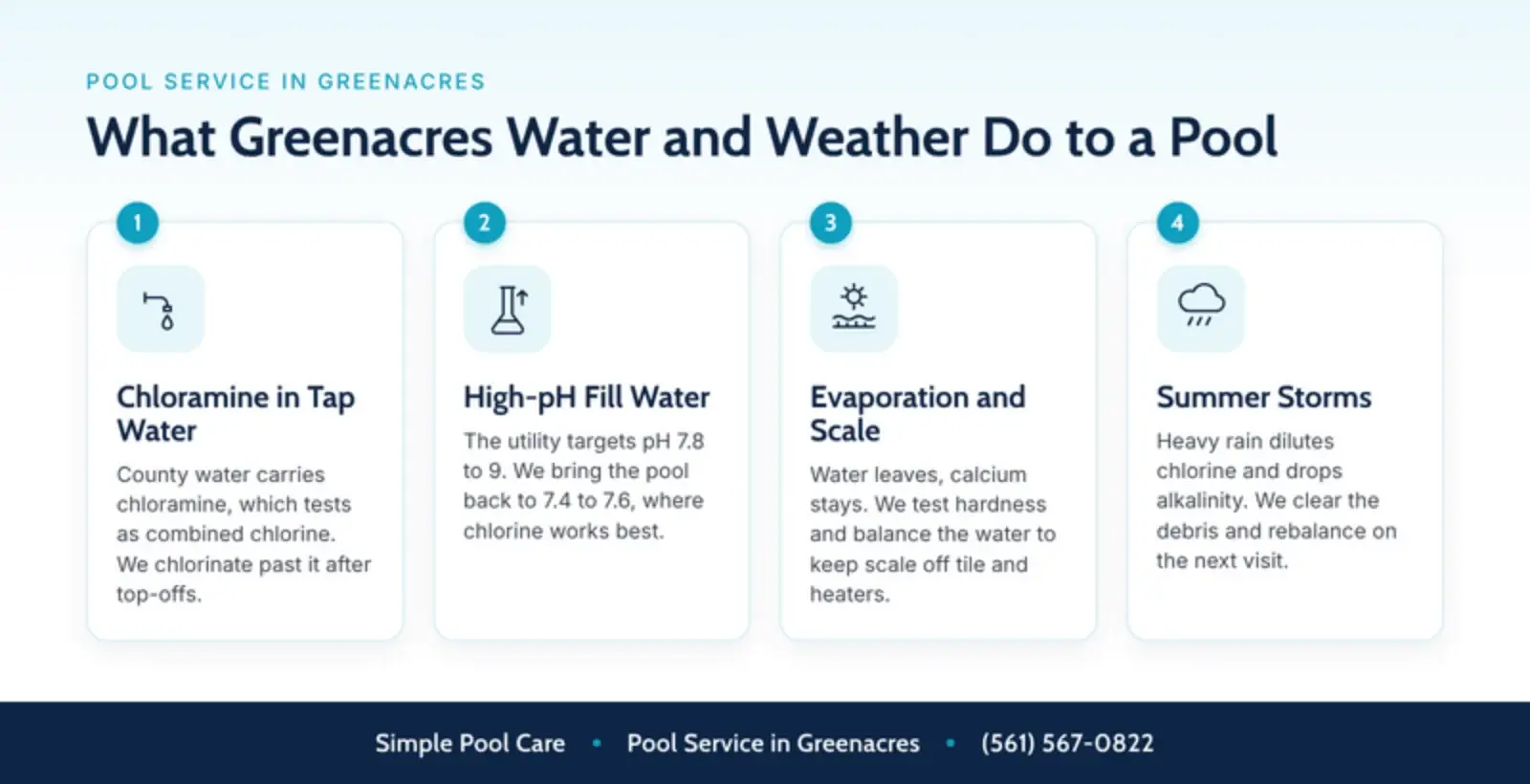
Pool service in Greenacres starts with what comes out of the hose. County water here carries chloramine and runs above pool pH, so every weekly visit tests for both and corrects them.

Local Pool Services in Greenacres, Owner-Operated
Greenacres is a residential city in central Palm Beach County. It covers about six square miles and is home to nearly 44,000 people. There’s no ocean or Intracoastal frontage, so salt air isn’t what wears a pool down here. The tap water and the weather are.
The city counts 17,108 homes, and they come in every shape: single-family houses, condos, villas, townhomes and apartments. Our residential pool service covers the private pools, the ones behind houses, villas and townhomes where the pool belongs to you. You’ll find them on the residential streets off Jog Road, Forest Hill Boulevard and Tenth Avenue North.
Simple Pool Care is owner-operated and local. We carry a license and insurance, hold a 5.0 rating on Google, and have factory training on Hayward, Pentair, Jandy and Zodiac gear. When you call, you reach the people who actually service the pool.
Plans stay simple. Our full plan begins at $170 per month and the chemical-only plan at $100, and routine chemicals come with either one. The full plan also gets your filter cleaned two times a year.
Every pool in town shares the same tap water, and it arrives carrying chloramine at a pH above where a pool should sit. Neither is a problem in a glass of water. Both need correcting in a pool, every week. To talk it through, call (561) 567-0822 or request a quote, and we’ll tell you which plan suits your pool.
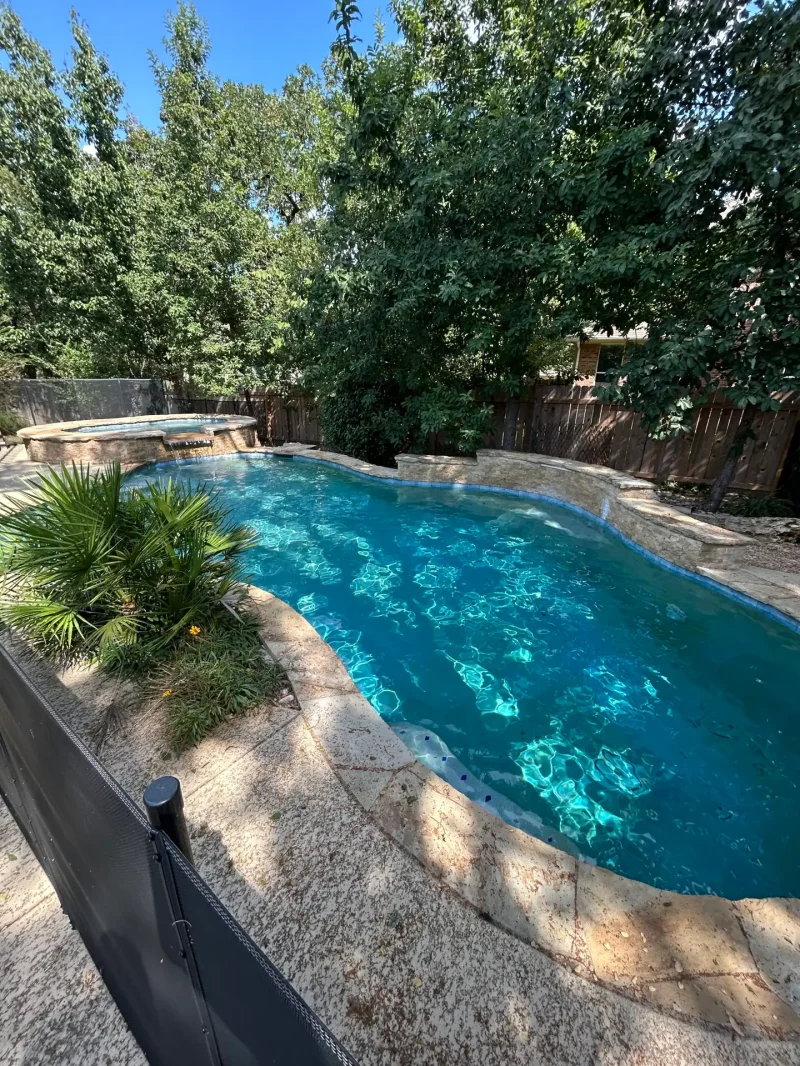
What Greenacres Tap Water Brings to Your Pool
Greenacres gets its water from Palm Beach County Water Utilities. The county pumps it from wells about 150 feet down in the Biscayne Aquifer. Then it goes through one of the county’s plants, which use lime softening, ion exchange and membrane treatment. You can check the numbers yourself in the county’s annual water quality report.
It’s good drinking water, with zero quality violations in 2025. For a pool, though, three things about it matter every time you add water.
Chloramine Comes In With Every Top-Off
The county disinfects with chloramine, which is chlorine bonded to ammonia. It suits a long pipe network because it lasts. In a pool, however, chloramine reads as combined chlorine on a test kit, and it works far too slowly to keep swimming water sanitary.
The county’s 2025 report lists its chlorine and chloramine level at a highest running average of 3.04 ppm. A pool wants combined chlorine at zero, and 0.2 ppm at most. So after a refill or a big top-off, we add enough chlorine to reach breakpoint. That takes about ten times the combined chlorine reading.
Twice a year the county switches to plain chlorine to clean its pipes, and it warns that the tap may taste or smell more strongly of chlorine while it does. During those stretches, tap water tests as free chlorine instead. If your readings look different after a top-off, that switch can be the reason.
Fill Water Arrives Above Pool pH
The county targets a pH of 7.8 to 9 in its eastern system, which includes Greenacres. That makes sense for pipes, since higher pH limits corrosion. A pool, on the other hand, wants 7.4 to 7.6.
The gap matters because pH decides how much of your chlorine is in its fast-acting form. At pH 7.5, roughly half the free chlorine is in that form. Let it rise to 7.8 and the share falls to around one third. Every top-off nudges the pool upward, so we bring the pH back down with acid on each visit.
Calcium, Evaporation and the Tile Line
Groundwater tends to hold more calcium than water drawn from lakes and rivers, which is one reason the county softens it. Its annual report doesn’t list a hardness number, though. So we test calcium hardness at your pool instead of guessing, and we hold it at 200 to 400 ppm.
Evaporation is the slow part. Water leaves, but the calcium and other dissolved solids stay behind, and the next top-off adds more. Scale forms first where water evaporates or heats up: the tile line, the heater’s heat exchanger and the plates of a salt cell. Keeping pH and alkalinity in range is what holds it off.
Once calcium climbs too high, the practical fix is to let out part of the water and replace it with fresh water that’s lower in hardness and dissolved solids. Chemicals alone won’t pull calcium out.
Total dissolved solids build the same way. Every top-off and every dose of chemicals adds a little, and none of it evaporates. We track it against the level the pool started at. Once it sits roughly 1,500 ppm over that starting point, a partial drain is due. For a salt pool, the starting point includes the salt.
Reading the Saturation Index
Water balance comes down to five readings working together: pH, alkalinity, calcium hardness, temperature and dissolved solids. Pool techs fold them into one number, the saturation index. Between -0.3 and +0.3, the water neither lays down scale nor eats at plaster and grout.
Above that range, the water drops calcium as scale. Below it, the water turns corrosive and starts pulling calcium out of the surface. In Greenacres, high-pH fill water and summer heat both push the index toward the scale side, so that’s the direction we correct against.
| Reading | County tap water (2025 report) | Pool target |
|---|---|---|
| Disinfectant | Chlorine and chloramine, highest running average 3.04 ppm | Free chlorine 2 to 4 ppm, combined chlorine 0 (0.2 ppm max) |
| pH | Utility target 7.8 to 9 | 7.4 to 7.6 |
| Calcium hardness | Not listed in the report | 200 to 400 ppm |
How Pool Service in Greenacres Handles the Water
Every visit starts with a full test, because the tap water and the weather both move the numbers. We read free chlorine, combined chlorine, pH, alkalinity, stabilizer and calcium, then correct whatever is off before we leave.
Stabilizer matters more than most people expect. Unstabilized chlorine is half gone after less than an hour of strong sun. With cyanuric acid at 30 to 50 ppm, chlorine holds up three to ten times as long. Let it build too high, though, and chlorine turns sluggish, so we keep it from creeping.
Then comes the cleaning. We skim, brush the walls and tile line, vacuum, and clear both baskets at the skimmer and pump. Then we read the filter gauge. A reading 8 to 10 psi higher than the freshly cleaned pressure means it is time to backwash or clean the filter.
Run time matters as much as chemistry. Running the full volume through once cleans only about 63% of the water, and it takes about four passes to reach 98%. So the pump has to run long enough each day to turn the water over several times. A variable speed pump can do that at low speed on far less power.
Last comes the equipment check, covering the pump, timer, filter, heater and any salt cell. Every visit ends with a written record of the test results and each chemical dosed, so the chloramine and pH corrections are on record.
Rainy Summers and Dry Winters in Greenacres
Greenacres gets the same wet season as the rest of South Florida, with heavy afternoon storms through the summer. A heavy downpour waters down the chlorine and can knock total alkalinity down quickly. With less alkalinity to buffer it, the pH starts bouncing around. The same storm washes leaves and grass clippings off the yard and into the water.
After a storm we net the debris, rebalance, and bring the chlorine back up before algae gets started. If the pool has already turned green, that becomes a separate cleanup, covered further down.
The dry months bring the opposite problem. With little rain to top the pool up, you add water from the hose more often. Each top-off brings in more chloramine and more high-pH water, so in the dry season we watch for the pH drifting upward.
Homes, Villas and Townhomes Across Greenacres
Greenacres was founded by Lawrence Carter Swain and incorporated in 1926. It has since grown into a city of single-family neighborhoods, villas, townhomes and condo communities, and that mix shapes how pool service in Greenacres works.
If the pool belongs to your home, it’s yours to keep up, and that’s the swimming pool service we provide. Shared pools in condo and townhome communities are usually run by the association, so check with yours before you book anything.
Gates are the other practical detail. The city’s swimming pool permit checklist requires a fence or screen enclosure around any pool 24 inches deep or more. The fence has to be at least 4 feet high and hard to climb. Its gate must close and latch by itself and swing away from the pool.
When you sign up, tell us how to get in, whether that’s a gate code, a lockbox or a side gate. And if your gate has stopped closing on its own, get the latch fixed. It’s there to keep small children out of the water.
Pool Services in Greenacres, From Cleaning to Repairs
Weekly care makes up most of our pool services in Greenacres. When something else comes up, the same company handles it, from a filter that needs attention to a pump that has quit.
Pool Cleaning in Greenacres
Pool cleaning in Greenacres centers on weekly pool service, with the water testing above built into every visit. Our pool cleaning plans also cover the filter. The full plan builds in two filter cleaning visits a year, and a cartridge gets cleaned sooner when its gauge climbs about 10 psi.
Scale at the waterline is common where top-offs are frequent. Light buildup comes off with regular brushing. Heavier deposits call for tile cleaning, which removes the scale without draining the pool.
Pool Repair in Greenacres
Most pool repairs run $100 to $800, and we diagnose before we price anything. A humming pump that won’t start is often a capacitor, about $150 with labor. A leaking motor or shaft seal is $250 to $600. If a capacitor or a seal fixes it, a new pump can wait. Our pool pump repair page walks through the common faults.
Expect $200 to $800 for heater repairs and $100 to $500 for filter repairs. Scale from high-pH water is a common reason a heat exchanger loses efficiency, which is one more reason the weekly balance matters.
Equipment Installation in Greenacres
When repair stops making sense, we quote equipment installations for free. Installed prices run $1,500 to $2,800 for a variable speed pump, $2,000 to $4,000 for a gas heater, $3,000 to $7,500 for a heat pump, and $300 to $1,000 for a new filter.
Variable speed motors use significantly less energy than the old single-speed ones. That’s why they’re the usual choice when an older pump fails. Sizing and what the swap involves are on our pool pump installation page.
Green Pools, Salt Systems and Acid Washes in Greenacres
Our specialty pool services handle the larger projects that come up once, not every week. A green to clean recovery runs $250 to $800, and most pools can be swum in again within 24 to 72 hours while the water stays in. An acid wash costs $300 to $700, plus another $150 to $250 for any job that requires emptying the pool first.
Converting to salt systems costs $1,500 to $3,000. A salt pool runs at 3,000 to 3,500 ppm salt, and scale builds on the cell plates when the water runs high in pH. The cell reverses polarity to shed some of it, but it still needs regular inspection and cleaning.
What Pool Service in Greenacres Costs
Full-plan pool service in Greenacres runs from $170 a month. For that you get the weekly visit, every routine chemical, the cleaning, the equipment check, and the twice-yearly filter cleaning.
The chemical-only plan runs from $100 a month. We still come weekly to test and balance the water, chloramine and pH corrections included, and the skimming, brushing and vacuuming stay with you.
The exact figure comes down to pool size and condition, so we quote after a look at it. Repairs follow the same rule: we pin down the fault and quote the fix before any work begins, and equipment quotes are free.
The monthly price doesn’t cover repairs, new equipment, green pool recoveries or acid washes. Those are priced as separate jobs, using the ranges listed above, so you always know what you’re paying for before we start.
Request Pool Service in Greenacres
To start pool service in Greenacres, request a quote online or call (561) 567-0822. Tell us your street, the rough size of the pool and whether it’s screened, and we’ll come back to you with a plan.
You can read what customers say on our reviews page first. To learn more about our pool service company and the services we offer, start at the homepage.
Pool Service in Greenacres FAQs
Straight answers to what Greenacres homeowners ask us most. Don’t see yours? Call (561) 567-0822.
Cost and Choosing Pool Service in Greenacres
Pool service in Greenacres costs from $170 monthly on our full plan, or from $100 monthly if you only want the chemistry handled. Chemicals come with both. The full plan adds the cleaning, an equipment check and two filter cleanings a year. Exact pricing depends on pool size and condition.
Each visit includes a full water test and correction, plus skimming, brushing and vacuuming, both baskets emptied and a look over the equipment. For Greenacres pools we read combined chlorine every time, because county tap water adds chloramine whenever the pool is topped off. A report follows every visit.
Yes. Simple Pool Care services residential pools across Greenacres, from homes off Jog Road and Forest Hill Boulevard to the streets along Tenth Avenue North. If the pool belongs to your home, call (561) 567-0822 or request a quote online with your address.
Yes. Simple Pool Care holds a 5.0 Google rating, and our reviews page shows our Google reviews. We don't sort them by city, so Greenacres customers appear alongside everyone else. Read them before you call anyone, us included.
You get an owner-operated company that is licensed, insured and rated 5.0 on Google, with factory training on the major equipment brands. Whoever you hire, the best pool service in Greenacres tests combined chlorine and pH every visit, because that's what the tap water changes. We do, and our plans include chemicals.
Greenacres Water and Pool Problems
Not mainly through hardness. The county softens its water and doesn't publish a hardness figure. The bigger factors are chloramine and a pH of 7.8 to 9. Evaporation then concentrates calcium, so we test hardness at the pool and hold it at 200 to 400 ppm.
County tap water is disinfected with chloramine, and chloramine shows up as combined chlorine on a test kit. It sanitizes a pool far too slowly. The fix is adding enough chlorine to reach breakpoint, with free chlorine at 10x the combined figure, until the combined reading falls to almost zero.
A green pool here usually follows heavy summer rain, a hot spell or a missed week. Storms dilute chlorine and drop alkalinity, and high-pH fill water weakens the chlorine that's left. Our green to clean recovery usually clears it in 24 to 72 hours without draining.
Repair it if the fix is small, like a capacitor at about $150 with labor or a shaft seal at $250 to $600. Replace it when the motor is failing or repairs keep stacking up. A variable speed pump runs $1,500 to $2,800 with installation and uses far less energy.
Only when the job needs it. Green pools and most balance problems are fixed without draining. A partial drain makes sense when calcium or dissolved solids climb too high. An acid wash means emptying the pool, which can add $150 to $250, and an empty shell can be pushed up by ground water.
