Pool Filter Installation in West Palm Beach, FL
Premium Pool Filter Installation for Homeowners Across West Palm Beach, FL and surrounding areas

Schedule Service!
A Filter Is the One Piece of Equipment You Buy by the Square Foot
If your water’s been cloudy no matter what you throw at it, your filter’s leaking, or it’s just old and worn out, a new one makes a bigger difference than most folks expect. A good filter does the heavy lifting so your chemicals, pump, and heater don’t have to. Simple Pool Care installs and replaces pool filters all over West Palm Beach and Palm Beach County, sized right and sealed up tight. Call (561) 567-0822 or request a free quote and we’ll get you back to crystal-clear water.
Signs it’s time for a new filter
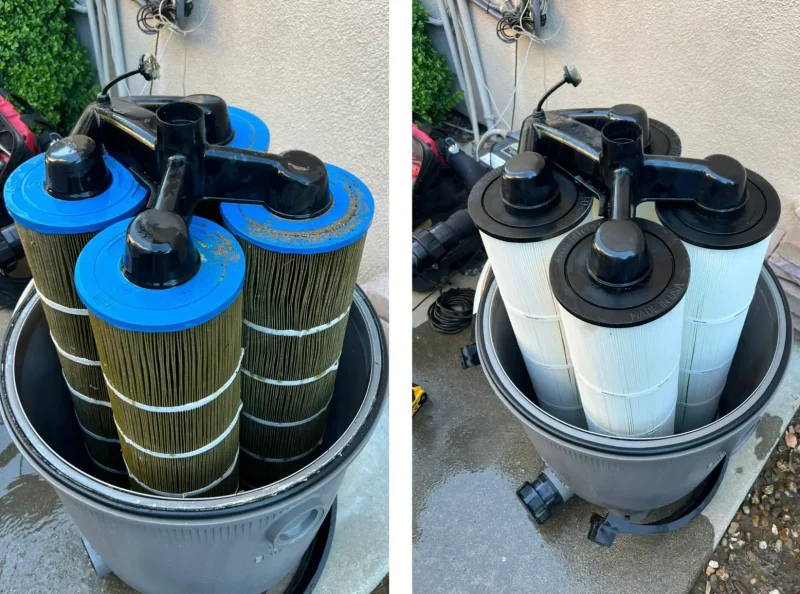
A filter doesn’t last forever, especially in our water. You’re probably due for a replacement if:
- The tank is cracked, warped, or leaking and won’t hold pressure.
- You’re cleaning or backwashing constantly and the water still won’t clear up.
- The pressure stays high even right after a thorough cleaning.
- Cloudy water or algae keeps coming back.
- Internal parts (cartridges, DE grids, sand laterals) are worn out or no longer made for your model.
- It’s pushing 8 to 12 years old. Age matters less than what’s still available for it. Once the manufacturer stops making grids, laterals or a tank band for your model, a small repair turns into a hunt, and that’s usually the point where replacing costs less than chasing parts.
Not sure whether it’s a replacement or a fixable problem? We’ll tell you straight. Sometimes a pool filter repair or a deep filter cleaning buys you more time, and we’ll say so instead of selling you a new unit you don’t need. If your pressure has been climbing and you’re trying to work out whether that’s a repair or the end of the road, the repair page walks through how to read the gauge.
Need pool service? Get in touch with us and schedule your FREE pool service quote from Simple Pool Care
Cartridge, D.E. or Sand: How to Choose
There are three types, and the best one depends on your pool, your landscaping, and how hands-on you want to be.
- Cartridge filters are the go-to for a lot of Palm Beach County pools. No backwashing means you’re not dumping hundreds of gallons of water, or salty runoff onto your landscaping, every week, and the bigger units trap very fine particles, which is exactly what you want during our pollen season. You rinse the cartridges a few times a year and swap them every couple of years.
- DE filters give you the clearest water of the three, catching the finest stuff other filters miss. If you’ve got mature oaks, heavy pollen, or you’re just picky about clarity, DE is hard to beat. They take a bit more upkeep, with backwashing and recharging with DE powder.
- Sand filters are the simple, durable, set-it-and-forget-it option. Easy to run, low fuss, with a sand change every few years. Popular for rentals, vacation homes, and anyone who wants the least hands-on system.
Not sure which way to go? Around here we often point homeowners toward a large-capacity cartridge for the pollen handling and water savings, but we match the filter to your actual setup, never a one-size-fits-all pitch. If you want the detail on what each type actually catches, the filter repair page breaks it down.
Two things people find out too late.
Space. A cartridge filter takes roughly half the floor area of a sand or DE system that moves the same water. On a lot of Palm Beach County pads, jammed against a fence with a heater and a salt cell already sitting there, that’s not a nice-to-have. It’s whether the unit fits.
Water changes. Everyone sells cartridge on “no backwashing,” and the water savings are real. Here’s the part that gets left out: backwashing is also a partial water change. Every backwash on a sand or DE filter pulls a few hundred gallons out and replaces them with fresh, which drags dissolved solids and accumulated stabilizer down with it. A cartridge pool never gets that. Nothing is quietly diluting it in the background, so it eventually needs a partial drain on purpose.
We still put cartridge on most of the pools we do, and we’d rather you know that going in than find out from your test kit in year three.
How Big a Filter Does Your Pool Actually Need?
Bigger than most people guess, and there’s a way to check.
Filter size gets treated like a preference. It isn’t. It comes out of two numbers you already have: how much water your pool holds, and how fast your pump moves it.
Start with flow. The design standard for a residential pool is a six hour turnover, meaning the whole pool passes through the filter four times a day.
Pool gallons divided by 6, divided by 60, gives the gallons per minute your system has to move.
A 15,000 gallon pool comes out around 42 gpm. A 20,000 gallon pool, around 56 gpm.
Then convert flow into filter area. Every filter type is rated for a maximum flow per square foot of media. Divide your flow rate by that number and you have the minimum filter you can get away with:
- High-rate sand handles 5 to 20 gpm per square foot. A 15,000 gallon pool needs about 3 sq ft, roughly a 24 inch tank.
- DE handles 2.0 gpm per square foot. That same pool needs about 21 sq ft of grid.
- Cartridge handles 0.375 gpm per square foot. That same pool needs about 112 sq ft of element.
This is why cartridge filters are sold in hundreds of square feet and sand filters in single digits. Cartridge media handles a small fraction of the flow per square foot that a sand bed does, so it needs a lot more surface area to move the same water. A 425 sq ft cartridge isn’t eighty times better than a 4.9 sq ft sand filter. It’s a different way of counting.
Two things fall out of this that are worth knowing before you buy.
Undersized is the expensive mistake. A filter below the line runs high on pressure from the first month, needs cleaning constantly, and pushes back against your pump the whole time. You’ll pay for it in cleanings and in pump life.
Oversized is barely a mistake at all. A filter isn’t a pump. Going a size up costs you the purchase price and the space on the pad, and buys you longer runs between cleanings at lower pressure. When a customer is on the fence between two sizes we almost always tell them to take the bigger one.
This is also the reason filtration is worth taking seriously rather than treating as the boring part. Chlorine handles most of what gets into a pool within minutes, but not all of it. The CDC notes that Cryptosporidium can survive more than seven days in properly chlorinated water. Anything chemistry can’t kill has to be physically caught and taken out, and that’s entirely down to the filter.
When we quote you, we run these numbers against your actual pool and your actual pump, and we’ll show you the arithmetic if you want to see it.
What pool filter installation costs in West Palm Beach
Honest answer: it depends on the filter you choose and your setup. In our area, a new filter installed typically runs about $300 to $1,000, with labor on a straight swap usually in the $110 to $140 range. Roughly:
- Cartridge: about $250 to $1,200 installed.
- Sand: about $350 to $1,050 for the unit, plus installation.
- DE: about $550 to $1,300 installed.
Bigger pools and more involved plumbing land at the higher end. We give you a clear, itemized quote up front so there are no surprises, and we’ll help you weigh the cheaper unit against the one that costs you less to run and maintain over the years.
Where Filter Installs Go Wrong
Here’s the part people underestimate: a great filter installed wrong will leak, lose pressure, and wear out early. Getting it right means sizing it to your pool volume, pump flow, and plumbing, not just bolting in whatever’s in stock. Too small and it clogs fast, runs high on pressure, and strains the pump every hour it runs. Too big isn’t really a problem. A filter isn’t a pump. The only cost of going a size up is the price and the footprint, and what you get back is longer runs between cleanings. We also make sure every union, fitting, and seal is properly aligned and pressure-tested, and that the new filter plays nice with your pump, heater, salt system, and automation. Done right, you get clean water, easy maintenance, and an install that lasts.
One more thing we check before we quote a cartridge: what pump is feeding it. Too much flow through a cartridge drives debris into the pleats instead of catching it on the surface, and it will keep eating cartridges no matter which brand you buy. If you’ve been replacing them every year, the filter probably isn’t the problem. That’s a pump conversation, and it’s worth having before you spend money on a new filter.
Our installation, start to finish
- We inspect your equipment pad, plumbing, and flow needs, and talk through your goals and budget.
- We recommend the right filter and size, and explain the trade-offs in plain English so you can choose with confidence.
- We remove the old unit and haul it off, update any worn fittings or unions, and install the new filter to manufacturer spec.
- We prime it, pressure-test it, confirm flow and circulation, and make sure it’s communicating with the rest of your equipment.
- We walk you through caring for it so it lasts and your warranty stays intact.
Building a new pool or redoing the whole equipment pad? We handle full installs too, and we’ll make sure the filter is matched to the rest of the system from day one.
Brands we install
We install the filters built to handle South Florida pools, including Pentair (Clean & Clear, FNS Plus), Hayward (SwimClear, ProGrid), Jandy, and Sta-Rite. Whatever you pick, we follow manufacturer guidelines so your warranty stays protected and you get the full lifespan out of it. We’ll also tell you honestly when a mid-range unit is plenty and when it’s worth stepping up for your pool.
Ready for clear water again?
Stop fighting cloudy water and a filter that can’t keep up. We install pool filters across West Palm Beach and most of Palm Beach County, and the full list of areas is at the bottom of this page. Call Simple Pool Care at (561) 567-0822 or request your free quote online. Local, licensed, insured, and 5-star rated by your neighbors all over Palm Beach County. Filter installation is part of our full pool equipment installation lineup, right alongside pump, heater, and light installs. Once your new filter is in, we can keep it running strong with regular filter cleaning or weekly pool service.
We Are Experts With:




Your Trusted Pool Service Partner
It’s easy to get started with Simple Pool Care.
Trusted by 100+ homes throughout West Palm Beach and neighboring cities.
We treat our customers like family, which is why we crafted our Pool Service plans to service our customers with the utmost professional service so you can enjoy your pool worry free.
Built Around Reliable Service
We show up when we say we will, we quote before we start, and we tell you what your pool actually needs rather than what’s easiest to sell. That’s most of it.
Over 10 years of experience in the pool service industry spanning across 2 counties.
Servicing over 100+ customers a year while maintaining a 5 star rating from our clients.
When you choose Simple Pool Care, you have a friend in the industry you can trust.
We are available day and night for our customers. We take your business seriously.
Frequently Asked Questions
The questions we get asked most often about pool filter installation.
In our area, a new pool filter installed usually runs about $300 to $1,000, depending on the type and your plumbing. Roughly, cartridge filters run $250 to $1,200 installed, sand filters $350 to $1,050 for the unit plus install, and DE filters $550 to $1,300 installed. Labor on a straightforward swap is typically $110 to $140. We give you an itemized quote up front and you approve it before we start.
For most West Palm Beach pools we lean toward a large-capacity cartridge filter, because it handles our heavy pollen well and doesn't waste water or send salty backwash onto your landscaping. DE filters give the clearest water of all if clarity is your top priority and you don't mind a little extra upkeep. Sand filters are the simplest and most durable, which makes them great for rentals and low-maintenance owners. We'll match the right one to your pool, not just sell a favorite.
If the tank is cracked, the filter is 8-plus years old, or replacement parts are worn out or no longer made, replacement is usually the smart move. If it's a clamp, O-ring, valve, or a single set of grids, a repair often gets you years more. Parts availability decides it more often than age does: once the manufacturer stops making grids, laterals or a tank band for your model, chasing parts costs more than replacing the unit. We inspect it and give you an honest recommendation either way, no upsell.
There's a calculation, and you can run it yourself. Start with flow: pool gallons divided by 6 hours divided by 60 minutes gives the gallons per minute your system has to move. A 15,000 gallon pool works out to about 42 gpm. Then divide that flow by the rated flow per square foot for the filter type you're considering. High-rate sand handles 5 to 20 gpm per square foot, DE handles 2.0, and cartridge handles 0.375. So that same 15,000 gallon pool needs roughly a 3 square foot sand tank, about 21 square feet of DE grid, or about 112 square feet of cartridge. That's why cartridge filters are labeled in the hundreds of square feet and sand filters in single digits. Undersizing is the expensive mistake, because the filter runs high on pressure from day one and fights your pump. Oversizing barely costs you anything beyond the purchase price and the space on your pad, so when someone is on the fence between two sizes we usually say take the bigger one.
More than people expect, and it varies a lot by type. A cartridge filter needs roughly half the floor space of a sand or DE system that moves the same amount of water, which is often the deciding factor on a tight pad. You also need clearance above the tank to lift the lid and pull the element or the grids out, and enough room around it to get a wrench on the unions. We measure the pad during the quote rather than finding out on install day. If your equipment is squeezed into a side yard against a fence, tell us when you call and we'll plan the layout around it.
A straightforward filter swap is usually done the same day, often in a couple of hours. If we're updating plumbing, fittings, or relocating equipment on the pad, it can take longer, and we'll give you a realistic timeframe before we begin.
Yes. We safely remove and dispose of your old filter, update any worn unions or fittings, and leave your equipment pad clean and tidy. You don't have to deal with the old unit.
Yes, and this is the part that gets skipped when cartridge gets sold on "no backwashing." Backwashing a sand or DE filter dumps a few hundred gallons and replaces them with fresh water, which is a partial water change happening in the background whether you think about it or not. A cartridge filter doesn't do that. Nothing is diluting your pool, so dissolved solids and stabilizer keep climbing until you drain some off deliberately. We still recommend cartridge for most pools here, but we'd rather you hear this from us at the quote than from a test kit in year three.
Often, yes. A modern, properly sized filter eases the load on your pump and chemicals, and a cartridge filter skips backwashing entirely, which saves a lot of water over a year here. Worth knowing the trade-off, though: backwashing is also a partial water change, so a cartridge pool never gets that background dilution and eventually needs a partial drain on purpose. Better filtration also means fewer chemical adjustments and a clearer pool with less effort, so the upgrade tends to pay you back over time.
