
Pool Filter Repair in West Palm Beach, FL
Pool filter repair in West Palm Beach for cartridge, sand and DE filters on all the major brands. Every swimming pool filter repair starts with a diagnosis and a price before any work.

Swimming Pool Filter Repair Starts at the Gauge
A pool filter rarely quits all at once. First it leaks at the clamp, or the pressure climbs and won’t drop after a cleaning, or sand starts showing up on the pool floor. By the time the water looks dull, the filter has usually been struggling for a while.
That’s the work our pool filter repair covers, on cartridge, sand and DE filters. Inside the tank, the usual failures are a cracked manifold, broken laterals, a torn grid or cartridge, or a worn O-ring. Outside it, we see split tank bands, leaking valves, cracked lids and gauges that no longer read true. Our factory training covers Hayward, Pentair, Jandy and Zodiac, so most of what we open is familiar. A gauge that reads wrong is a cheap part, but it can hide every other problem, so we check that too.
Every job starts with a diagnosis. We read the gauge, open the filter and find the actual cause. Then we give you a price before we replace anything. Most filter repairs land somewhere between $100 and $500.
Sometimes nothing is broken at all. A filter that’s simply overdue needs a proper pool filter cleaning, which costs less than a repair. If that’s what we find, that’s what we’ll tell you.
If the pool turned green while the filter was down, we fix the filter first and then start a green to clean recovery. That usually has the pool swimmable in 24 to 72 hours, and most don’t need draining.
How to Read Your Pool Filter Gauge
The pressure gauge on top of the tank is the best early warning you have. It only helps, though, if you know what normal looks like for your pool.
Start by recording a clean starting pressure. Right after a cleaning or backwash, write down the gauge reading and keep it at the equipment pad. Compare every later reading to that number. As the filter catches dirt, the pressure going in rises and the flow coming out drops. That’s normal, and it means the filter is doing its job.
Once the gauge sits about 8 to 10 psi above that clean number, a sand or DE filter needs a backwash and a cartridge needs cleaning. If your filter’s manual gives a different number, go by the manual. Either way, backwash by the gauge and not by the calendar. A sand filter actually traps finer dirt as it loads up, so backwashing too often leaves the water duller, not cleaner.
High Pressure That Won't Come Down
If the pressure is still high right after a cleaning, the filter isn’t just dirty. On a sand filter, the bed may be packed with scale or stuck together, which happens with hard water and with some clarifiers. On cartridge and DE filters, oils and minerals can plug the fabric until water barely gets through. A partly closed valve or a blocked return line also pushes the gauge up, so we check those before we blame the filter.
Low Pressure and Weak Returns
Low pressure with weak returns usually means the pump isn’t getting enough water. Check the skimmer basket and the pump basket first. If both are clear, something is restricting the suction line, or the impeller is clogged or damaged. A starved pump changes its sound. That’s cavitation, and if it keeps going, it can seriously damage the pump, the motor or both. At that point it’s a pool pump repair rather than a filter job.
Air Bubbles at the Returns
Bubbles blowing out of the returns mean air is getting into the system. Most often it comes in on the suction side, through low water at the skimmer, a clogged basket or a worn pump lid O-ring. A filter can also trap air at the top of the tank. That’s why there’s an air relief valve up there, and opening it lets the trapped air out.
Pool Filter Repair by Filter Type
All three filter types do the same job, but each one catches dirt differently and each one breaks in its own way. The biggest difference is how small a particle it can stop.
| Filter | Catches particles down to | What usually fails |
|---|---|---|
| Cartridge | 10 to 25 microns | Torn or crushed elements, an element off its center pipe, cracked lids, worn tank O-rings |
| Sand | 25 to 100 microns | Broken laterals, leaking multiport valve gaskets, wrong or worn sand, a blocked sand bed |
| DE | 2 to 6 microns | Torn grid cloth, cracked manifolds, a torn air bleed screen, plugged grids |
For scale, a human hair is about 70 microns thick, and most people can’t see anything much smaller than 40. DE catches the smallest particles of any pool filter. That’s worth knowing before you swap a working DE filter for a cartridge because it looks easier to look after. It can still be the right call, as long as you know the filter will let finer dirt through.
Cartridge Filter Repair
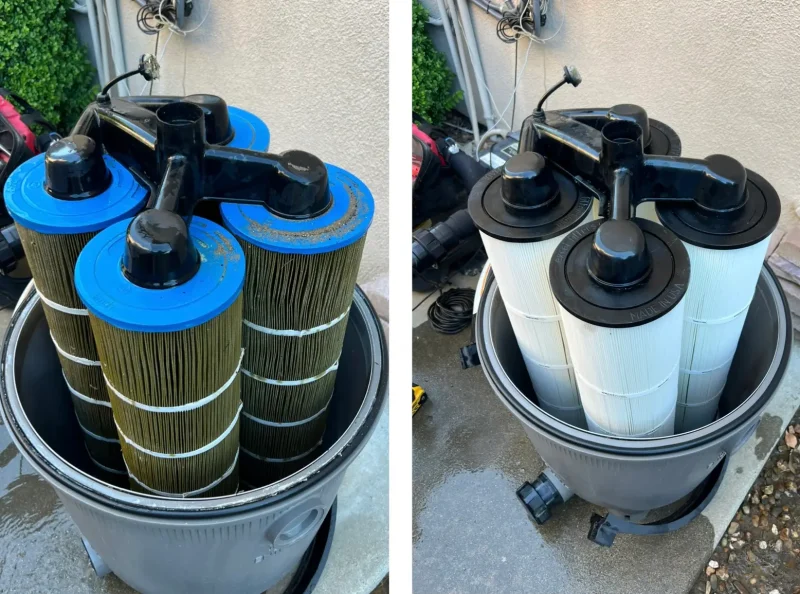
A cartridge filter is a tank with one or more pleated fabric elements inside. When the water looks dull but the pressure seems fine, we look for a torn or punctured element first, because dirty water goes straight through the tear. An element that isn’t seated on its center pipe lets water bypass it the same way. So does a broken or missing air bleed screen at the top of the tank.
If you buy a new cartridge every year, look at the pump. Cartridges take more damage from high water velocity than any other filter type. Too much flow drives dirt so deep into the pleats that cleaning can’t get it out, and it can push dirt right through the element. An oversized pump will keep ruining cartridges no matter how many you buy.
When we clean a cartridge, we degrease it first and only use an acid cleaner if there’s scale. Acid first can set the oils into the fabric for good. We inspect the lid O-ring whenever the tank comes open, because a worn one leaks water or lets air into the filter.
Sand Filter Repair
A sand filter pushes water down through the sand and out through slotted laterals at the bottom. The slots let water pass but are too small for the sand. So when sand turns up on the pool floor, a lateral is usually broken. We also look for why it broke, since high pressure inside the tank can crack them.
The sand matters as much as the parts. Pool sand filters take #20 silica sand, sized between 0.35 and 0.56 mm. The wrong grade can pass into the pool, cloud the water or cause the filter to fail. People sometimes blame good laterals when the sand was the real problem. The amount matters too. The tank needs open space above the sand, usually about half the depth of the sand bed, so the bed can lift during a backwash. Overfill it and backwashes take longer, and the sand can shift around inside the tank.
Sand in the backwash water points somewhere else: a damaged distributor at the top of the tank, a backwash flow that’s too strong or sand that’s the wrong size. New sand has sharp edges that grab dirt, while old sand wears smooth and filters poorly. Worn sand calls for sand changes, because no part swap will fix it. A leaking multiport valve gasket is another common call, and it’s a simple part to replace.
DE Filter Repair
A DE filter coats fabric-covered grids with a thin layer of diatomaceous earth, about 1/16 to 1/8 inch thick. The water flow holds that powder on the grids, and the coating traps the finest dirt of any pool filter.
When DE powder shows up in the pool, a grid has torn, or the air bleed screen inside the tank is torn or out of place. When water comes back unfiltered, we check the manifold for chips and cracks. Grids also fail slowly. Too little DE lets oils clog the cloth, which cuts the flow and eventually damages the grid. Too much DE lets the coatings on neighboring grids touch and bridge together.
If you add DE yourself, wear a dust mask. The powder is fine enough to hang in the air, and it isn’t something you want to breathe. Store it away from the pump motor, too, because airborne DE can work its way into the motor windings.
Why Filters Wear Out Faster in Palm Beach County
A filter here works harder than one up north, mostly because it runs all year. Nobody closes a pool for the winter in West Palm Beach, so the pump and filter rarely get a break.
Then there’s what lands in the water. Oak pollen and love bugs pack filters in spring and fall. Summer storms wash in leaves, sand and runoff all at once. Our hard water also leaves calcium in sand beds, on DE grids and in cartridge pleats, which keeps nudging the pressure up.
Where the chlorine goes in matters too. A chlorinator or feeder plumbed in before the filter sends concentrated chemical straight through it. That can shorten filter cycles and raise the pressure. Feeders belong after the filter and the heater, so neither one sees that dose.
Too much flow is the other common cause. Every filter has a maximum flow rating. Push past it and a sand filter drives dirt deeper into the bed, where a backwash struggles to get it out, and some water slips through unfiltered. In a DE filter, the flow forces powder into the grid cloth where it won’t let go, which shortens grid life.
Do Not Open a Pool Filter Under Pressure
One warning before anyone heads out with a wrench. A pressure filter holds real force. If the clamp or tank band comes off while that pressure is still inside, the top can separate violently and cause serious injury. Some filters have even been recalled after their tops blew off, so it’s worth checking your model in the CPSC recall database.
The safe sequence is short. Turn the pump off. Open the air relief valve on top of the tank. Wait until the air stops hissing and the gauge reads zero. Only then touch a clamp, a band or a fitting. The same rule applies to turning a multiport valve handle: pump off first, every time.
Rinsing a cartridge is a fair job for a homeowner. Anything that means opening the tank, replacing laterals or reseating a lid, we’d rather do ourselves.
What Happens on a Pool Filter Repair Visit
Every filter call follows the same four steps, so we never have to guess.
Read the Gauge
We start with the pump running. We note the pressure, look at the returns, and check the baskets and the water level. That tells us whether the trouble is in the filter, on the suction side or in the plumbing after it.
Release the Pressure
Then the pump goes off and the air relief valve opens. Nothing gets unclamped until the air stops and the gauge reads zero. Only then do we take the filter apart.
Inspect and Quote
We inspect the cartridges or grids, the manifold, the laterals, the O-rings and the tank itself. You get the cause and a price before we replace any part. If a cleaning would solve it, we say so. If the tank has a crack, we tell you that too, because a cracked tank can’t safely hold pressure.
Repair and Record
After the repair, we reassemble the filter, bleed the air, restart the pump and check every joint for leaks. Then we write down the new clean starting pressure, so the next time the gauge climbs, you’ll know exactly how far it has gone.
When Pool Filter Repair Isn't Worth It
Most filter problems are worth fixing. O-rings, gauges, air relief valves, laterals, grids and cartridges are all replaceable, and a sound tank can outlast several sets of them.
Replacing the whole filter makes more sense when the tank itself has cracked, when parts for an older model are hard to find, or when the filter was too small for the pump from day one. In those cases, the money is better spent on pool filter installation, which runs about $300 to $1,000 installed. When it’s close, we’ll give you both numbers.
What Pool Filter Repair Costs
Most pool filter repairs in West Palm Beach cost between $100 and $500. Small parts like O-rings, gauges, clamps and air relief valves sit at the low end. Internal work, like a new manifold, a set of laterals or a full set of DE grids, sits at the high end.
You get the diagnosis and the price before we touch the filter. What we won’t do is sell you a part the filter doesn’t need. A dirty filter only needs a cleaning, and worn sand only needs changing.
Keeping Your Filter Healthy After the Repair
A repaired filter stays that way when somebody watches the gauge. Our weekly pool service checks filter pressure on every visit, so we catch a climbing number long before it turns into another repair.
Filter work is one part of our pool repairs, alongside pumps, heaters and spas, and of our wider pool service in West Palm Beach. Request a quote or call (561) 567-0822, and tell us what the gauge reads. That’s usually where we start.
Pool Filter Repair FAQs
Here’s what homeowners ask us most about filters that leak, lose pressure or stop cleaning the water. Don’t see yours? Call (561) 567-0822.
Cost, Repair or Replace and Choosing a Company
Most pool filter repairs in West Palm Beach run $100 to $500. Small parts like O-rings, gauges and air relief valves sit at the low end, while manifolds, laterals and DE grids cost more. Simple Pool Care diagnoses the filter first and quotes the repair before any work starts.
Repair it when the tank is sound and the problem is a part, like an O-ring, lateral, grid or cartridge. Replace it when the tank has a crack, parts are hard to find or the filter is too small for the pump. A new filter usually runs $300 to $1,000 installed.
Not safely. The tank holds pressure whenever the pump runs, and a patched crack can fail without warning. A cracked tank or lid means a new part or a new filter. Cracked internal parts are different. A DE manifold or a sand filter lateral is replaceable, and that's a normal repair.
A well-kept filter tank lasts for years, but the media inside wears out sooner. Filter sand usually needs changing every 5 to 7 years. Cartridges and DE grids wear faster when the filter runs hard. High flow, hard water and heavy debris all shorten their life.
Simple Pool Care is run by its owner here in West Palm Beach. We are licensed and insured and rated 5.0 on Google. Our factory training covers Hayward, Pentair, Jandy and Zodiac. We find the real cause before quoting, and if the filter only needs cleaning, we'll tell you.
Pressure, Leaks and Common Filter Problems
There's no single right number, because every system has its own clean pressure. Write down the reading right after a cleaning or backwash. When the gauge climbs about 8 to 10 psi above that, the filter needs backwashing or cleaning. If it stays high after cleaning, something needs repair.
Low filter pressure usually means the pump isn't getting enough water. Check that the skimmer and pump baskets are clear and the water level is at mid-skimmer. If both check out, look for a blocked suction line or a clogged impeller. Bubbles in the pump basket point to an air leak.
Sand in the pool usually means a broken lateral at the bottom of a sand filter, though the wrong sand size can do it too. DE powder in the pool means a torn grid or a damaged air bleed screen inside a DE filter. Either way, the filter needs opening and repair.
Most filter leaks come from a worn tank O-ring, a loose clamp or band, a cracked lid or a worn multiport valve gasket. Those are simple repairs. A crack in the tank itself is different, because the tank holds pressure, so Simple Pool Care will recommend a replacement.
Only after you release the pressure. Turn the pump off, open the air relief valve on top and wait until the gauge reads zero before touching a clamp, band or valve handle. A pressurized filter top can separate violently. Rinsing a cartridge is fine, but leave internal repairs to a technician.
