
Pool Acid Wash in West Palm Beach, FL
Pool acid wash in West Palm Beach for plaster stains that brushing and chemicals won’t shift. We find what caused the stain, check the ground before draining, and quote before we start.

Pool Acid Washing for Stained, Blotchy Plaster
Some stains sit on the plaster and brush off. Others are in the surface itself, and no amount of shock or scrubbing will reach them. When the whole finish has gone gray and blotchy, that’s usually where pool acid washing comes in.
A pool acid wash is controlled etching, not a cleaning. We drain the pool and work diluted muriatic acid across the bare plaster in passes. It takes off a very thin layer, and the staining comes off with it. What you see afterwards is the fresher plaster underneath.
That’s exactly why we don’t sell it lightly. Plaster you remove doesn’t grow back, so we check for a cheaper fix first. Leaf stains often bleach out with chlorine, and many metal stains respond to a treatment with the water still in. If the white crust is only on the waterline tile, that’s pool tile cleaning, not an acid wash.
The other issue is local. Palm Beach County sits on a high water table, and an empty pool shell can lift out of wet ground. So before any water comes out, we look at the conditions and the pool’s relief valve.
For a typical home pool, a pool acid wash usually runs $300 to $700, with another $150 to $250 when draining is needed. Call (561) 567-0822 and we’ll look at the stains before we give you a number.
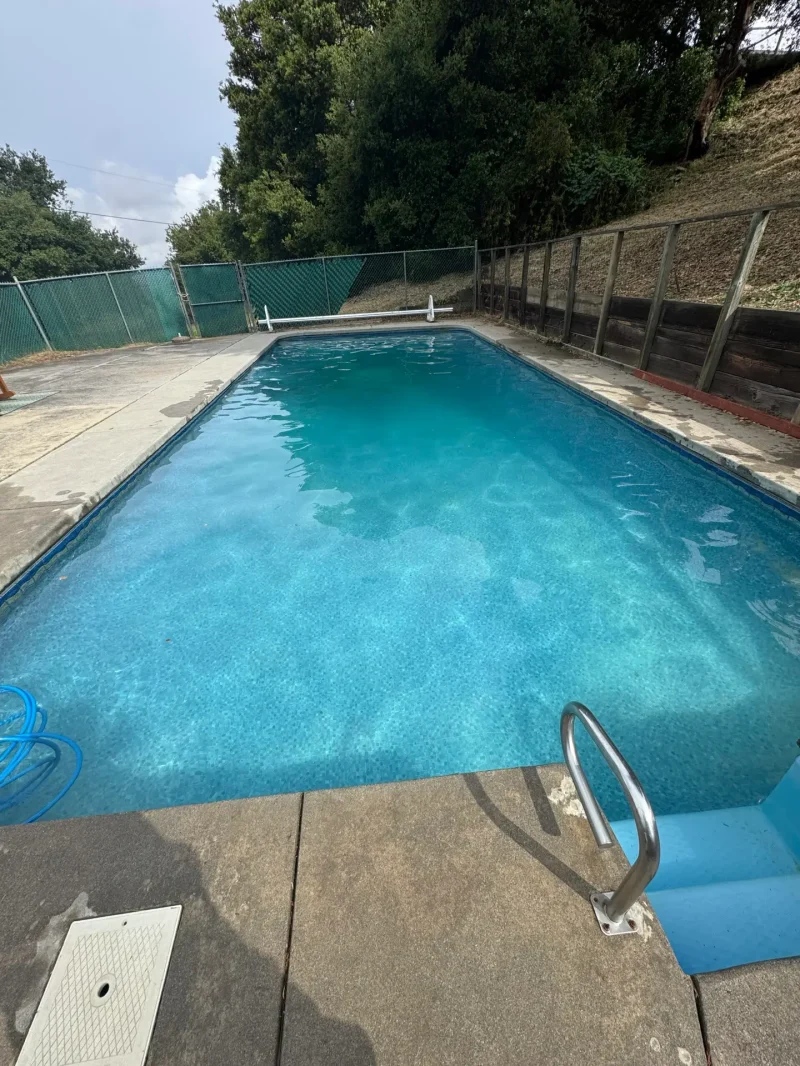
What a Pool Acid Wash Removes
An acid wash works on stains that have soaked into the top of the plaster or bonded to it. It won’t fix every problem a tired pool has, so it helps to know which side of the line yours sits on.
Stains an Acid Wash Takes Off
Mineral and metal stains are the big one. Iron shows as rust brown or almost black, manganese as brownish black, and copper as blue green, or purple when the stabilizer runs high. Calcium scale bonded to the walls, steps and floor comes off too.
It also lifts old algae marks, including the dark spots black algae leaves in the plaster, and the general yellowing or graying that builds up after years of water that ran out of balance. On a pool that sat neglected for a while, it’s often the step that finally resets the surface.
What It Won't Fix
It won’t fix a green pool. That’s a water problem first, so a green to clean recovery comes before anyone looks at stains. It won’t fix calcium on glazed waterline tile either, and it can’t put back plaster that is thin or chipping. Those pools need resurfacing, and another acid wash would only make them worse.
Last, it won’t keep a metal stain away if metal is still getting into the water. More on that below, because it’s the most common reason an acid wash gets wasted.
Signs Your Pool Needs an Acid Wash
Most pools we see for this show several signs at once. The stains stay put after brushing, shocking and a full week of good chemistry. The finish has gone gray or blotchy across the whole pool instead of one corner. Dark algae spots keep coming back in the same places.
Run a hand along the wall or the steps, too. A rough, sandpaper feel usually means scale or etching. And if the plaster hasn’t been touched in many years of hard Florida water, it may simply be time. If you’re not sure, we’ll test the water and look at the stains. Often the answer is a smaller job.
Why Pool Plaster Stains and Etches
Plaster isn’t just a coating. It’s a cement product, and calcium carbonate is one of its main ingredients. That makes it react to the water in ways fiberglass and vinyl don’t, and it explains most of what we see on stained pools.
Corrosive Water Eats the Surface
Water that’s low in calcium hardness, combined with low pH or low alkalinity, turns aggressive. It starts pulling calcium out of the plaster, and it can etch a surface in a surprisingly short time. Etched plaster is rough at a tiny scale, so it holds stains and algae spores and stains faster the next time.
That balance has a number, the saturation index. It’s worked out from pH, water temperature, calcium hardness, alkalinity and dissolved solids. A reading from -0.3 to +0.3 counts as balanced. Lower than that, the water dissolves plaster. Higher, it lays down scale. On a plaster pool, calcium hardness should sit around 200 to 400 ppm.
Metal Stains Have a Source
Iron, copper and manganese don’t appear from nowhere. Some fill water carries iron or manganese. Copper usually comes from the heater’s heat exchanger or old copper plumbing once low pH starts corroding it, and copper algaecides, which work well on stubborn black algae, add it directly. Stainless rails and ladders contain iron, too.
The source has to be found and stopped before the stain comes off. Otherwise new stains form on the fresh surface. It’s also why we don’t just shock a pool that has copper in the water. High chlorine or a jump in alkalinity can push dissolved copper straight onto the walls. And stains get harder to remove the longer they sit, so it pays to deal with them early.
Leaf Stains and Scale
Dark stains under trees are usually tannins from leaves, acorns and seed pods that sat on the floor. Chlorine often bleaches those out, so they rarely need an acid wash.
Scale is different. It’s a crusty, grayish deposit that forms when pH, alkalinity and calcium all run high, especially where water evaporates or heats up. Our hard water makes it common here. Light scale comes off with acidic cleaners, while heavy scale spread across the plaster is acid wash territory.
Pool Acid Wash, Chlorine Wash or Stain Treatment
Plenty of stained pools never need draining. Here’s how we match the fix to the problem.
| Problem | Usual fix |
|---|---|
| Iron, copper or manganese stains on sound plaster | Stain treatment, water stays in |
| Leaf and tannin stains | Chlorine, usually no draining |
| Algae marks after a green pool | Clear the water first, then a chlorine wash if marks remain |
| Calcium on the waterline tile | Tile cleaning, no draining |
| Deep staining or scale across the plaster | Pool acid wash |
| Thin or chipping plaster | Resurfacing |
A stain treatment uses a sequestering or chelating agent. It binds the dissolved metal so it stays in the water instead of on your walls, and the filter catches much of it as the product breaks down. After about 24 hours, the water gets retested to see how much came out. The pool stays full the whole time, so there’s no draining risk at all.
A chlorine wash suits organic marks, like the shadows algae leaves after a green pool, because it doesn’t strip plaster. A pool acid wash is for what’s left after that: staining or scale bonded into the surface across much of the pool.
Draining a Pool in Palm Beach County
The acid is the part you can control. The drain is the part that can damage the pool shell or lift it out of the ground.
Why an Empty Pool Can Float
Groundwater pushes up on the underside of an in-ground pool all the time. When the pool is full, the weight of the water holds the shell down. Empty it, and that weight is gone. If the water table rises high enough, an empty pool can float right out of the ground.
That’s what the hydrostatic relief valve is for. It sits at the lowest point of the floor. When groundwater pressure builds, it opens and lets that water into the pool, which relieves the push from below. Some properties also have well points in the deck, tied to a pump that draws down the water around the shell.
The rule we follow is simple. Never lower the water where ground pressure can damage the structure, and don’t drain until you know the pool is protected. A rented pump and a garden hose don’t come with that check.
Timing Around the Rainy Season
In South Florida, the water table runs highest in the summer rainy season, and it climbs fast after a run of storms. Heat also speeds up algae on freshly exposed plaster. So when a pool can wait, we schedule the wash for the cooler, drier months, roughly late fall through early spring.
Where the Water Goes
A drained pool sends thousands of gallons somewhere, and after an acid wash that water has to be neutralized first. Where it can go, and in what condition, depends on local rules and on the capacity of the line taking it. We handle that as part of the job.
How We Handle a Pool Acid Wash
Every pool acid wash we do follows the same order, because skipping a step is how surfaces get damaged.
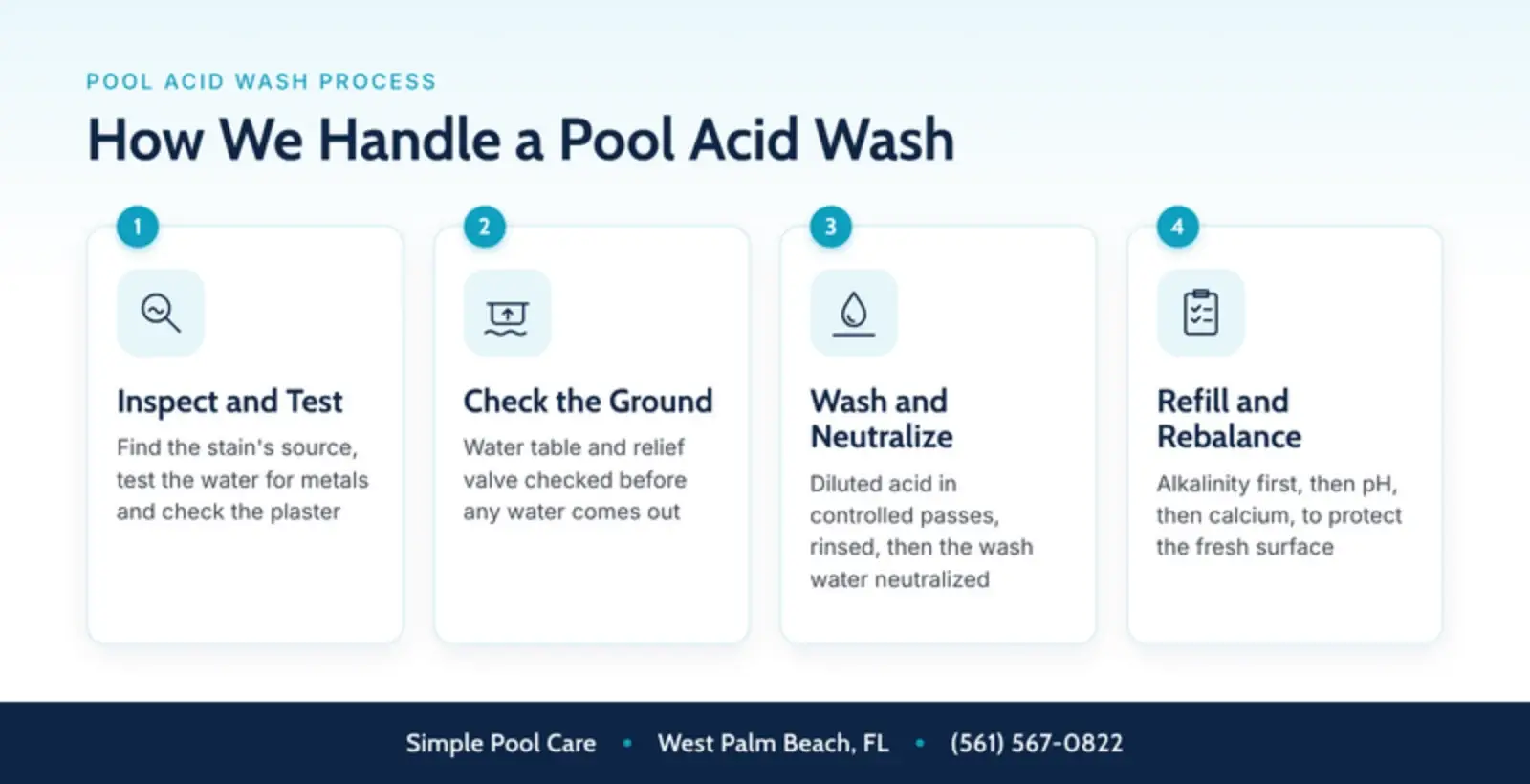
Inspect and Test First
We look at the stains, the plaster and the water. We test pH, alkalinity, calcium hardness and metals, and we try to pin down where any metal is coming from. If the plaster is too thin, or a stain treatment would do the job, we’ll tell you before anything gets drained.
Drain, Wash and Neutralize
Once the ground conditions check out, we drain the pool and protect the fittings and equipment. The acid goes on diluted, in controlled passes, and gets rinsed off before it can cut too deep. Then the wash water is neutralized before it leaves the pool.
Refill and Rebalance
We test the refill water and correct total alkalinity first, then pH, then calcium hardness. Done out of order, each adjustment fights the last one. The goal is to get the saturation index inside -0.3 to +0.3 quickly, because balanced water protects the surface while corrosive water starts etching it again.
After that, the surface needs steady chemistry more than anything. That’s where weekly pool service earns its keep, because the weekly test catches pH, alkalinity and metals drifting before they mark the plaster.
Muriatic Acid Is Not a DIY Chemical
Muriatic acid is hydrochloric acid. At full strength it’s about 31 percent, and it fumes. OSHA sets a ceiling exposure limit of 5 ppm for hydrogen chloride in air, and treats 50 ppm as immediately dangerous to life and health.
So we work it diluted, in chemical goggles, impervious gloves and boots, with a face shield for longer jobs and the wind at our backs. Acid always goes into water, never water into acid, and it never gets mixed with chlorine or any other pool chemical. Handled wrong, it burns skin and etches plaster in patches you’ll be looking at for years.
How Many Acid Washes Can Plaster Take?
Not many. Each pool acid wash takes plaster off, and that plaster doesn’t come back. Most finishes have maybe five or six washes in them over their whole life, and fewer if they were applied thin or have spent years in corrosive water.
So we treat it as a last resort. If someone offers to acid wash your pool every couple of years, ask why. A balanced pool shouldn’t need it that often, and for thin plaster the honest answer is often no wash at all.
When Resurfacing Is the Better Call
Pool plaster is a thin layer over the gunite shell. When the gray gunite starts showing through, the plaster is chipping or coming loose, or the surface still feels rough after a wash, the plaster is finished. Washing it again only speeds that up.
A new finish needs a careful first month. Most of its hydration happens in the first 28 days, and that’s when it’s most likely to stain, scale or discolor. Start-up means brushing at least twice a day, alkalinity set to 80 ppm before the pH comes down to 7.2 to 7.6, and calcium brought up slowly, no higher than 200 ppm in that first month. No salt goes in for 28 days either, so a salt system stays off until then.
What a Pool Acid Wash Costs in West Palm Beach
A pool acid wash for a typical home pool costs about $300 to $700 here, and most land around $450. Price follows surface area, roughly $0.40 to $0.60 a square foot, so bigger pools cost more. Draining adds $150 to $250 when it’s part of the job.
What moves the number is pool size, how deep the staining goes, the shape the plaster is in and the ground conditions. We give you a flat, itemized quote after we’ve seen the pool, and you approve it before any work starts.
Sometimes the quote is for less. If a stain treatment or plain chlorine will do it, that’s what we’ll price, and your plaster stays where it is.
Keeping the Finish Bright After a Pool Acid Wash
A fresh surface stays bright when the water stays balanced. Most stained pools got that way slowly, through months of low pH, high stabilizer or metals nobody was tracking. That’s why we suggest regular service after a wash rather than waiting for the next stain.
Pool acid washing is one of our specialty pool services, alongside green pool recovery, salt systems and sand changes. It’s also part of our wider pool service in West Palm Beach. Request a quote online or call (561) 567-0822. We’ll tell you honestly whether your pool needs an acid wash or something smaller.
Pool Acid Wash FAQs
Stained plaster raises the same handful of questions, and these come up most. Don’t see yours? Call (561) 567-0822.
Cost, Timing and Choosing a Company
A pool acid wash for a typical home pool costs about $300 to $700 in West Palm Beach, and most land near $450. Draining adds $150 to $250 when it's needed. Simple Pool Care prices by surface area and the stains we find, with an itemized quote before work starts.
Only when nothing gentler works. Every wash strips some plaster, and most finishes have maybe five or six in them over their life, fewer if the plaster is thin. A balanced pool shouldn't need one every couple of years.
The cooler, drier months, roughly late fall through early spring. The water table runs lower outside the summer rainy season, which makes draining safer, and cooler water slows algae on freshly exposed plaster. If your pool can wait, we schedule it for that window.
We don't recommend it. Full strength muriatic acid is about 31 percent hydrochloric acid and fumes, and OSHA's ceiling limit for it in air is 5 ppm. Too strong or too long etches the plaster for good, and draining without checking the water table can lift the shell.
Simple Pool Care is a licensed, insured, owner-operated West Palm Beach company rated 5.0 on Google. We look for the stain's source before washing, check the ground before draining, and tell you when a cheaper stain treatment will do. You get an itemized quote before any work starts.
Stains, Plaster and Draining
It removes a thin layer, and that's how it works. Taking off a little plaster exposes the brighter surface underneath. Done too strong, too often or on thin plaster, though, it leaves permanent etching and brings resurfacing years closer, so we check the plaster first.
Often, yes. Metal stains on sound plaster usually respond to a sequestering or chelating treatment with the water still in, and leaf stains often bleach out with chlorine. Waterline tile calcium comes off without draining too. An acid wash is for stains bonded deep into the plaster.
Yes, where the water table is high, as it is in much of Palm Beach County. Groundwater pushes up on an empty shell with nothing inside to hold it down. A hydrostatic relief valve in the floor lets that water in, so we check conditions before draining.
Usually because the source is still there. Iron and copper come from fill water, corroding heater parts or copper algaecides, and they stain fresh plaster just like old plaster. The source has to be stopped before the stain comes off, and the refill balanced quickly.
No, not on its own. A green pool needs the water cleared first with chlorine, brushing and filtration, which is our green to clean service. Once it's clear, we look at the marks left behind. Many lift with chlorine, and only deep staining needs an acid wash.
