
Pool Service in Palm Beach Gardens, FL
Pool service in Palm Beach Gardens that keeps up with fed golf course turf and the chloramine in Seacoast tap water. Weekly visits start at $170 per month, chemicals in the price.

Weekly Pool Cleaning in Palm Beach Gardens, One Monthly Price
Palm Beach Gardens was planned as a garden city, and it still looks the part. Today it’s known for golf courses and gated communities, and the lots around them carry a lot of landscaping. That greenery is pleasant to live with. It also drops leaves and pollen into the pool all year, and fertilizer rides in with them.
Our pool cleaning in Palm Beach Gardens runs on a weekly visit. We balance the water, net the surface, scrub the walls, run the vacuum, dump the baskets and give the equipment pad a once-over. Afterward you get the readings and a note of what went into the water.
Billing is one flat amount each month, with the chemicals included. The full plan starts at $170 per month. Prefer to do the netting and scrubbing yourself? The chemical-only plan starts at $100. Both plans work as monthly pool service with a visit every week, and there’s no separate line on the bill for chlorine, acid or stabilizer.
The water here has its own quirks, too. Most homes get Seacoast Utility Authority water, and it arrives carrying chloramine. Between that, the fed turf and the summer rain, we test far more than chlorine and pH on each visit. Calcium, stabilizer and combined chlorine all go in the log, so a slow change shows up early.
Simple Pool Care is a licensed and insured, owner-operated business with a 5.0 on Google. Phone (561) 567-0822 or send a quote request, and we’ll price your pool after a look at it.
What Palm Beach Gardens Does to a Pool
Sun, heat and storms hit every pool in South Florida. What sets this city apart is the water coming out of the tap and the amount of fed, watered turf around the pools. These are the local factors we plan each visit around.
Seacoast Tap Water Arrives With Chloramine
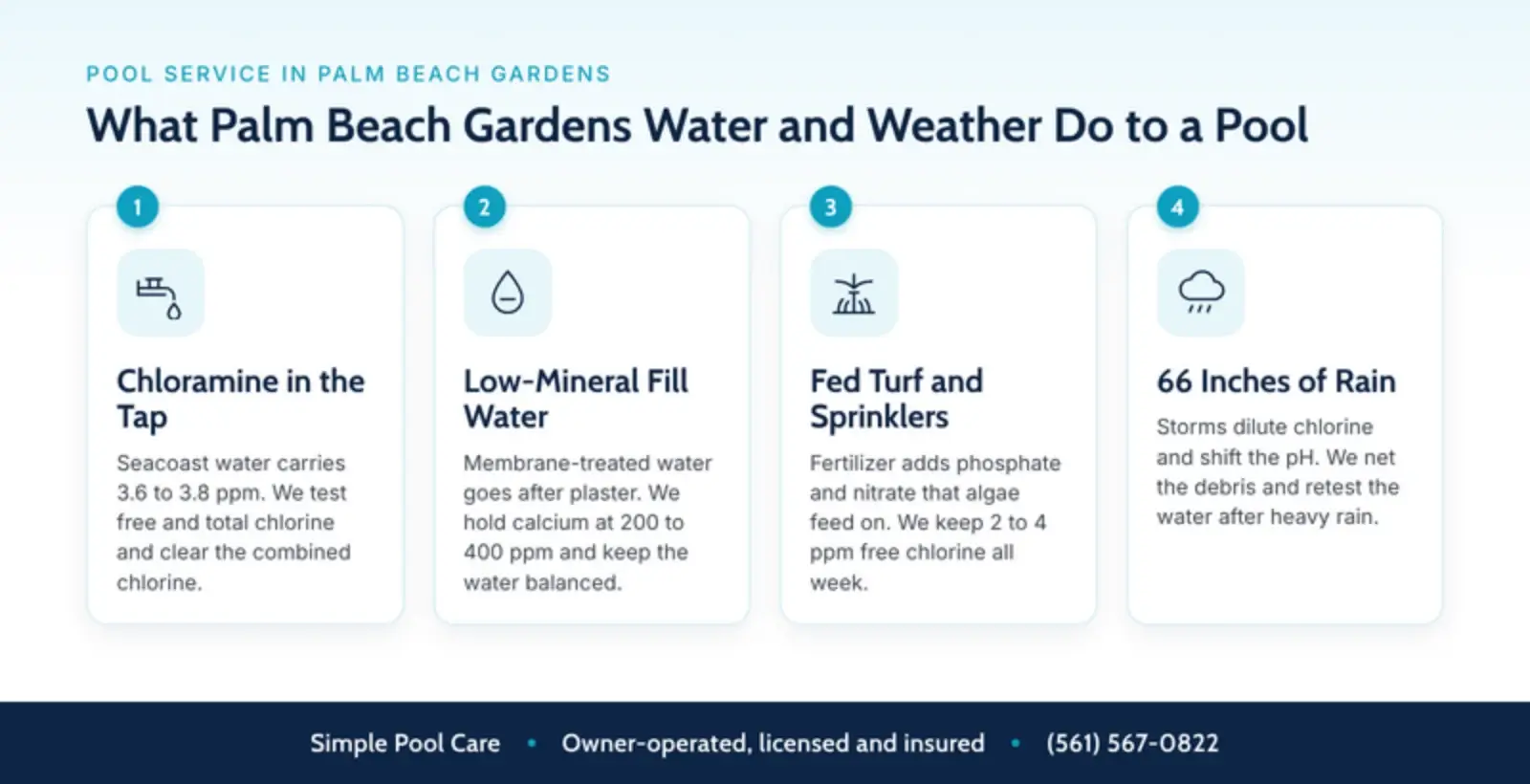
Most homes in Palm Beach Gardens get their water from Seacoast Utility Authority. Seacoast disinfects with chloramine instead of free chlorine, and its 2025 water quality report shows 3.6 to 3.8 ppm in the system. That works well for drinking water, because chloramine lasts a long time in the mains.
In a pool, though, it’s a problem. Chloramine counts as combined chlorine, and that’s exactly how a DPD kit reports it. It also kills germs far too slowly for a swimming pool. The goal is zero combined chlorine, and many codes draw the line at 0.2 ppm. So every top-up from the hose adds a little, and a refill adds a lot.
That’s why we test total chlorine as well as free chlorine on every visit. The gap between the two is the combined chlorine. When a fill or a heavy top-up pushes that number up, we shock to breakpoint, which works out to roughly 10 times the combined figure. Then the free chlorine can do its job.
Membrane Treated Water Starts Low in Minerals
Seacoast treats its water at the Hood Road plant with nanofiltration and reverse osmosis. A nanofiltration plant replaced the old lime softening plant in 2013. The utility calls nanofiltration demineralization, so the water leaves the plant carrying far fewer dissolved minerals than raw groundwater.
Water with very little dissolved in it is aggressive. Left that way, it goes looking for calcium in the plaster and the tile grout, and the finish slowly roughens. Plaster lasts best with calcium hardness in the 200 to 400 ppm range and the saturation index held within 0.3 of zero. Evaporation and some chlorine products push calcium back up over the months, so we test it every visit.
Here’s how Seacoast’s published numbers compare with what a pool needs.
| Reading | Seacoast tap water (2025 report) | Pool target |
|---|---|---|
| Chloramine (shows up as combined chlorine) | 3.6 to 3.8 ppm | Zero, with 0.2 ppm the ceiling |
| Nitrate (as nitrogen) | 0.044 ppm | No target; dilution is the only fix |
| Sodium | 35.5 ppm | Salt pools run at 3,000 to 3,500 ppm |
| Calcium hardness | Seacoast doesn’t publish it | 200 to 400 ppm, so we test it |
Fertilized Turf and Sprinkler Overspray
Golf courses and big lawns get fed, and fertilizer is one of the sources of phosphate in pool water. Nitrate comes from similar places. Both are algae food. Algae that blows in from the landscaping can even arrive with phosphate already stored in its cells.
Irrigation adds to the load. City code limits sprinklers to the hours between 5 p.m. and 9 a.m., so a head aimed at the pool fires at night while nobody is watching. Overspray carries grass clippings and lawn runoff with it. If your coping looks wet and gritty each morning, a sprinkler is the usual culprit.
There’s no practical way to strip nitrate out of pool water. The only fix is dilution, which means letting out some of the water and topping up with fresh. Seacoast’s water is very low in nitrate, so a partial refill does work, but it costs water and time. The better plan is keeping 2 to 4 ppm of free chlorine in the water all week, because the food supply around a golf course never runs out.
Screen Enclosures Help, but Not With Chemistry
If your pool sits under a screen enclosure, it collects far fewer leaves and palm fronds. That makes the weekly cleaning quicker. A screen doesn’t stop algae, though. Rain still comes through, fine pollen still lands, and the chemistry still drifts between visits. So a screened pool gets the same tests and the same brushing as an open one.
Summer Storms and 66 Inches of Rain
The city averages about 66 inches of rain a year, and roughly half of it falls from June through September. A hard downpour dilutes the chlorine and can knock alkalinity down, which leaves the pH free to bounce. It also washes leaves and mulch over the coping.
Alkalinity gets checked every week and again after any heavy storm, which is the standard the trade works to. If a storm leaves the level over the skimmer mouth, we let some out until the skimmer weir can float and pull debris again.
Salt pools feel a wet summer too. Rain and the extra water we let out both carry salt away, and Seacoast water brings back almost none, at 35.5 ppm sodium. So after a stormy month, a salt pool usually needs salt added before the cell can keep up.
Gated Communities, HOAs and Older Pools
The city’s list of homeowner and property owner associations runs to dozens of names. PGA National, BallenIsles, Mirasol and Avenir are all on it. Many of them sit behind a gate.
For a pool company, that mostly means logistics. A gate may ask for a vendor pass or proof of insurance, and some associations have rules about visible equipment, screens or work hours. Tell us how your community handles vendors, and we’ll set up access before the first visit.
The pools themselves vary a lot. The city was incorporated in 1959, PGA National was developed starting in 1978, and land to the west is still being annexed and built out. So one street can hold a decades-old pool with original plumbing next to one built a few years ago. Older equipment pads usually need closer watching, from worn o-rings to tired pump motors.
Where Pool Water Can Go When You Drain
Most pools never need a full drain. When one does, for a repair, an acid wash, or a partial refill to dilute nitrate or stabilizer, the water has to go somewhere sensible.
The Northern Palm Beach County Improvement District runs stormwater and flood control for communities including PGA National, BallenIsles and Mirasol. Its guidance is plain. Don’t send pool water into a storm drain. Either leave the pool a week without adding chlorine or use a neutralizer, check that the pH sits between 6.5 and 7.8, then release the water slowly over a lawn. Skip it during drought, heavy rain or watering restrictions.
Lowering the water carries a structural risk as well. Where groundwater sits high, its pressure can push on an empty or half-empty shell from below. That’s why we only drain when the job truly needs it, and only as far as it needs.
Pool Services in Palm Beach Gardens, From Cleaning to Repairs
Our pool services in Palm Beach Gardens start with weekly cleaning, but the same company handles the repairs and upgrades. That saves you hunting for a second contractor when the pump starts making noise.
Pool Cleaning in Palm Beach Gardens
Our weekly pool service is the base plan for pool maintenance in Palm Beach Gardens, with testing, balancing, skimming, brushing, vacuuming, baskets and an equipment check every week. It sits under our pool cleaning work, along with tile and spa cleaning. Full service also includes a professional filter cleaning twice a year, plus a read of the filter gauge each week.
Pool Repair in Palm Beach Gardens
We diagnose every problem and quote it before touching anything, and most pool repairs come in between $100 and $800. A dead capacitor, one of the most common pump failures, is around $150 for the part and the labor. Motors and shaft seals cost $250 to $600. Pump noise and pumps that won’t start are covered under pool pump repair, and heaters that won’t light under pool heater repair, where most jobs cost $200 to $800.
New Pumps, Heaters and Filters
When equipment is past saving, our equipment installations cover the replacement, and those quotes are free. For a variable speed pump, our pool pump installation work runs $1,500 to $2,800 installed. Expect $2,000 to $4,000 for a gas heater, or $3,000 to $7,500 for a heat pump. Filter replacements run $300 to $1,000. If you live in an association, check whether it needs to approve the change first.
Salt Cells, Green Water and Other Specialty Jobs
Converting to salt runs $1,500 to $3,000, and our salt systems page explains how the cells make chlorine. Those cells still collect scale, and the salt reading needs to stay in its 3,000 to 3,500 ppm band, so we keep an eye on both. When the water has gone green, our green to clean service runs $250 to $800, and most pools are clear for swimming 24 to 72 hours later, without draining. Both are part of our specialty pool services.
What a Week of Pool Service in Palm Beach Gardens Looks Like
Water chemistry comes first. Our tech checks free and total chlorine, pH, alkalinity, stabilizer and calcium, and doses anything out of range before touching a brush. The targets are 2 to 4 ppm free chlorine and a pH in the 7.4 to 7.6 window.
Stabilizer gets its own look. Kept between 30 and 50 ppm, it guards chlorine against the sun, which can wipe out half of an unprotected dose in less than an hour. Overshoot it and the chlorine turns sluggish, and only fresh water brings it back down.
Then comes the cleaning. Skimming comes first, then brushing the walls, steps and waterline, vacuuming the floor and tipping out the skimmer and pump baskets. Brushing earns its time, too. It scrubs off the thin slime film where bacteria and algae hide from chlorine.
Last, we look at the equipment. We read the filter pressure against its clean starting number, since a rise of 8 to 10 psi means it’s time to backwash or clean it. We also listen to the pump, check the heater and timer, and inspect any salt cell on the pad.
Owners who travel for months at a time get the same routine. Nobody needs to be home. We just need a way through the gate and to the equipment pad.
What Pool Service in Palm Beach Gardens Costs
Our full weekly plan starts from $170 per month, and chemical-only starts from $100. Both include the chemicals, so your monthly pool service bill has nothing added for chlorine or acid. Full service also covers a filter cleaning twice a year.
The exact figure depends on the pool’s size, how much shade and landscaping hang over it, and whether it’s screened. A big open pool on a golf course lot takes more time each week than a small screened one. That’s why we quote each pool after seeing it.
Repairs and upgrades are quoted separately. Most repairs fall between $100 and $800, a variable speed pump is $1,500 to $2,800 installed, and a green pool recovery is $250 to $800.
Why Choose Simple Pool Care for Pool Service in Palm Beach Gardens
The owner runs the business and the routes, it’s fully licensed and insured, and the Google rating stands at 5.0. Factory training on Hayward, Pentair, Jandy and Zodiac gear means the people testing your water can also fix the pump or heater when it fails. Get to know our pool service company, or request a quote online. You can also call (561) 567-0822 and talk it through.
Pool Service in Palm Beach Gardens FAQs
Straight answers for Palm Beach Gardens pool owners, from monthly cost to tap water.
What It Costs and How We Work
Full weekly pool service in Palm Beach Gardens starts from $170 per month, with the chemicals in the price. Our chemical-only plan starts from $100 per month for owners who handle the netting and scrubbing. Price depends on pool size, shade and screening, so Simple Pool Care quotes each pool first.
Yes. Our pool service is billed as one monthly price, and the visits happen every week. That's what most people mean by monthly pool service. You get four or five visits a month, one bill, and no separate charge for the chemicals we add.
A visit covers a complete water test with any doses needed, netting, wall scrubbing, vacuuming, basket cleanout and a look at the equipment. Combined chlorine is on the test list too, because Seacoast tap water carries chloramine. You get the readings and dosing afterward.
Yes. PGA National, BallenIsles, Mirasol and the other gated communities are inside Palm Beach Gardens, so they're in our service area. Let Simple Pool Care know how your gate checks in vendors, and we'll sort out access ahead of the first service day.
Simple Pool Care is owner-operated, carries a license and insurance, and holds a 5.0 on Google. Factory training on Hayward, Pentair, Jandy and Zodiac means one company can clean the pool and fix the equipment. Chemicals are part of the monthly price.
Water, Weather and Pool Problems in Palm Beach Gardens
Not the way most people expect. The majority of homes get Seacoast Utility Authority water, which is membrane treated and low in minerals. The bigger issue is chloramine, 3.6 to 3.8 ppm in 2025, which reads as combined chlorine. We test for it every visit.
Usually the chlorine dipped for a day or two while algae had food waiting. Fertilizer, sprinkler overspray, leaves and summer rain all feed it here. Keeping 2 to 4 ppm of free chlorine in the water all week stops it. A pool that's already green needs a green to clean first.
Yes, mostly through nutrients. Fed turf and irrigation add phosphate and nitrate, which algae feed on, and nitrate only comes down by diluting with fresh water. So on a golf course lot, we keep the chlorine steady every week, because chasing a bloom costs more.
Heavy rain dilutes chlorine, can drop alkalinity and lets the pH swing. It also blows leaves and mulch into the pool. About half the city's 66 inches of yearly rain falls from June through September. After a big storm, we net the debris and recheck the chemistry.
No. The Northern Palm Beach County Improvement District says pool water shouldn't go into storm drains. Leave the pool a week without chlorine or use a neutralizer, check the pH is 6.5 to 7.8, then release the water slowly over a lawn.
