
Pool Service in Boynton Beach, FL
Pool service in Boynton Beach from $170 a month with chemicals included. Boynton Beach treats its tap water with chloramine, so every visit includes a combined chlorine test alongside free chlorine.

Pool Services in Boynton Beach for Year-Round Swimmers
We’re Simple Pool Care, an owner-operated and local company that Google reviewers rate 5.0. We carry a license and insurance, and we handle pool services in Boynton Beach of every kind: weekly cleaning, pump and heater repairs, new equipment and green pool recovery. We’re factory trained on Hayward, Pentair, Jandy and Zodiac equipment, so whatever sits on your pad, we know it.
Pools here have a few habits of their own. The city softens its water and disinfects it with chloramine. That second detail matters, because a test kit files chloramine under combined chlorine. An owner who doesn’t know that can end up chasing the wrong problem, pouring in more chlorine when the pool really needs a proper shock.
Then there’s who swims. Nearly a quarter of the people who live in Boynton Beach are 65 or older, and many of them like the water warm. A heated pool loses more water to evaporation, eats chlorine faster and scales its equipment sooner. So it needs a closer eye than a cold one.
Full service costs from $170 a month. Chemical-only costs from $100. You don’t pay extra for chemicals on either one, and full service also covers two filter cleanings a year. For repairs, we track down the fault and give you a price before we touch anything.
Call (561) 567-0822 to set up a first visit. We’d rather test the water and see the equipment than guess at a price over the phone. A short look at the pool usually tells us more than a long conversation.
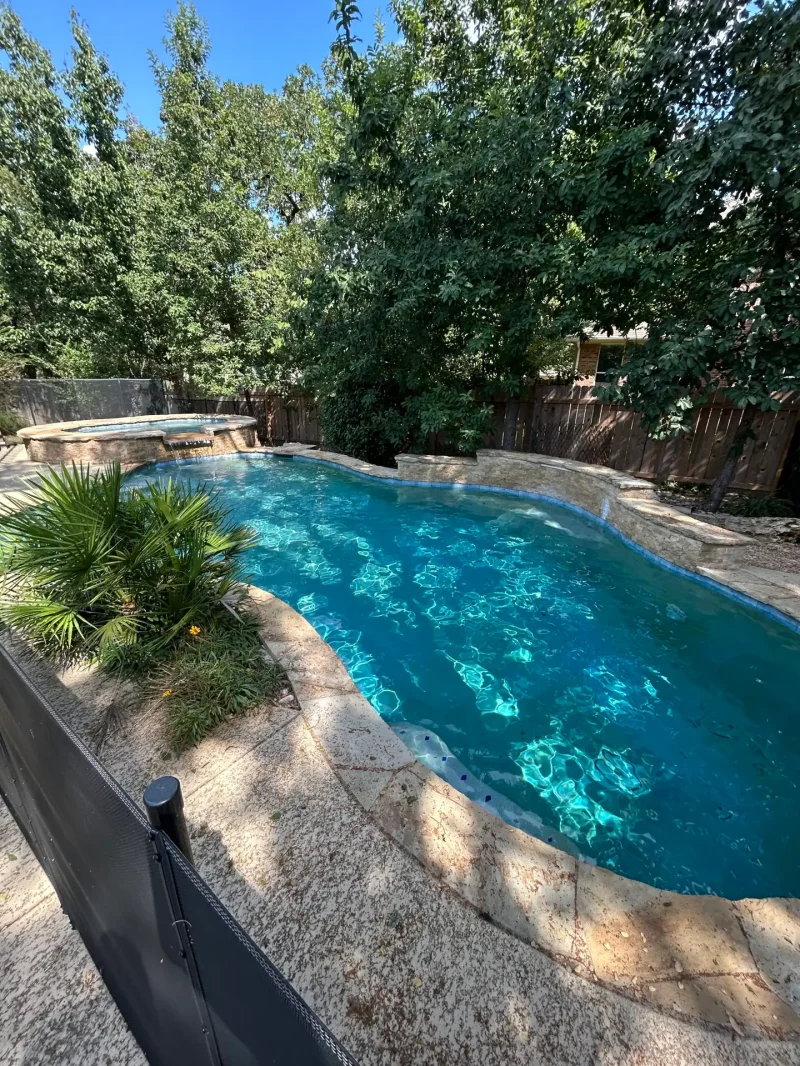
Four Things That Shape Pool Care in Boynton Beach
Four local conditions decide what a weekly visit here has to cover. Two come out of the tap, one comes from the people who swim, and one rolls in with the weather. Each one changes what we test for and what we watch.
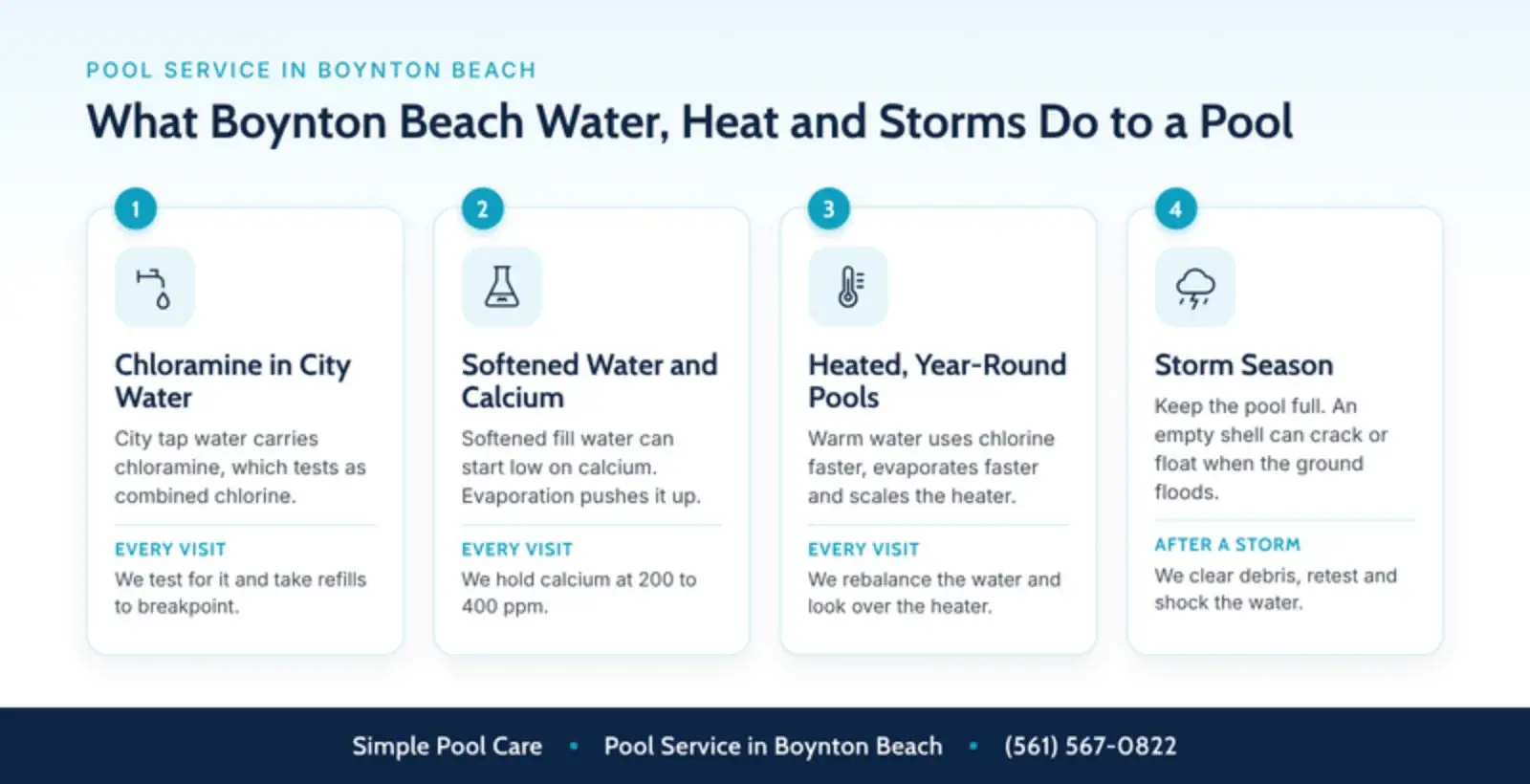
Chloramine in City Water
City water in Boynton Beach comes from Boynton Beach Utilities. It pumps from 30 wells between 50 and 240 feet deep, then treats the water at two plants. For most of the year, the city disinfects it with chloramine. Chloramine is chlorine tied to a little ammonia, and it lasts a long time in miles of pipe. That staying power suits a water utility.
Swimming water is another matter, because chloramine kills germs far too slowly to protect swimmers. Worse, it lands in the same column as the waste swimmers leave behind. Most test kits measure free chlorine first, then total chlorine. Subtract one from the other and you have the combined chlorine. Our target is zero, and we act on anything above 0.2 ppm. The city’s 2025 report puts its average disinfectant level at 2.84 ppm.
A weekly top-up only adds a little, and the free chlorine already in the pool works through it. A full refill after an acid wash is a different story. Fill a drained pool from the hose, and the first test can show combined chlorine before anyone has been in. We then dose to breakpoint, with free chlorine at roughly ten times whatever the combined number shows, before we call the pool ready.
Once or twice a year, the city switches to free chlorine for about three weeks to clean its pipes, and the tap may smell stronger. For the pool, it only means top-up water carries free chlorine for those weeks. That’s why pool service in Boynton Beach starts with a combined chlorine reading. Boynton Beach Utilities also supplies reclaimed water, and that never belongs in a pool.
Softened Water and Calcium
The east plant softens water with lime and runs it through sand filters, after an ion exchange step that strips out much of the mineral content. Meanwhile, the west plant pushes well water through nanofiltration membranes. Both cut hardness, so fresh tap water can leave a new fill short on calcium. In the dry months, December through May, the city also leans on its western wells and on water it stored underground in the rainy season. Since the source shifts with the seasons, we test the fill water rather than assume.
That matters more than it sounds. Plaster, grout and pebble finishes want 200 to 400 ppm of calcium hardness. Below about 150, the water starts dissolving calcium out of the surface, and the finish roughens and etches over time.
Evaporation then works in the opposite direction. The sun takes water and leaves the calcium where it is, so the number climbs as summer goes on. Calcium also dissolves less readily as water heats up, which is why scale tends to start inside the heater. If the waterline already wears a white crust, that’s a job for tile cleaning. Otherwise, we test calcium on the first visit and follow the saturation index from then on.
The City's Numbers Next to Ours
Here’s how the city’s 2025 water report lines up against the ranges we hold a pool to. The full document sits on the city’s water quality report page.
| Boynton Beach tap water, 2025 | Our pool target |
|---|---|
| Disinfectant: chloramine, 2.84 ppm average | Combined chlorine at 0 (0.2 ppm at most), free chlorine 2 to 4 ppm |
| Sodium: 43.2 ppm | Salt pools: 3,000 to 3,500 ppm |
| Softened with lime and nanofiltration | Calcium hardness: 200 to 400 ppm |
| Hardness, pH and alkalinity: not published | pH 7.4 to 7.6, alkalinity 80 to 120 ppm, a saturation index that stays within 0.3 of zero |
Warm Water for Year-Round Swimmers
Boynton Beach has a lot of older residents. In the 2020 census, 22.7 percent of the people living here were 65 or older, and the median age was 43.5. Older swimmers tend to want warmer water, and that changes how a pool runs.
For everyday swimming, 82 degrees is the usual comfort mark. Older swimmers and young children often want 80 degrees or more. Holding the water there from November to March means the heater or heat pump runs for months at a stretch. For pool service in Boynton Beach, that puts the heater in the weekly picture.
What Heat Does to the Water
Warm water burns through chlorine faster and gives algae an easier start. It also evaporates faster, and evaporation makes up about half of the heat a pool loses. More evaporation means more top-ups, and every top-up here brings in a little more chloramine and calcium.
A cover is the cheapest fix. It cuts evaporation, holds heat overnight and saves on chemicals, so the heater runs less. If you heat through the winter, a cover earns its keep.
Keeping an Eye on the Heater
On a weekly visit we look over the heater along with the pump, filter and timer. We also hold the water chemistry where scale is slow to form on the heat exchanger. If yours has stopped, our page on pool heater repair in Boynton Beach covers what usually goes wrong and what it costs. If the unit is beyond fixing, pool heater installation compares gas heaters and heat pumps.
Storm Season and Salt Air
Hurricane Wilma hit Boynton Beach on October 24, 2005, and damaged homes and businesses across the city. Storm prep for a pool comes down to a few simple rules, and the first one surprises people.
Keep the Water In
Leave the pool full when a storm is coming. Heavy rain saturates the ground, and groundwater pushes on the shell from outside. A full pool pushes back. An empty one can crack, or where the water table runs high, lift right out of the ground.
Shock the pool before the storm arrives, and keep the pump running while you still have power. Bring the patio furniture inside, and never sink it in the pool, because it can stain the finish.
After the Storm Passes
Make sure the yard is safe first, and watch for downed lines and wildlife. Then net out the debris before it stains the surface. If the pool overflowed, lower it to mid-skimmer. Finally, retest and shock again. If the water has already turned, that’s a job for green to clean.
Salt Air Near the Intracoastal
On its east side, the city stops at the Intracoastal. Homes near the water get more salt in the air, and salt is hard on metal: heater cabinets, equipment fasteners, light rings and screen enclosure frames. We flag corrosion when we see it, because a rusted part costs less to replace before it fails. Farther inland, salt is less of a factor.
Older Neighborhoods, Older Pools
Boynton Beach dates back to 1920, and plenty of its neighborhoods are decades old. Developments like Hampshire Gardens, Leisureville and Sterling Village went up in the 1960s, and Lake Boynton Estates was the city’s first planned subdivision.
Older pools need a gentler approach. Aging plaster gets rougher and more porous, so algae finds it easier to hold on, and low calcium or low pH eats into it faster. Older equipment pads also tend to carry a single-speed pump, an old sand filter and a heater with plenty of hours on it.
When an older pad needs work, we tell you what’s worth replacing and what still has life in it. A variable speed pump is usually the first upgrade worth making, since it runs longer and slower on far less power. Sand filters also need new sand roughly every 5 to 7 years, and sand changes are a quick job.
How Weekly Pool Service in Boynton Beach Works
We work through the pool in the same order each week. The full checklist sits on our weekly pool service page, but here’s how it plays out for a pool on city water.
First we test pH, alkalinity, calcium and stabilizer, plus free and combined chlorine, and adjust anything that’s off. Combined chlorine gets extra attention here because of the chloramine in top-up water.
Then we clean. That means skimming the surface, brushing down the tile line and walls, running the vacuum and dumping out both baskets.
Next comes the equipment. We look over the pump, filter pressure, heater, salt cell and timer, and hold the water level near the middle of the skimmer.
Last comes the digital report, which lists the readings, what went into the water and anything to keep an eye on. If you split the year between here and somewhere else, you can see how the pool is doing from wherever you are.
If You Leave for the Summer
Plenty of owners head north once the heat sets in. Before you go, tell us your dates, leave the gate and equipment area open to us and decide whether the heater stays on. An empty house still needs weekly pool service in Boynton Beach, because the sun, the rain and the algae don’t take the summer off.
While you’re away, we keep chlorine and pH steady, watch the water level through the rainy months and empty the baskets on every visit. If something breaks, we call you with the fault and the price before we fix it, so you’re never surprised by a bill when you get back.
Pool Services We Handle Across Boynton Beach
Weekly care is the core of it. Still, the same company that services your pool can also fix it or replace what’s worn out.
Pool Cleaning in Boynton Beach
Our pool cleaning in Boynton Beach comes as weekly full service or a chemical-only plan, and both cover routine pool maintenance. Full service includes two filter cleanings a year, built into what you already pay each month, which keeps filter pressure down and water moving through a long heating season.
Pool Repairs in Boynton Beach
Our pool repairs take in pumps, filters, heaters and spas. We find the cause first and price the fix before any work, and the bulk of repairs fall in the $100 to $800 range. For a pump that hums, leaks or won’t prime, see pool pump repair.
New Equipment in Boynton Beach
When replacing makes more sense than repairing, our pool equipment installations include new pumps and heaters, plus filters, lights and automation. Installation quotes are free.
Specialty Work in Boynton Beach
Our specialty pool services include acid washes, green pool recovery, salt system conversions, automation and sand changes. If you’re weighing a salt system, salt pools hold 3,000 to 3,500 ppm. Against that, the 43 ppm of sodium in city water barely registers.
What Pool Service in Boynton Beach Costs
Full weekly service begins at $170 a month, and chemical-only begins at $100. We bill it as monthly pool service in Boynton Beach, so every weekly visit and the routine chemicals sit in one price. The price moves with pool size, whether there’s a screen cage, how many trees hang over the water and how the pool looks on day one.
Most repair bills come in between $100 and $800. Replacing a pump capacitor costs around $150 including labor. Heater repairs usually run $200 to $800, and a new shaft seal or motor $250 to $600. We diagnose and quote before we start.
For new equipment, a variable speed pump costs $1,500 to $2,800 to install. A gas heater is $2,000 to $4,000 fitted, and a heat pump $3,000 to $7,500. Green pool cleanups cost $250 to $800. Acid washes are $300 to $700, plus another $150 to $250 when we have to drain the pool.
Request Pool Service in Boynton Beach
Because we’re owner-operated, there’s no franchise office between you and the people who look after your pool. Request a quote on the site or phone (561) 567-0822, and we’ll book a first visit to test your water and walk the equipment pad with you.
Want to know more about who we are and everything we do? Start with our pool service company homepage.
Pool Service in Boynton Beach FAQs
Straight answers on cost, city water, heated pools and storms. Don’t see your question? Call (561) 567-0822.
Plans, Prices and Who Shows Up
Simple Pool Care charges from $170 a month for full weekly service and from $100 a month for chemical-only. Routine chemicals cost nothing extra on either plan, and full service throws in a filter cleaning every six months. Pool size, a screen cage and the pool's starting condition decide the exact figure.
Yes. Both of our plans include routine chemicals, so the monthly price is what you pay. That's worth checking when you compare quotes, because a lower rate that bills chemicals separately often costs more once summer chlorine use climbs.
We do both. Simple Pool Care repairs pumps, filters and heaters and installs new equipment, and most repairs run $100 to $800. We find the cause, price the fix and start only once you approve it. Our training on Hayward, Pentair, Jandy and Zodiac gear comes straight from the manufacturers.
Yes. We just need a way into the backyard and the equipment area, so nobody has to be home. After each visit you get a digital report listing the readings and what we added, so you can check on the pool from wherever you spend the summer.
We're owner-operated and carry a license and insurance, and Google reviewers give us a 5.0. We test for the chloramine in city water, keep heated pools balanced through winter and quote repairs before any work. You also get a report after every visit, and the chemicals are in the price.
City Water, Heated Pools and Storms
It can raise combined chlorine. Boynton Beach disinfects its water with chloramine, which test kits count as combined chlorine and which sanitizes too slowly for pools. Normal top-ups add very little. When we refill a drained pool, we keep adding chlorine until free chlorine sits near ten times the combined number, which clears the chloramine.
Mostly the opposite. The city softens its water with lime and membranes, so a fresh fill can come up short on calcium, and low calcium etches plaster. Evaporation then pushes calcium up through summer. We aim for 200 to 400 ppm and keep testing.
For everyday swimming, 82 degrees is the usual comfort mark, and older swimmers often prefer 80 degrees or a little warmer. Warm water uses chlorine faster, evaporates faster and scales the heater sooner. A cover at night cuts evaporation and heat loss. Keep spas below 104 degrees.
No, keep it full. When heavy rain soaks the ground, groundwater presses against the shell from below, and with no water inside, the pool can crack or even float up. Shock the water before the storm, keep the pump running while you have power and never put patio furniture in the pool.
Weekly, for most pools. Heat, sun and summer storms move chlorine and pH within a few days, and heated pools drift faster still. A screened pool with no trees and light winter use can stretch to every two weeks, but weekly visits keep algae from getting started.
