
Pool Services in Juno Beach, FL
Pool services in Juno Beach for homes on a barrier island, where salt air works on every pump and heater. Full weekly care costs $170 a month and up and includes chemicals.

Pool Service in Juno Beach, Between the Ocean and the Intracoastal
Juno Beach is a small town on a barrier island, squeezed between the Atlantic and the Intracoastal. Every backyard gets the same sea breeze. That breeze carries salt, and the salt settles on pool equipment all over town.
So pool service in Juno Beach starts at the equipment pad, not just the water. On every visit we look over the pump, heater, salt cell and fittings for the first signs of corrosion. A rusted clamp caught early is a small fix. Missed, it can cost you a motor.
The water has its own local twist. Both utilities that supply the town run membrane plants, and both disinfect with chloramine. That means fresh fill water starts low in minerals and already carries combined chlorine. We test for both after any big refill.
Then there are the empty houses. Census estimates count about one home in four here as held for seasonal or occasional use. A problem that someone living there would spot in a day can run for weeks at an empty house. A pool nobody is watching needs a technician who notices small changes from week to week, plus a report after every visit.
Simple Pool Care is owner-operated, licensed and insured, with a 5.0 Google rating. Full service runs from $170 a month including chemicals, or from $100 for chemical-only. Call (561) 567-0822 for a quote.
What a Barrier Island Does to a Pool
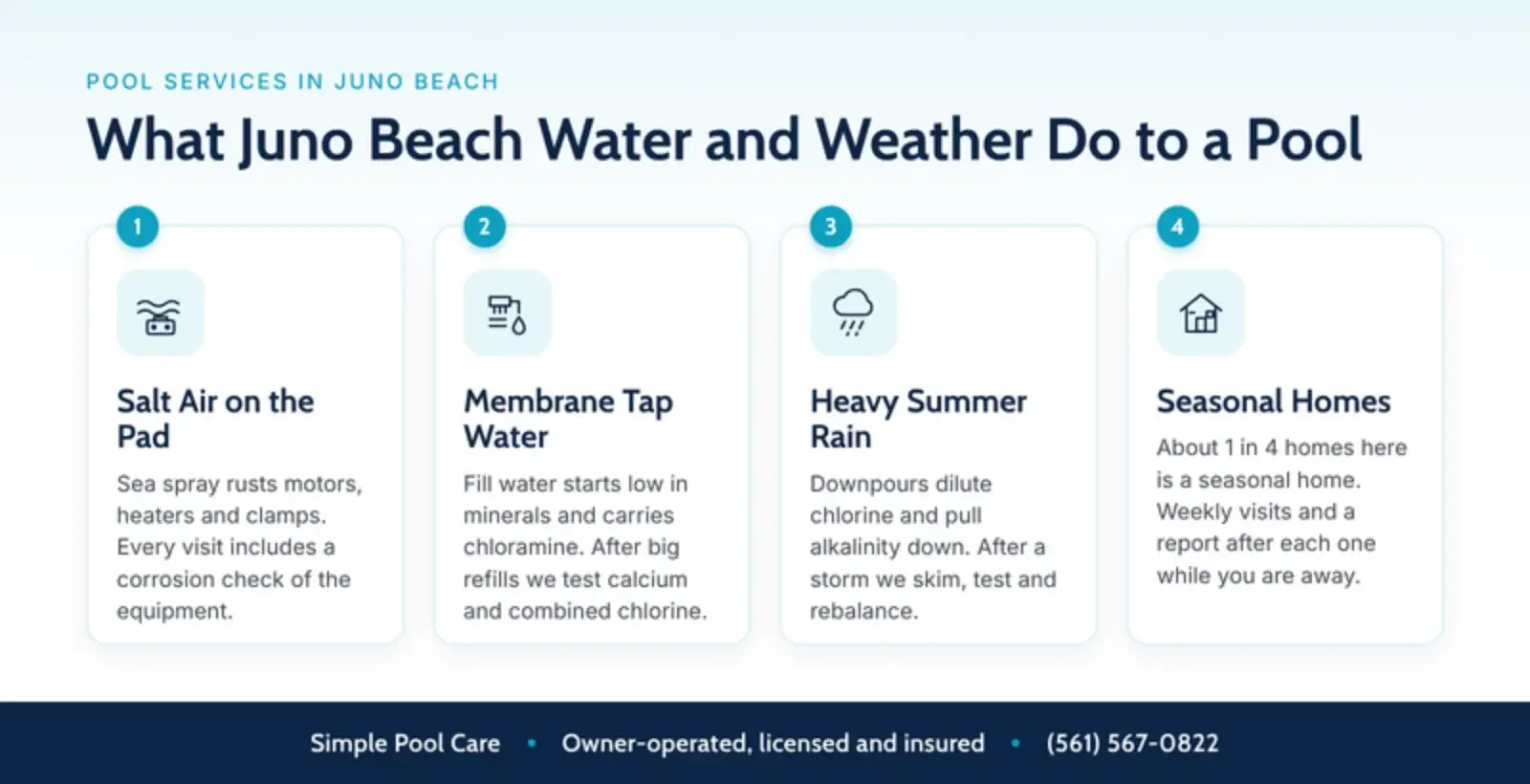
Four things about this town shape our pool services in Juno Beach. None of them is rare in South Florida on its own. Together, though, they explain why a Juno Beach pool needs a closer eye on equipment and water balance than the same pool farther inland.
Salt Air on the Equipment Pad
Salt spray is the obvious one. It lands on motor housings, heater cabinets, hose clamps and the screws that hold the pad together. Then the humidity keeps it damp, so rust starts where nobody looks, like the back of a motor or under a heater panel.
The other corrosion happens underwater, where you can’t see it working. When dissolved solids build up, unlike metals sharing the pool start to corrode one another. Think of the heater’s copper exchanger next to a stainless ladder and a metal pump impeller. The first sign is usually discolored metal or copper staining on stainless. Bad bonding and grounding leave the same marks, so we test the bonding before we blame the water.
Our limit for TDS is 1,500 ppm above the pool’s start-up reading. That baseline counts your fill water and, on a salt pool, the salt itself. A salt pool can show a big TDS number and still be in good shape.
Membrane-Treated Water From Two Utilities
The town’s water page lists two suppliers. Homes on the north end buy water from a neighboring utility, and the south end is on Seacoast Utility Authority. Both treat with membranes. Nanofiltration handles fresh water from the shallow aquifer, and reverse osmosis handles brackish water from the deep Floridan aquifer.
Seacoast describes its nanofiltration as demineralization, and that matters for a pool. Fill water that went through membranes starts low in minerals. Water short on calcium dissolves it from plaster and tile grout, and it’s harder on heater parts too. So after a big refill we test calcium hardness and raise it with calcium chloride when it’s short.
Both suppliers also disinfect with chloramine, and in a pool test that reads as combined chlorine. A normal top-off adds very little. A full refill, though, can show combined chlorine before anyone swims. To burn it off, we lift free chlorine to ten times the combined level.
| Item | Tap water (2025 utility reports) | Pool target |
|---|---|---|
| Treatment | Nanofiltration and reverse osmosis at both suppliers | Test calcium hardness after any big refill |
| Disinfectant | Chloramine. Seacoast monthly readings 3.6 to 3.8 ppm; north-end supplier 0.6 to 4.4 ppm | Combined chlorine 0, no higher than 0.2 ppm |
| Calcium hardness | Not published; membrane water starts low in minerals | 200 to 400 ppm |
Sand and Sunscreen From the Beach
Swimmers who walk up from the beach bring sand with them. It sinks, gathers on the steps and in the corners, and ends up in the filter. Sunscreen and body oil float up and leave a greasy ring at the tile. Once that ring forms, it grabs more dirt from the water.
Wind off the ocean adds dust, leaves and salt. Wind-borne debris raises dissolved solids and can cloud the water. That’s why we watch filter pressure closely here. A loaded filter shows up as the gauge sitting 8 to 10 psi higher than when it was clean, and regular filter cleaning keeps it from getting that far.
Heavy Rain on Low Ground
The town calls itself a barrier island, and its flood page notes that low-lying areas, including the streets near Pelican Lake, can flood during long stretches of heavy rain. A pool on low ground fills fast in a summer downpour.
Rain works on the water in two ways. It thins out the chlorine, and it can pull total alkalinity down so the pH swings. After a big storm we skim out the debris, test, and rebalance. If the water is over the skimmer, we lower it just to the middle of the skimmer opening. We never go lower than that on wet ground.
Pool Services in Juno Beach, Service by Service
The coast changes how each of our pool services in Juno Beach plays out. Below is what’s different about each one, with a link to that service’s own page.
Pool Cleaning in Juno Beach
Our pool cleaning visits cover the basics every week: netting, brushing, vacuuming and both baskets. Brushing does extra work on a beach pool, because sand settles in the corners and sunscreen film builds up at the waterline faster than it does inland.
A screen enclosure keeps leaves and most wind-blown debris out, which helps. It doesn’t change the chemistry, though. Sun, rain and swimmers still move the readings, so a screened pool still needs testing every week.
Pool Pump Maintenance and Repair in Juno Beach
The pump runs every day, and here it runs in salty, humid air. Pool pump maintenance on our visits means listening for bearing noise, checking the lid O-ring for air leaks, clearing the basket and watching the shaft seal for drips. Air in the line makes a pump cavitate, and over time that damages the pump and motor.
When a motor hums but won’t start, the capacitor is a common cause, and that fix runs about $150 with labor. Our pool pump repair page goes through the other usual failures. If you are replacing rather than fixing, pool pump installation in Juno Beach covers sizing and running costs.
Pool Heater Repair in Juno Beach
Heaters take salt air on the outside and water chemistry on the inside. A heat pump’s coil fins sit right in the breeze, and gas heater cabinets rust at the seams. Inside, the copper heat exchanger is where corrosive water does its damage. Water that runs low in calcium or low in pH eats at it.
That’s one more reason we track calcium so closely on membrane-treated fill water. Expect $200 to $800 for most heater repairs, and you get a diagnosis before any quote. Our pool heater repair page covers the common faults, from ignition trouble to low water flow.
Salt System Care in Juno Beach
Most salt chlorinators want the water held between 3,000 and 3,500 ppm. The cell produces nothing while the pump is off, so pump hours and chlorine output go together. Cells reverse polarity to shed scale, but they still need a look and an occasional cleaning.
With salt in the air and salt in the water, bonding matters even more on a salt pool. On salt pools we test the salt level and look at the cell on our visits. Our salt systems page covers conversions, which run $1,500 to $3,000.
Pool Lights Inside the Sea Turtle Protection Zone
The beach here is one of the densest sea turtle nesting areas in the world, and the town protects it with lighting rules. Its Sea Turtle Protection Zone covers every property within 600 feet landward of the mean high water line. That can include homes on the west side of Ocean Drive.
New or replacement exterior lighting in the zone needs a town sea turtle lighting permit as well as a building permit. The application asks for pool light fixture locations on the plans. From March 1 to October 31, exterior lamps must give off only long wavelength light, which usually means amber, orange or red LEDs.
So if a pool light fails at a home near the beach, plan the replacement around the permit. Our pool light installation page covers fixtures, wiring and safety checks.
Draining a Pool in Juno Beach
Draining a pool on a barrier island takes care. When groundwater sits high, it presses up on the shell, and an emptied pool can lift. The hydrostatic relief valve at the deep end exists for exactly that reason, so we check it before any drain.
Where the water goes matters too. Town rules make it illegal for any liquid to enter the drainage system, so pool water can’t go down the storm drain. We plan the discharge before we open a valve.
Most of the time we avoid draining at all. A green to clean recovery brings most pools back within one to three days, with the water left in. When stains or scale call for an acid wash, expect $300 to $700, and another $150 to $250 when the pool has to be drained.
Pool Maintenance in Juno Beach for Seasonal Homes
Census estimates put about 930 of the town’s roughly 3,660 homes in the seasonal or occasional-use group. That’s about one in four, and it means a lot of pools here go weeks without the owner seeing them. So pool maintenance in Juno Beach often means looking after a pool for someone who is out of town.
While You Are Away
We service the pool whether you’re home or not, provided we have a way in to the pool and the equipment pad. Each visit ends with a report that lists the readings and anything we added or fixed. If something on the pad starts to sound or look wrong, we call you before it turns into a dead motor and a green pool.
Tell us before you leave for the season. We need gate codes and access to the equipment area, plus a phone number that reaches you while you’re gone. It also helps to know whether the heater should stay off until you’re back.
Storm Season With Nobody Home
Hurricane season runs from June 1 to November 30, and it overlaps the months when many seasonal owners are gone. After a storm we check the pad before anything gets switched back on. The town’s own storm guidance says not to use motors or appliances that got wet until someone takes them apart, cleans them and dries them. A pump that sat in floodwater falls into that group.
Then we net the debris, test, and raise the chlorine before algae gets started. Leave the water in the pool before a storm. A full pool keeps its weight on the shell against rising groundwater.
What a Juno Beach Pool Visit Covers
Our weekly pool service runs the same checklist at every house, and the table shows the readings we hold the water to. The last column is why each one matters on this stretch of coast.
| Reading | Target | Why it matters in Juno Beach |
|---|---|---|
| Free chlorine | 2 to 4 ppm | Heat and strong sun burn it off quickly |
| pH | 7.4 to 7.6 | Keeps chlorine strong and protects plaster and heaters |
| Total alkalinity | 80 to 120 ppm | Steadies pH when summer storms hit |
| Calcium hardness | 200 to 400 ppm | Fill water from membrane plants runs low |
| Combined chlorine | 0 ideal, 0.2 ppm max | Tap water chloramine raises it |
| Stabilizer (CyA) | 30 to 50 ppm | Keeps sunlight from destroying chlorine |
| Salt (salt pools only) | 3,000 to 3,500 ppm | What the cell needs to make chlorine |
| Saturation index | -0.3 to +0.3 | Water neither etches nor scales |
| TDS | Up to 1,500 ppm over the start-up reading | Keeps metal corrosion in check |
Beyond the water, each visit covers brushing, vacuuming, skimming, both baskets, a filter pressure reading and a walk around the equipment. On a beach pool, that walk-around is where we catch corrosion early.
Pool Service and Repair Costs in Juno Beach
Pricing for pool services in Juno Beach is built around the weekly plan. The full-service plan starts at $170 a month. Chemical-only service starts at $100. Both prices cover the chemicals, and the plan includes a filter cleaning twice a year. Size, screening and condition set the final number, so we price the pool once we’ve seen it.
Every repair gets a diagnosis and a quote before work starts. Most pool repairs come in at $100 to $800. Motor or shaft seal work is $250 to $600, heater work $200 to $800, and filter repairs fall between $100 and $500.
Our pool equipment installations come with free quotes. For a variable speed pump, figure $1,500 to $2,800 installed. Gas heaters are $2,000 to $4,000 and heat pumps $3,000 to $7,500, while replacing a filter costs $300 to $1,000. Green pool recovery runs $250 to $800, and the rest of our specialty pool services are priced on their own pages.
Request a Quote for Pool Services in Juno Beach
Simple Pool Care is owner-operated, licensed and insured, with a 5.0 Google rating. Our techs are factory trained on Hayward, Pentair, Jandy and Zodiac equipment.
To book pool services in Juno Beach, request a quote through our booking page or call (561) 567-0822. Let us know if the house is lived in full time or only part of the year, and if the pool is salt or chlorine. To compare plans side by side, visit our pool service company home page.
Pool Services in Juno Beach FAQs
Short answers to common questions about pool services in Juno Beach.
What It Costs and How It Works
Weekly full service in Juno Beach is priced from $170 a month, chemical-only from $100, chemicals included either way. Your exact price comes down to pool size, screening and condition. We price repairs after a diagnosis, and most land in the $100 to $800 range.
Once a week. Sun, heat, salt air and summer rain move chlorine and pH quickly in Juno Beach, and seven days is roughly the limit before the water starts to slip. A weekly visit also gives us a look at the pump, heater and salt cell, which matters on a barrier island.
Yes. Census figures count roughly one Juno Beach home in four as a seasonal or part-time home. You don't need to be home. We need access to the pool and equipment, and you get a report after every visit. If something looks wrong on the pad, we call you.
Yes. A screen enclosure keeps out most leaves and wind-blown debris, so cleaning goes faster. It does nothing for the chemistry, though. Sunlight still burns off chlorine, rain still dilutes it, and swimmers still add sunscreen and oils. The water needs testing and balancing every week, screen or no screen.
Simple Pool Care is owner-operated, licensed and insured, with a 5.0 Google rating. Our techs are factory trained on Hayward, Pentair, Jandy and Zodiac. On a Juno Beach pool we treat the equipment check as seriously as the water test, because salt air is hard on pumps and heaters.
Juno Beach Water and Equipment Questions
Rarely. Both utilities that serve Juno Beach treat with nanofiltration and reverse osmosis, so fill water starts low in minerals. Low calcium, which can etch plaster, is the bigger worry here. Tap water also carries chloramine, which reads as combined chlorine after a big refill.
Yes, over time. Salt spray settles on pump motors, heater cabinets, clamps and screws, and the humidity keeps it working. We check the equipment pad on every visit, and we check bonding when metal parts in the water start to discolor, since poor bonding causes staining too.
A heavy rain thins the chlorine and can pull alkalinity down, and that's often enough to turn a pool green when the weather is warm. Low spots in town also flood in long rainy stretches. A green to clean visit usually clears the water in 24 to 72 hours, rarely with any draining.
Only with care, and usually not. On low coastal ground, high groundwater can push an empty pool upward, so testing the hydrostatic relief valve comes first. Juno Beach also makes it illegal for any liquid to enter the storm drainage system. We can fix most problems, green water included, without draining.
They can. Homes within 600 feet landward of the mean high water line sit in the town's Sea Turtle Protection Zone. New or replacement exterior lighting there needs a permit that asks for pool light locations. From March 1 to October 31, exterior lights must be long wavelength, such as amber LEDs.
