Pool Service in North Palm Beach, FL
Pool service in North Palm Beach, FL, from an owner-operated, licensed and insured company. We plan every weekly visit around the village’s chloramine-treated tap water and the salt air off its canals.

Pool Services in North Palm Beach, Planned Around the Water
North Palm Beach was laid out as a waterfront village. When it was built, the developers dredged canal cul-de-sacs so more streets would back onto water. Today, more than a third of the village’s area is water, and plenty of backyard pools sit a few steps from a seawall.
That water shapes the job. The tap water that fills your pool carries chloramine, the canal air carries salt, and the ground beside the canals can hold water close to the surface. Our pool services in North Palm Beach are built around those conditions, not a checklist copied from somewhere inland.
The weekly visit sits at the center of our pool service in North Palm Beach. Each time, the technician tests and corrects the water, brushes the walls, steps and tile line, vacuums the floor, clears both baskets and looks over the equipment. Afterward, you get a report with the readings and everything we added.
Plans begin at $170 a month on the full plan or $100 on chemical-only, with chemicals included in both. The full plan adds two filter cleanings a year. So if you spend part of the year away, the pool still gets looked after every week.
We’re a licensed, insured, owner-operated company rated 5.0 on Google. Call (561) 567-0822, and we’ll come and look at the pool before we quote.
Pool Service in North Palm Beach Starts With the Tap Water
Seacoast Utility Authority supplies the village’s drinking water, and the village has no public supply wells of its own. Most of Seacoast’s water comes from 38 wells in the shallow surficial aquifer, 75 to 200 feet down. Six deeper wells draw brackish water from the Floridan aquifer, about 1,500 feet down. It’s treated at the Hood Road membrane plant, mostly by nanofiltration, with reverse osmosis for the brackish Floridan water. Two things about the finished water matter for your pool: the disinfectant it carries, and how much of the hardness the membranes take out.
Chloramine Shows Up as Combined Chlorine
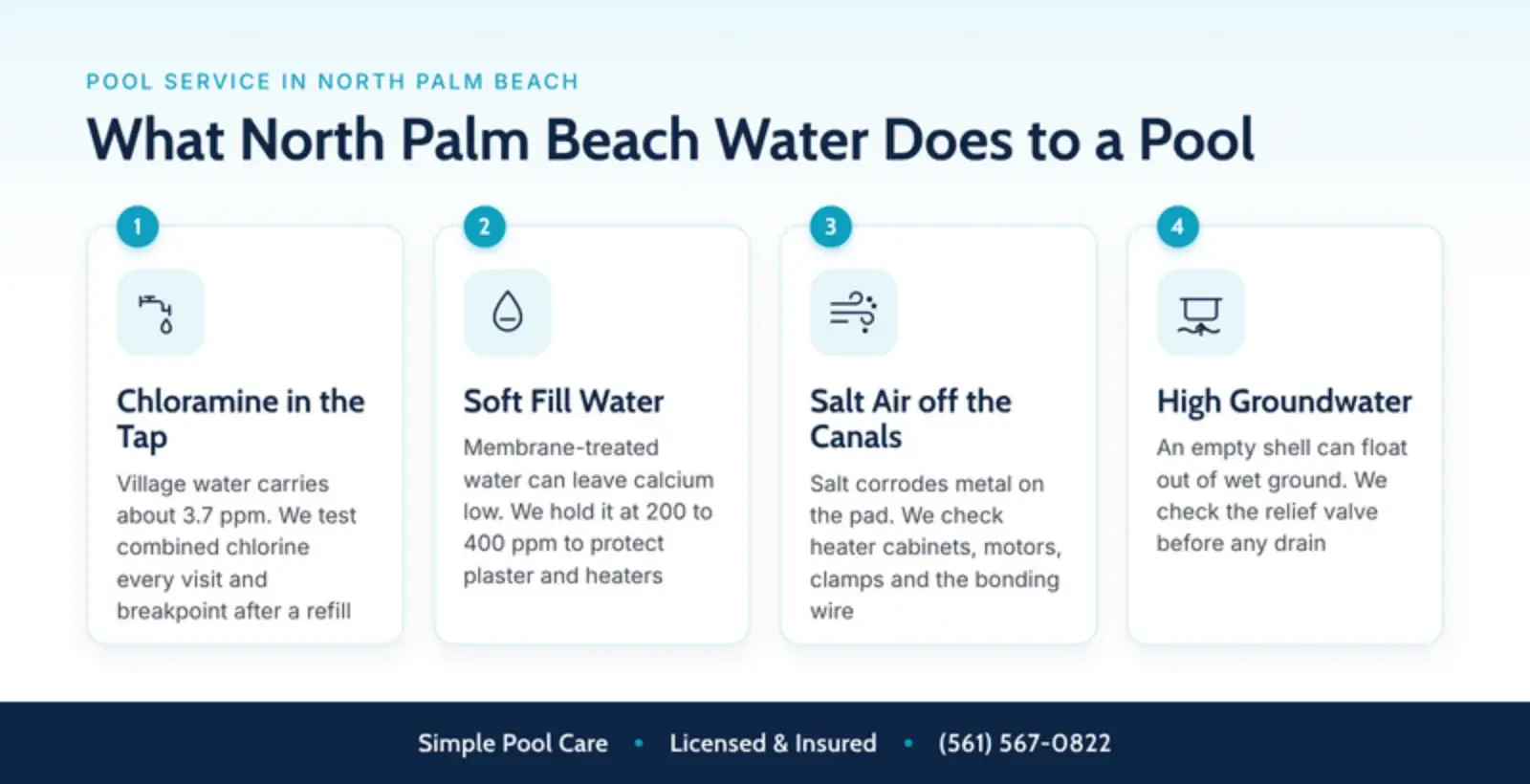
Seacoast disinfects with chloramines rather than free chlorine. Its 2025 water quality report lists a residual of about 3.7 ppm. Chloramine suits miles of water main because it lasts so long. In a pool, though, it acts far too slowly to sanitize, and a pool test reads it as combined chlorine.
This matters most after a refill. A pool filled from the tap can start well above the 0.2 ppm combined chlorine limit we hold, before anyone has even swum in it. So after a drain and refill, we take the water to breakpoint and retest, rather than adding a normal week’s chlorine. Breakpoint takes free chlorine of roughly ten times the combined reading. With a test that reads monochloramine directly, the target is about five times that number.
Topping up with the garden hose adds a little chloramine every time, too. That’s one reason we test combined chlorine on every visit instead of free chlorine alone.
Membrane-Treated Water Can Run Low on Calcium
Nanofiltration and reverse osmosis pull out much of the calcium and magnesium that make water hard. That’s great for your shower head. A pool, however, wants calcium hardness between 200 and 400 ppm. Water with too little calcium turns aggressive. It starts taking what it needs from the plaster and grout, and it can damage the heater as well.
Seacoast’s report doesn’t publish a hardness figure, so we measure calcium on every visit instead of guessing. When it runs low, we raise it with calcium chloride. Over the years, evaporation pushes the other way. It removes pure water and leaves the minerals behind, which is why an older pool can drift high instead.
Canals, Seawalls and Salt Air in North Palm Beach
More than a third of North Palm Beach is water, from residential canals to the Intracoastal itself. The village’s country club sits on an island in the Intracoastal, reached by three bridges. The canal cul-de-sacs were dredged when the village was first developed, and gated communities such as Old Port Cove sit right on the water.
Salt Air on the Equipment Pad
Brackish water and the breeze off it carry salt, and salt eats metal. Where an equipment pad faces a canal, we check heater cabinets, pump motor housings, hose clamps and timer boxes for rust. We also make sure the bonding wire is still attached. Corrosion caught early is usually a small part. Left alone, it can end in a seized motor or a heater that won’t fire.
Storm Surge and the Equipment Pad
Storms are the other waterfront risk. The village’s flood guidance points out that evacuation orders here are driven by storm surge, not wind, and it tells residents to cut utilities at the main before leaving. For your pool, that means switching off the pump, heater and automation at the breaker before you go.
If surge or floodwater reaches the pad, leave everything off until the wiring and motors have been checked. Once the power is safe, we clear the debris, test for the salt and dirt the storm carried in, and rebalance the water. We also hold off on any draining until the ground dries out, for the reasons below.
Why We Don't Drain a Pool Here Without Checking First
The village was developed on former mangrove swamp and farmland, and parts of it sit low beside tidal water. Near the canals, groundwater can sit close to the surface. An empty pool shell is light, and with enough water pushing up from below, it can float out of the ground.
So any drain starts with the pool’s hydrostatic relief valve. It sits in the floor and lets groundwater in before the pressure can lift the shell. We also avoid draining after heavy rain, when the water table is up. If a full drain isn’t safe, a partial drain often does the job. And plenty of problems people want to drain for, like cloudy or green water, get fixed with the water left in. Before an acid wash or any big refill, we walk you through all of it first.
A Village Built in the 1950s and 60s
North Palm Beach was incorporated in 1956, and the National Association of Home Builders named it the best planned community of 1956. Then it filled in quickly. The population grew from 2,684 in 1960 to 9,035 by 1970. Old Port Cove’s Marina Tower followed in 1975, and communities like Governor’s Pointe, Harbor Isles and Prosperity Harbor came between 1981 and 2004.
That leaves a wide spread of pool ages across the village. A pool from the early years has usually been resurfaced at least once, and its equipment may have been replaced several times. Meanwhile, newer pools often came with newer pads, automation and salt systems.
On an older pad, we look at the equipment as a set, not one part at a time. A pump, filter and heater installed years apart don’t always match in size or flow. When replacing makes more sense than another repair, pool pump installation in North Palm Beach covers sizing and the options.
Pool Service in North Palm Beach, Service by Service
Weekly service is the core, and the same company handles repairs and new equipment, so one call covers the lot.
Pool Cleaning in North Palm Beach
Our pool cleaning covers the routine side. That means weekly pool service, plus deep filter cleaning for whichever filter type you run. If evaporation has left a white crust at the waterline, pool tile cleaning takes it off without scratching the glaze.
Pool Repairs in North Palm Beach
For pool repairs, we find the cause and give you a price before touching anything. Most repairs run $100 to $800, and a failed pump capacitor is about $150 with labor. For a pump that hums but won’t start, see pool pump repair. For a heater that won’t fire, start with pool heater repair.
Equipment Installation in North Palm Beach
Our pool equipment installations cover new pumps, heaters, filters, lights and automation. Installed prices run $1,500 to $2,800 for a variable speed pump and $2,000 to $4,000 for a gas heater, while a heat pump can be anywhere from $3,000 to $7,500. Quotes for new equipment are free.
Specialty Jobs in North Palm Beach
Our specialty pool services cover the bigger one-off jobs. A green to clean recovery runs $250 to $800. Most pools clear within 24 to 72 hours with the water left in, which matters here given the groundwater. Meanwhile, a salt system conversion costs $1,500 to $3,000.
What Pool Maintenance in North Palm Beach Looks Like Each Week
Every visit follows the same routine, adjusted for the village’s water. First, we test free and combined chlorine, pH, alkalinity, calcium hardness and stabilizer. Then we skim, brush, vacuum and empty the baskets, check the filter pressure and look over the pad.
Brushing matters more than it looks. It breaks up biofilm, the slime layer bacteria build on pool walls. Bacteria living in that slime can need a disinfectant level 100 times higher to kill. On the filter, we backwash or clean it when the gauge climbs 8 to 10 psi past its clean reading.
Rain is the other variable. A heavy summer storm can drop total alkalinity quickly, and then the pH is free to swing. So after a big storm, we check alkalinity as well as chlorine. That habit is a large part of good pool maintenance in North Palm Beach, where summer afternoons often bring a storm.
The Readings We Hold in North Palm Beach Pools
These are the ranges we balance to, with the local reason each one matters.
| Reading | Target | Why it matters here |
|---|---|---|
| Free chlorine | 2 to 4 ppm | Sun and rain use it up between visits |
| Combined chlorine | 0, never above 0.2 ppm | Chloramine from the tap reads here after a refill or top-up |
| pH | 7.4 to 7.6 | Decides how well the chlorine works |
| Total alkalinity | 80 to 120 ppm | Heavy rain pulls it down |
| Calcium hardness | 200 to 400 ppm | Membrane-treated fill water can start low |
| Cyanuric acid | 30 to 50 ppm | Shields chlorine from the sun, but too much slows it |
| Saturation index | -0.3 to +0.3 | Below it the water etches plaster, above it scale forms |
Dissolved solids climb as well, because evaporation leaves salts behind and every chemical dose adds a little more. We don’t let them climb more than 1,500 ppm over the pool’s start-up reading. Beyond that, galvanic corrosion becomes more likely wherever different metals meet in the system, such as a copper heat exchanger and a metal pump impeller.
Village Pool Rules Worth Knowing
The village code is plain about pools. Every swimming pool in North Palm Beach must be kept in a clean and sanitary condition. In addition, a barrier, fence or screen enclosure has to surround it, and installing a pool barrier takes a building permit and an inspection.
New pools, spas and hot tubs also fall under Florida’s pool safety law. The village building department asks the owner to choose a compliant barrier, an approved safety cover, or alarms or self-closing latches on doors that open to the pool.
If you leave for the summer, an unattended pool can turn green fast in our heat, and a green pool breaks the clean and sanitary rule. Weekly service keeps it right while you’re gone, and the report shows you what we found on every visit.
What Pool Service in North Palm Beach Costs
Full weekly pool service in North Palm Beach starts at $170 a month. That price covers the weekly visits, routine chemicals and two filter cleanings a year.
Chemical-only plans begin at $100 a month. You net and brush, and we handle the testing, the balancing and the chemicals.
Pool size, a screen enclosure, tree cover and the pool’s starting condition set the final number. If the pool is green on day one, it needs a recovery before the weekly price applies.
Acid washing costs $300 to $700, with $150 to $250 more if the pool has to be drained. Given the groundwater here, we’ll tell you up front whether draining is safe before you commit.
Get a Quote for Pool Service in North Palm Beach
The company is owner-operated and fully licensed and insured, and we hold factory training on Hayward, Pentair, Jandy and Zodiac equipment. Use the form to request a quote, or ring (561) 567-0822. We’ll see the pool and its pad in person before putting a price on it.
For the bigger picture, our homepage explains how our pool service company works, from weekly visits to repairs and new equipment.
Pool Service in North Palm Beach FAQs
Answers to common questions from North Palm Beach pool owners.
Plans, Prices and Picking a Company
Pool service in North Palm Beach costs from $170 a month on the full weekly plan, or from $100 on chemical-only. Both plans include the chemicals. Pool size, screening, tree cover and condition set the final price. Repairs are quoted after diagnosis, and most run $100 to $800.
Full service covers testing, balancing, chemicals, brushing, vacuuming, emptying the baskets and checking the equipment, plus two filter cleanings a year. Chemical-only covers the testing, balancing and chemicals, while you handle the netting and brushing. Either way, you get a report with the readings after every visit.
No. As long as we can reach the pool and the equipment, we service it while you're away and send a digital report after each visit. Seasonal owners in North Palm Beach can check from out of town that the water is clean and balanced.
Yes. We cover the whole village, including Old Port Cove, Prosperity Harbor, Harbor Isles, Governor's Pointe and the streets around the North Palm Beach Country Club. For gated communities, we just need gate access arranged with your HOA or front desk before the first visit.
Because the owner runs it and answers for every pool. Simple Pool Care is licensed and insured, carries a 5.0 Google rating and has factory training on Hayward, Pentair, Jandy and Zodiac. Every visit is planned around the village's chloramine-treated water and canal salt air, and you get a report with the readings each time.
North Palm Beach Water and Pool Problems
Not in the usual way. Seacoast runs the water through nanofiltration and reverse osmosis, which remove much of the hardness. That can leave calcium low, and low-calcium water can etch plaster and damage heaters. So we test calcium every visit and keep it at 200 to 400 ppm.
Because the tap water brings it in. Seacoast disinfects with chloramines, reported at about 3.7 ppm in 2025, and a pool test reads chloramine as combined chlorine. A hose top-up adds a little. A full refill adds a lot, so after one we take the pool to breakpoint and retest.
Only with care. Parts of the village sit on low former mangrove land beside the canals, where groundwater can stand high, and an empty shell can lift out of the ground. So we check the hydrostatic relief valve first, avoid draining after heavy rain, and use a partial drain when that works.
Yes. Air off the brackish canals and the Intracoastal carries salt, which slowly corrodes metal on the equipment pad. On waterfront homes in North Palm Beach, our equipment checks cover heater cabinets, motor housings, clamps and the bonding wire. That way, corrosion gets caught while it's still a small fix.
Village code says every swimming pool must be kept clean and sanitary and surrounded by a barrier, fence or screen enclosure. A new barrier needs a building permit and an inspection, and new pools and spas also go through Florida's pool safety rules. Weekly service keeps the pool clean and sanitary.
