
Pool Services in Westgate, FL
Pool services in Westgate shaped by two local facts: low ground that floods in summer storms, and county tap water treated with chloramine. Weekly visits start at $170 a month, with the chemicals built into the price.

Pool Service in Westgate for Low Ground and County Water
Westgate is unincorporated Palm Beach County: about 8,400 residents in roughly 1.5 square miles. It has no city hall and no coastline. What it does have is low ground, a grid of single-family streets and tap water from the county utility.
Each of those shows up in the pool. When a summer storm stalls overhead, yards flood and some of that runoff can wash into the water. Meanwhile, the tap water arrives softened and treated with chloramine, which changes what a top-up does to the chemistry. And since people live in most homes here year round, the pool gets used year round too, often by kids.
We built our pool service in Westgate around that. On each weekly stop we test the water and balance it, brush, vacuum, empty the baskets and look over the equipment. Chemicals are covered by the monthly rate, and a digital report after the visit lists the readings and everything we added.
We’re a local, owner-operated business, licensed and insured, and Google reviewers score us 5.0. Our factory training comes from Hayward, Pentair, Jandy and Zodiac. That means the people who look after your water can also fix or replace the equipment that moves it.
Full service runs from $170 a month. Chemical-only starts lower, at $100. If the pool needs more than a weekly visit, we handle repairs, new equipment and green pool cleanups as well. Call (561) 567-0822, and we’ll see the pool before we give you a price.
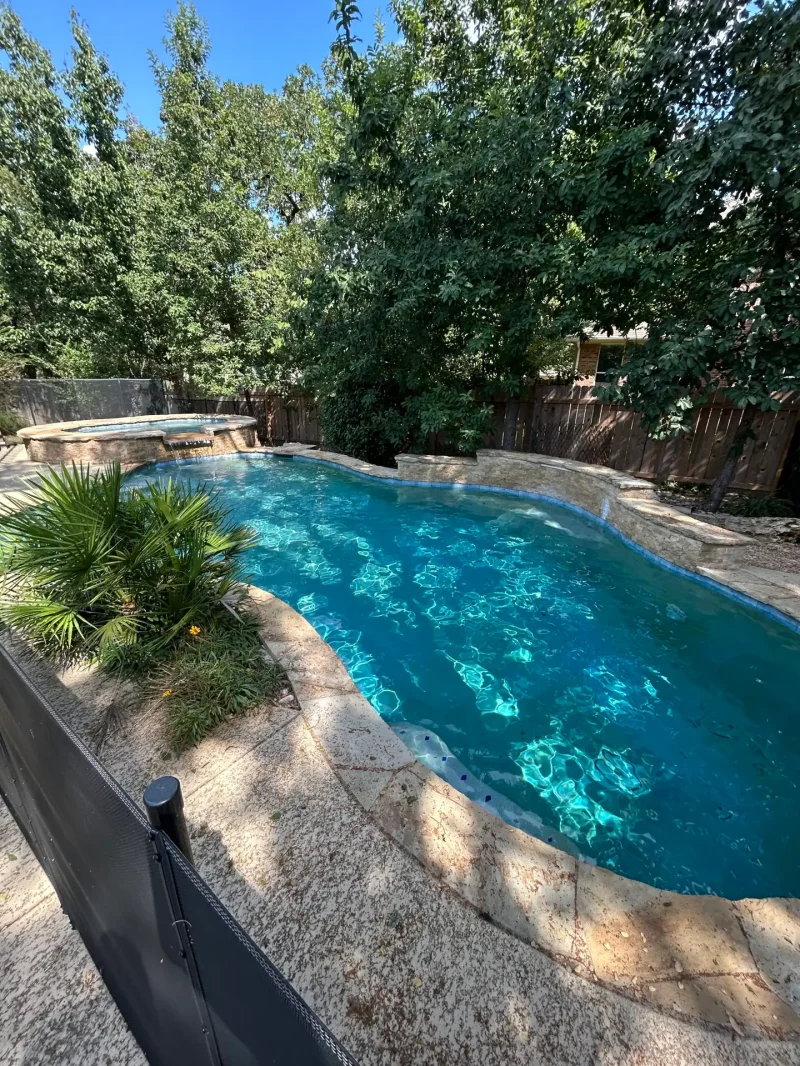
Westgate Sits Low, and Pools Feel It
Westgate lies in the C-51 Basin. The county’s own redevelopment plan for the area calls it one of the lowest-lying parts of Palm Beach County, and says drainage and flooding affect many residents. A drainage canal runs through the western part of the neighborhood, but there’s no lake, lagoon or ocean frontage anywhere in it.
For a pool owner, low ground means two things. Heavy rain changes the water quickly, and the soil around the pool can stay soaked for days after a wet spell. Both shape how we look after a pool here.
What a Downpour Does to the Water
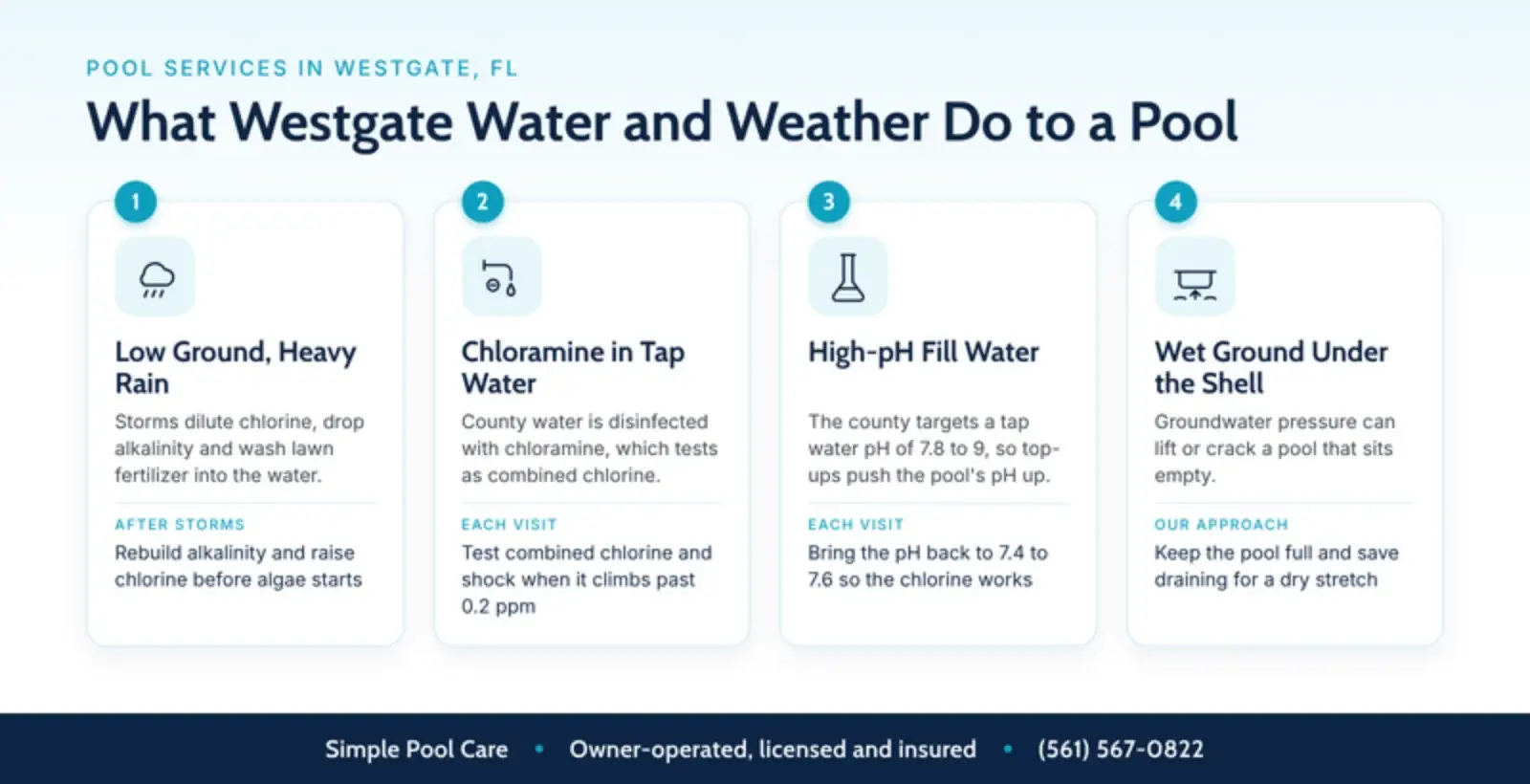
When a storm parks over Westgate, the rain thins out the chlorine and can sink total alkalinity in a single afternoon. Once the alkalinity is low, the pH starts bouncing with every chemical you add. Rain also carries leaves, soil and lawn fertilizer in from the yard, and fertilizer brings phosphates and nitrates that algae feed on.
That’s how a week of storms turns clear water dull and then green. So after a big one, we clear the debris, test everything, rebuild the alkalinity and push the chlorine up before algae gets a start. If the water has already turned, a green to clean recovery comes first, and most pools are back in use inside 24 to 72 hours, usually with the water left in.
Why We Don't Rush to Drain a Pool Here
An in-ground pool is a heavy shell sitting in wet ground. Full of water, its own weight holds it in place. Empty it while the groundwater is high, though, and the pressure pushing up from below can lift or crack the shell. Many pools have a hydrostatic relief valve set into the deepest point of the floor. It opens to let groundwater in and take the pressure off.
That’s why draining is a last resort in Westgate, and a drain job is best timed for a dry stretch. Most stains, scale and green water can come out while the pool stays full. When a pool truly needs emptying, for an acid wash or a resurface, we answer the groundwater question before anything else.
What Comes Out of the Hose in Westgate
Westgate is unincorporated county, so Palm Beach County Water Utilities supplies its tap water. The county’s 2025 water quality report says the eastern system draws from the Biscayne Aquifer, about 150 feet down. It treats that water with lime softening and ion exchange, nanofiltration or reverse osmosis, depending on the source. Three details in that report matter for a pool.
Softened Fill Water Changes the Scale Story
Plenty of people assume an inland neighborhood means hard water. In fact, the county softens its water at the plant before it reaches your hose. That doesn’t make a pool scale-proof, though. Each time the sun evaporates an inch, pure water leaves and the minerals stay behind. Then the top-up adds a little more, so calcium and dissolved solids creep up season after season.
Softer water also cuts the other way. When calcium hardness is low and the pH or alkalinity slips with it, the water turns aggressive and starts dissolving the calcium in plaster and grout. Our target for calcium hardness is 200 to 400 ppm, and we test it instead of guessing. If the waterline has already crusted over, pool tile cleaning takes care of it.
Chloramine Reads as Combined Chlorine
The county disinfects water in its eastern system with chloramine, a blend of chlorine and ammonia. It suits water mains, because the water travels a long way through the system before anyone drinks it. In a pool, however, it’s far too slow to sanitize. Worse, your test kit counts it as combined chlorine, the same number swimmer waste produces.
After a big refill or a long top-up, then, the combined chlorine number can jump. Ideally it reads zero, and 0.2 ppm is the ceiling. Clearing it means raising free chlorine to roughly 10 times the combined chlorine number. Twice a year, the county also switches to plain chlorine for a while to clean its pipes, so fill water can test differently from one month to the next.
Tap Water pH Runs Higher Than a Pool Wants
The same report gives a pH target of 7.8 to 9 for eastern customers. That suits pipes, but a pool sanitizes best at 7.4 to 7.6. With the pH at 7.5, about half of your free chlorine is the strong, fast-acting kind. Once it drifts up to 7.8, the strong share drops to roughly a third. So after a big top-up, a pool can show a fine chlorine reading while doing much less work.
Lowering it again with acid is part of every weekly visit. Here’s how Westgate tap water compares with the numbers we keep a pool at.
| Reading | Westgate tap water | Pool target |
|---|---|---|
| pH | 7.8 to 9 (county target) | 7.4 to 7.6 |
| Disinfectant | Chloramine | Free chlorine held at 2 to 4 ppm |
| Combined chlorine | Chloramine reads as combined | Ideally 0, 0.2 ppm maximum |
| Calcium hardness | Softened at the plant | 200 to 400 ppm |
| Source | Biscayne Aquifer, about 150 feet down | Topped up from the tap |
Older Neighborhood, Younger Households
Westgate started in 1921 as the Westgate Estates subdivision, and the county describes Westgate Estates as one-story, mostly single-family homes. A century of building and rebuilding means pools and equipment pads here come in every age and layout. We don’t assume anything about yours until we’ve looked at it.
It’s also a young neighborhood. The 2020 census put the median age at about 31, and nearly half of Westgate households had children under 18. Only 4.6 percent of homes sat vacant, so most pools here see use all year instead of sitting closed for a season.
Kids in the Water Most Afternoons
A pool full of kids every afternoon needs more chlorine than one that sits quiet. Sweat and urine react with chlorine to form combined chlorine, and that’s what stings eyes and gives off the strong “pool smell.” Sunscreen and body oils use up chlorine as well. A quick rinse before swimming cuts how much of it gets in. On each visit we check the combined reading and shock when it calls for it.
What the County Requires Around a Pool
Palm Beach County code requires a barrier around every swimming pool, and the county’s hurricane guide warns of fines of up to $1,000 a day for not complying. The Consumer Product Safety Commission’s barrier guidelines call for a barrier at least 48 inches high, no opening a 4-inch ball could pass through, and gates that close and latch by themselves.
Storms are hard on screen enclosures and fences. If a panel blows out or a gate stops latching, get it fixed before anyone swims.
A Weekly Visit at a Westgate Pool
The visit runs in the same order every week. First comes the water: chlorine (free and combined), pH, alkalinity, calcium and stabilizer, all corrected before we leave. Then the cleaning, which means skimming, brushing the walls and tile line, vacuuming and clearing out both baskets. Last is the equipment: filter pressure, pump sound, the heater and the salt cell if there is one.
Stabilizer needs closer watching on a pool that gets topped up often. Cyanuric acid shields chlorine from the sun, which can burn off half of unprotected chlorine in under an hour. We keep it around 30 to 50 ppm. Rain and top-ups dilute it, while trichlor tablets keep adding more, so we test it rather than assume.
Run time is the other quiet factor. One turnover cleans roughly 63 percent of the water, since clean water blends back into the rest. Getting to about 98 percent takes about four turnovers. So in the rainy season, when runoff and debris load the water, a timer cut short to save power is a common reason a pool goes cloudy.
Pool Services in Westgate We Handle
Our pool services in Westgate start with the weekly visit. Most customers call us when the pool needs something more, whether that’s a pump that won’t prime or a heater that won’t light.
Weekly Pool Cleaning in Westgate
Weekly visits are the heart of our pool cleaning, and two filter cleans a year come with full service. You can read the full checklist on our weekly pool service page.
Pool Repair in Westgate
When something stops working, we find the fault and price it before touching anything. Most pool repairs land somewhere from $100 to $800. Expect about $150 with labor for a pump capacitor and $250 to $600 for a motor or shaft seal. When a pump hums without starting, or screams while it runs, that’s a pool pump repair call.
New Pool Equipment in Westgate
Our pool equipment installations cover pumps, heaters, filters and automation, and quotes are free. Installed, a variable speed pump is $1,500 to $2,800, and it lets you run the filter longer for less power. Filters are $300 to $1,000 installed. For heat, gas heaters are $2,000 to $4,000 and heat pumps are $3,000 to $7,500.
Because Westgate is unincorporated, any permit for gas or electrical pool work comes from the Palm Beach County Building Division rather than a city office.
Specialty Pool Jobs in Westgate
Our specialty pool services cover the one-time work. Green pool cleanups run $250 to $800. Acid washes run $300 to $700, and draining, when the pool needs it, adds $150 to $250. A saltwater conversion is $1,500 to $3,000, after which our salt systems work keeps the cell checked. Plan on new filter sand every 5 to 7 years.
Getting a Westgate Pool Ready for Storm Season
Hurricane season brings the worst of everything above: days of rain, flooded streets, a yard full of debris and sometimes no power. The county’s hurricane planning guide asks residents to secure patio and yard furniture and to keep the property clear of anything that could become a wind-borne missile.
For the pool itself, keep the water in. A full pool is far harder to shift than an empty one, especially in ground that’s already waterlogged. Turn the pump and heater off at the breaker before the storm arrives, and leave them off if the equipment pad floods.
Afterward, expect low chlorine, low alkalinity and a skimmer full of debris. The pool needs netting, a filter check, a full test and a strong dose of chlorine. If the water has turned, it’s a recovery job before it’s a weekly one. Finally, walk the fence line and test the gates before anyone swims.
What Pool Services in Westgate Cost
Weekly full service begins at $170 a month. The price covers a visit every week, the routine chemicals and two filter cleans over the year. Chemical-only service begins at $100 a month, for owners who’d rather skim and brush themselves while we handle the water.
Your price depends on the size of the pool, whether it’s screened, how much tree cover hangs over it and the shape the water is in on day one. A green pool needs a cleanup before it can go on a weekly schedule. Weekly service runs without a contract.
Get a Quote for Pool Services in Westgate
Starting pool services in Westgate takes one conversation. Tell us about the pool and what’s going on with it. We’ll come out, look at the water and the equipment, and give you a price. Request a quote through the form, or call us at (561) 567-0822.
Our pool service company handles weekly cleaning, repair work and new equipment, so a single phone call takes care of the whole pool, from the chemistry to the pump.
Pool Services in Westgate FAQs
Answers to common questions about pool service in Westgate.
Prices and Hiring in Westgate
Weekly full service in Westgate starts at $170 a month. Chemical-only service starts at $100. Routine chemicals come with both, and full service adds a filter clean twice a year. Your exact price depends on pool size, screening, tree cover and the state of the water when you sign up.
Yes. Simple Pool Care takes weekly accounts and repair calls anywhere in Westgate, from homes off Westgate Avenue to the streets around Westgate Park and Recreation Center. If you're not sure your address falls inside Westgate, call (561) 567-0822 and we'll confirm it before booking.
Some jobs do. Westgate is unincorporated, so permits come from the Palm Beach County Building Division rather than a city office, and county rules require permits for most construction-related work. Ask about it when you get a quote, especially for a gas heater or new electrical work.
Yes. One technician handles your pool week after week, so someone knows how it normally looks, sounds and tests. That's how a change in pump noise or a slow climb in filter pressure gets caught early. Each visit also ends with a digital report of the readings and the chemicals added.
Owned and run locally, Simple Pool Care holds a license and insurance, and its Google rating is 5.0. Hayward, Pentair, Jandy and Zodiac factory training is part of the job here, chemicals are in the monthly price, and we know how county tap water and low, rain-soaked ground affect a pool. Weekly service runs without a contract.
Questions About Westgate Water and Storms
Less than people tend to assume. The county softens its water at the plant, so the fill water isn't the main source of scale. The bigger effects come from its high pH, targeted at 7.8 to 9, and the chloramine used to disinfect it. Evaporation still concentrates minerals, so we test calcium regularly.
Usually it's combined chlorine, not too much chlorine. County tap water carries chloramine, which shows up on a pool test as combined chlorine. Swimmer waste adds more. The fix is shocking the pool until free chlorine reaches roughly 10 times the combined chlorine number, which clears it.
Heavy rain dilutes the chlorine, drops the alkalinity and washes soil and lawn fertilizer into the water, and fertilizer feeds algae. Westgate sits low, so storm runoff is a real factor. Cleaning up a green pool costs $250 to $800, and swimming can usually resume within 24 to 72 hours.
No, keep the water in. A full pool's weight holds the shell down, while groundwater can push up an empty one in waterlogged ground. Secure patio furniture and loose items, as the county's hurricane guide advises, switch the equipment off at the breaker, and have the water tested afterward.
Yes. Palm Beach County code requires a barrier around every swimming pool, with fines of up to $1,000 a day for not complying. Federal safety guidelines call for a barrier at least 48 inches high, no gap a 4-inch ball could pass through, and gates that close and latch by themselves.
