
Pool Pump Repair in West Palm Beach, FL
Pool pump repair in West Palm Beach, from pool pump motor repair and start capacitors to leaking seals and lost prime. We diagnose first, quote before any work, and treat a dead pump as urgent.

Pool Pump Motor Repair Starts With a Diagnosis
The pump is the one piece of equipment the whole pool depends on. It pulls water in through the skimmer, pushes it through the filter and heater, and carries the chlorine back out through the returns. When it stops, all of that stops with it.
In our summer heat, a pool with no circulation can start to turn in a couple of days. That’s why a dead pump gets priority here. If the water has already gone green by the time we arrive, we get the pump running first and then handle the green to clean recovery.
Most pool pump repair comes down to a short list of parts: the start capacitor, the motor bearings, the mechanical shaft seal, the impeller, and the lid O-ring and unions. Variable speed drives have their own faults, and those need someone who knows the controls. We’ve been factory trained by Hayward, Pentair, Jandy and Zodiac.
Every job starts with a diagnosis, and you get the price before we touch anything. A pump that hums and won’t spin is often nothing more than a capacitor. Better to hear that from us than to pay for a pump you didn’t need.
We’re owner-operated, licensed and insured, and based here in West Palm Beach. Pump work is part of our wider pool repairs, so if the real problem turns out to be the filter or the heater, the same tech sorts that out too.
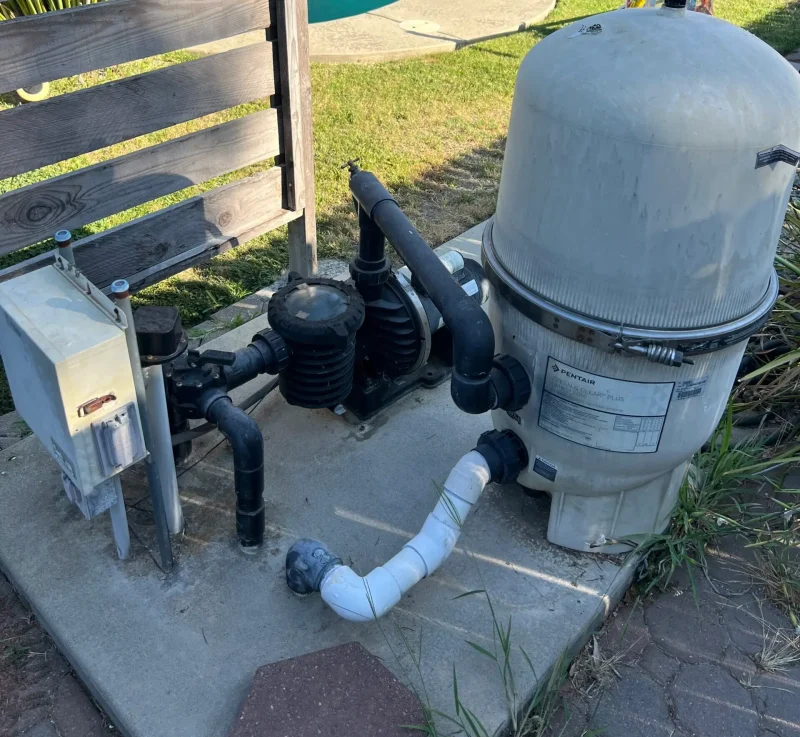
Pool Pump Repair Warning Signs and What They Mean
Pumps rarely quit without warning. Most of them change how they sound or behave first. The table matches each sign to its usual cause, and the sections under it say what to do until we get there.
| Symptom | Usual cause | Usual fix |
|---|---|---|
| Hums but won’t start | Start capacitor, low voltage or a jammed impeller | Capacitor, wiring or clearing the impeller |
| Grinding or screeching | Worn motor bearings | New bearings or a new motor |
| Water dripping under the motor | Failed mechanical shaft seal | Shaft seal replacement |
| Bubbles in the pump basket | Air getting in on the suction side | Lid O-ring, fitting or valve repair |
| Shuts off, then restarts | Thermal overload tripping on heat | Wiring, voltage or ventilation fix |
| Weak flow at the returns | Dirty filter, closed valve or clogged impeller | Clean, open or clear the restriction |
Humming but Not Starting
A hum with no spin means power is reaching the motor but the shaft isn’t turning. The start capacitor is the usual culprit. It gives the motor the kick it needs to get moving, and heat wears capacitors out. Low voltage, a loose connection or leaves wedged in the impeller can make the same noise, so we check those before we replace anything.
Switch the pump off at the breaker rather than letting it sit there humming, because a motor that can’t turn heats up fast. And if you’re looking around yourself, leave the capacitor alone. Capacitors store a charge even after the power is off.
Grinding or Screeching Noises
A grinding or screeching motor almost always means worn bearings. Bearings wear out with age, but on pumps around here the faster cause is water. When the shaft seal leaks, water runs along the shaft into the motor, and the bearings rust and start to growl. Caught early, the bearings can sometimes be replaced. More often, a motor that’s grinding loudly needs replacing, and left to run, it finishes itself off.
Not every noise comes from the motor, though. A rattle can be the pump vibrating against the pad because it isn’t fastened down. A gravelly sound with weak flow is usually cavitation, which we cover further down.
Water Leaking Between the Motor and the Pump
Water dripping from the gap between the motor and the pump body means the mechanical shaft seal has failed. That seal runs without any outside lubrication. The water moving through the pump is what keeps the seal faces cool, so a pump that runs dry, even briefly, can ruin it.
A seal leak is a repair you want done this week. On its own, it’s a modest job. Ignore it and the water reaches the motor bearings, and then it becomes a motor job. Leaks at the lid, the drain plugs or the unions are a different story. Those are usually just an O-ring or a gasket.
Losing Prime or Air in the Pump Basket
Most pool pumps here are self-priming. They can pull water up from the pool using only the water held in the pump housing, as long as no air is getting in. Bubbles in the pump basket mean air is getting in on the suction side. A pump that keeps losing prime has the same problem, only worse.
The usual causes are a low water level that lets the skimmer gulp air, a skimmer flap stuck open, a packed skimmer or pump basket, or a lid O-ring that’s dry or worn. A leak at a fitting or valve before the pump does it too, and the first fitting threaded into the pump housing is a common one. Underground suction leaks happen, but they’re rarer and harder to find.
Shutting Off and Restarting on Its Own
A pump that runs for a while, shuts off and then starts again by itself is usually tripping its thermal overload. That’s a switch inside the motor that cuts the power when it gets too hot, then resets once it cools. The overload is only doing its job, so the fix is finding out why the motor overheats.
The common reasons are undersized or very long wiring, low voltage, clogged cooling vents, or a motor baking in direct sun with no airflow. A motor that runs all day can feel hot to the touch, and that alone doesn’t mean anything is wrong. A burning smell, or a breaker that trips the moment the pump starts, is different. That one needs a tech.
Weak Flow at the Returns
If the pump runs and sounds normal but the returns are weak, the problem is usually a restriction rather than the motor. A dirty filter, a closed or half-closed valve, or debris wedged in the impeller will all cut the flow. Leaves and palm seeds slip past the pump basket more often than you’d think, especially once the basket cracks.
Impellers also wear with age. When the pressure on a clean filter sits lower than it used to, a worn impeller is one of the first things we look at.
What Cavitation Sounds Like and What Causes It
Cavitation happens when the impeller is starved of water and can’t keep up with what the pump is supposed to deliver. The sound of the pump changes, often to a rattling, gravelly noise. In bad cases, the pump and motor start to vibrate.
Cavitation is a symptom. Something on the suction side is holding the water back, so check these first:
- A full skimmer basket
- A packed pump basket
- A valve on the suction side that’s partly closed
- A leak or loose fitting in the suction plumbing
- A water level too low for the skimmer
Left running, cavitation can do serious damage to the pump, the motor or both. If your pump suddenly changes pitch, turn it off and check the baskets before anything else. Most of the time, that’s where the answer is.
What Our Pool Pump Repair Visit Covers
Every repair follows the same order, so we find the cause behind the symptom you noticed.
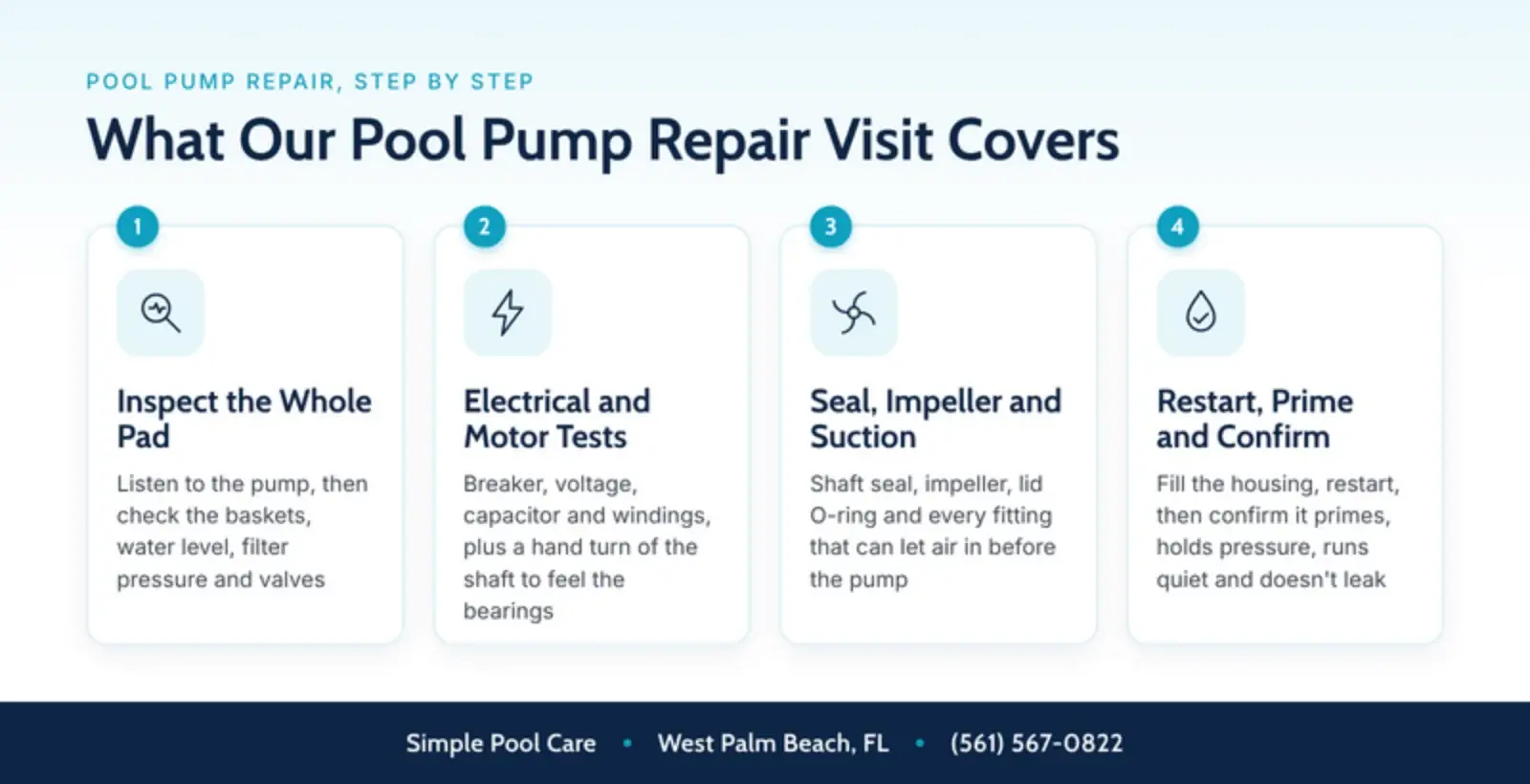
We Look at the Whole Equipment Pad
If the pump will run, we start by listening to it. Then we look at the baskets, the water level, the filter pressure and the valve positions. Plenty of pump complaints turn out to be a loaded filter or a closed valve making the pump fight for water.
Electrical and Motor Tests
We check the breaker, the timer or controls, and the voltage at the motor. Then, with the power locked off, we test the capacitor and the windings and turn the motor shaft by hand. A shaft that feels tight or rough points to bearings, a jammed impeller or a bent shaft. That tells us whether the motor is worth repairing.
Checking the Seal and Suction Side
If the pump leaks or won’t hold prime, we open it up. We check the shaft seal, the impeller and the diffuser, plus every O-ring and gasket on the suction side. Before we open anything under pressure, we shut the pump off and open the air relief valve on the filter. Skipping that step is how a lid or clamp comes loose with real force.
Restarting and Confirming Flow
After the repair, we fill the pump housing with water before restarting, so the new seal never runs dry. The lid O-ring gets a silicone-based lubricant, since petroleum products are hard on rubber. Then we watch it prime, check the filter pressure and the returns, and listen. We don’t leave until it holds prime and the drips have stopped.
Pool Pump Motor Repair: What's Worth Fixing
The motor is the expensive half of the pump, so most pool motor repair starts with one question: what can actually be fixed? A failed capacitor is a small, cheap part. Worn bearings can sometimes be replaced if the windings are still good, though on many pumps a grinding motor means a new motor. Burned windings, or a motor that’s rusted and seized inside, usually mean a new motor.
Matching the Replacement Motor
When a motor does need replacing, the new one has to match the old one’s total horsepower. That’s the nameplate horsepower multiplied by the service factor, not just the big number on the label. A smaller motor won’t move enough water. A bigger one isn’t an upgrade either, because the extra suction at the drain raises the entrapment risk.
We also photograph the motor nameplate on our first visit. It holds every spec we need to order the right part, and it’s far easier to read while the motor is still fairly new.
When the Pump Body Is the Problem
Sometimes the motor is fine and the wet end is the trouble. A cracked pump housing or lid usually can’t be sealed reliably, so that part gets replaced. On an older pump, that’s often the point where a whole new pump makes more sense.
Why Pumps Fail Early in West Palm Beach
A pump in South Florida works harder than the same pump up north. These are the local conditions behind most of the early failures we see.
Year-Round Run Hours
Pools here never close for winter, so the motor logs far more hours each year. Bearings, seals and capacitors all wear by the hour, not by the calendar.
Heat on the Equipment Pad
Pool motors are built to run in surrounding air up to about 122°F. A pad in full sun, boxed in by a fence or a tight shed, traps heat around the motor. The hotter it runs, the faster the windings wear out. Shade or a vented motor cover helps, as long as it doesn’t trap the hot air the motor pushes out.
Chlorine Tablets in the Skimmer
Dropping chlorine tablets in the skimmer basket is common here, and it’s hard on the pump. Every time the pump shuts off, that concentrated chlorine sits in the pump housing. Strong chemicals fed on the suction side corrode the shaft seal, and a leaking seal soon takes out the motor bearings. A floating dispenser, or an inline chlorinator plumbed after the filter and heater, is the better setup.
Water and Lawn Clippings at the Motor
Most pool motors are open designs that pull outside air through to cool themselves. Grass clippings and dust from mowers and leaf blowers clog those vents, and the motor runs hotter. Sprinklers aimed at the pad, or a pad that floods in a summer storm, put water into the motor. Don’t hose down the equipment, and store pool chemicals away from the motor, because their fumes corrode it.
Why a Bigger Pool Pump Isn't Better
When a pump dies, people often ask whether they should go up a size. Almost always, the answer is no.
A pump has to overcome the total dynamic head of your system. That’s the combined resistance of every pipe, fitting, valve, filter and heater the water passes through, plus the returns. A tech can measure it with a vacuum gauge before the pump and a pressure gauge after it. Size the pump to that number and it runs efficiently.
Go too big and the extra flow brings its own problems. Water pushed through the filter faster than its media is rated for raises the pressure and can let dirt slip through. Too much flow through a gas heater can cause condensation that looks like a leak. And more suction at the main drain raises the entrapment risk, which is why a bigger pump should never just be bolted onto an existing system.
Repair or Replace Your Pool Pump?
On a younger pump, repair almost always wins. A capacitor, a seal or a set of bearings costs a fraction of a new pump, and the rest of the unit still has years left in it.
Pumps here tend to need replacing at around 7 to 10 years, because they run most of the year. Once an older single-speed pump has a burned-out motor or a cracked housing, a new pump is usually the better spend.
Since July 19, 2021, federal energy rules have limited which pool pumps can be made and sold. Most single-speed and two-speed filter pumps rated at 1 total horsepower or more don’t meet the standard, so a like-for-like swap usually isn’t possible. Jandy’s guide to the DOE pool pump rules explains the details. In practice, the replacement is a variable speed pump, and our pool pump installation page covers sizing and running costs.
If the numbers are close, we lay out both, the repair and the replacement, and you choose.
What Pool Pump Repair Costs in West Palm Beach
Most pool pump repairs here land somewhere between $150 and $700, depending on the part and the pump.
A capacitor is one of the cheapest fixes, at around $150 with labor. Motor or shaft seal jobs usually run about $250 to $600. Replacement only enters the conversation with a cracked housing or a burned-out motor on an older pump. For comparison, a variable speed pump typically costs $1,500 to $2,800 installed.
We diagnose the pump first and quote before any work starts. You approve the price, then we do the repair. No part gets replaced just because swapping it was easier than testing it.
Keeping the Pump Healthy After a Repair
Most early pump failures start with something small. A packed basket, a dirty filter or a low water level makes the pump work harder every day until something gives. Our weekly pool service empties the baskets, watches the filter pressure and listens to the pump on every visit, and pool filter cleaning keeps that pressure where it belongs.
We handle pool pump repair in West Palm Beach, North Palm Beach, Palm Beach Gardens, Palm Beach and the rest of the area from Jupiter to Boynton Beach. Pump work is one part of our pool repairs, alongside spa repair, pool filter repair and pool heater repair, and every one of them is part of our full pool service in West Palm Beach.
Request a quote online or call (561) 567-0822. If the pump has stopped completely, mention it, because those calls get priority.
Pool Pump Repair FAQs
Here’s what people ask us when the pump stops, leaks or gets loud. Don’t see yours? Call (561) 567-0822.
Cost, Repair or Replace and Choosing a Company
Pool pump repair in West Palm Beach usually costs $150 to $700, depending on the part. A start capacitor is around $150 with labor, and a motor or shaft seal repair runs $250 to $600. Simple Pool Care tests the pump and quotes before any work begins.
Repair it when the pump is only a few years old and the problem is a capacitor, a seal or bearings. Replace it once an older single-speed pump has a burned-out motor or a cracked housing. Pumps here often need replacing at around 7 to 10 years, and the replacement is usually variable speed.
Pumps in West Palm Beach often need replacing at around 7 to 10 years, because pools here run all year. Heat on the equipment pad, chlorine tablets in the skimmer and seal leaks that reach the bearings shorten that. Fixing a noisy bearing or a dripping seal early buys the pump more time.
Yes. At Simple Pool Care, a dead pump gets priority, because without circulation a pool can go green fast in summer heat. Tell us the pump has stopped when you call. If it's humming, tripping the breaker or smells burnt, switch it off until we get there.
Simple Pool Care, an owner-operated pool pump repair company in West Palm Beach, is licensed, insured and rated 5.0 on Google. Our factory training covers Hayward, Pentair, Jandy and Zodiac. We test the pump before quoting, and we won't sell you a motor when a capacitor or a seal will do.
Pump Problems and Warning Signs
Usually the start capacitor, which is a small part. Low voltage, a loose wire or a seed pod stuck in the impeller produce the same sound. Turn the pump off at the breaker so the motor doesn't overheat, and don't touch the capacitor, because it can hold a charge.
Grinding or screeching usually means worn motor bearings, often because a leaking shaft seal let water reach them. A rattle can be the pump vibrating on its pad. If the noise is gravelly and the flow is weak, that's cavitation, usually from a clogged basket or a suction-side air leak.
Air is getting in on the suction side. Make sure the water reaches the middle of the skimmer mouth, both baskets are clear, and the lid O-ring is clean and lubricated with silicone. Bubbles in the pump basket confirm an air leak, often at the lid or the first fitting.
Water dripping between the motor and pump body is almost always the shaft seal. Leaks at the lid, the drain plugs or the unions are usually O-rings or gaskets. Fix a seal leak quickly, because the water runs into the motor bearings and turns a seal repair into a motor repair.
The motor is probably tripping its thermal overload, a built-in switch that cuts power when the motor overheats and resets once it cools. Common causes are low voltage, undersized wiring, clogged motor vents and direct sun on the motor. Hot to the touch alone is normal, but repeated shutoffs need a technician.
