
Pool Light Installation in West Palm Beach, FL
Pool light installation and pool light replacement in West Palm Beach, from LED retrofits in your existing niche to color-changing upgrades. We swap most lights with the pool still full, and the quote is free.

LED Pool Light Replacement, Usually Without Draining
Around here, people use the pool after dark for most of the year. Once the sun goes down, the underwater light is what lets you see the floor, the steps and the main drain. If you can’t see the bottom clearly from the deck, nobody should be swimming.
That’s why a dead, dim or yellowed light is worth fixing rather than living with. Pool light replacement is a regular part of our pool equipment installation work, alongside pumps, heaters and filters. We put in new lights, swap old incandescent and halogen fixtures for LED, and track down lights that leak or trip the GFCI.
Most of the time the pool stays full. A wet niche light sits in a housing in the pool wall. It lifts out on a coil of cord long enough to reach the deck. We do the work up there, reseat the fixture, and we usually finish in a single visit.
It’s also electrical work in and around water, and a failed underwater light is one of the most dangerous things a pool can have. So we treat it that way. We switch the power off at the breaker before anyone touches the fixture. Then we check the bonding and ground fault protection while the light is out.
We’re licensed, insured and factory trained on Hayward, Pentair, Jandy and Zodiac, and quoting is free. Call (561) 567-0822 and tell us what your light is doing.
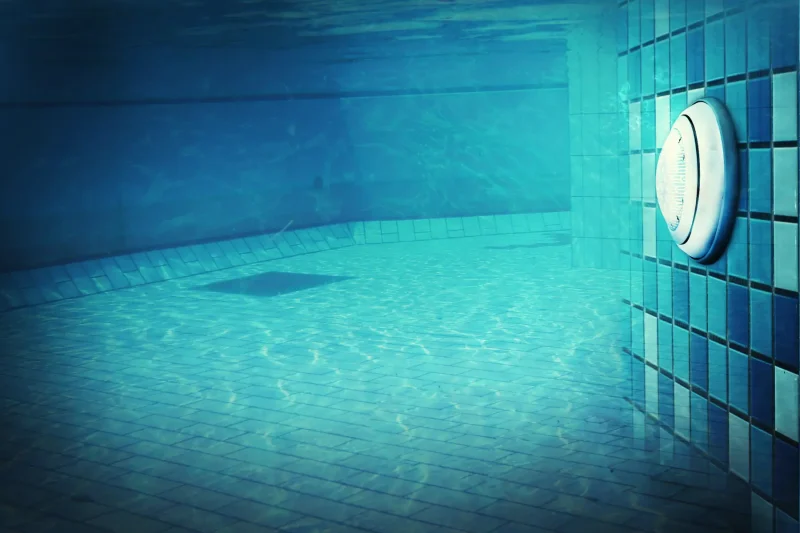
Signs Your Pool Light Needs Repair or Replacement
Most calls about lights come down to one of four things. Some need a simple pool light repair and some need a new fixture. A couple of them are safety problems, and those are the ones not to put off.
Burned Out, Flickering or Dim
Incandescent and halogen bulbs simply wear out, and a light that has gone dim or yellow is usually on its way. On an older fixture, the bulb is often the cheap part. The real question is whether the housing, lens and cord around it are still sound.
If the fixture is solid and watertight, a new LED lamp in the existing fixture can be enough. If the housing has cracks or corrosion, or lets water in, a full pool light replacement is the safer and longer-lasting choice. We look at it and tell you which one you need.
Water Inside the Lens
Water inside the fixture means a seal has failed, and that’s not a light you want running. Switch it off at the breaker and keep everyone out of the pool until somebody qualified has looked at it. In most cases, a flooded fixture needs a pool light replacement rather than a reseal.
A Light That Keeps Tripping the GFCI
A GFCI that trips when the light comes on is doing exactly the job it’s there for. It has found current leaking somewhere it shouldn’t, usually through water in the fixture, a damaged cord or a corroded connection in the junction box. Resetting it over and over isn’t the fix. Finding the leak is.
Loose in the Niche
A pool light should sit tight in its niche, with no gap between the fixture and the housing. Health inspectors check exactly that on public pools. A light that hangs out of the wall usually has a missing screw or a damaged niche, and it needs reseating properly before anyone swims.
LED Pool Light Replacement for Older Fixtures
If your pool still has its original light, it’s probably incandescent or halogen. Those draw a lot of power and burn out often. An LED pool light replacement is the upgrade most people make once the old one fails.
Incandescent and Halogen to LED
For decades, the standard residential pool light was a 120-volt incandescent or halogen fixture of 300 to 500 watts. An LED replacement uses up to 80 percent less power. It also tends to run for years where the old bulb lasted months, so you’re not back in the niche every season.
Color-Changing LED Lights
Most people replacing a light now go for a color-changing LED. These cycle through set colors and light shows, and you can sync several fixtures so the pool and spa match. If you have pool automation, or plan to add it, the lights can run on a schedule and from your phone.
Pool Light Brands We Install
We install pool and spa lights from Pentair (IntelliBrite and MicroBrite), Hayward (ColorLogic), Jandy (WaterColors) and PAL. We’ll match the light to the size of your pool and how you actually use it. Some people want a bright white for night swims, and others want color for parties.
12-Volt or 120-Volt
Not every pool light is low voltage, whatever you’ve read online. Many LED models come in both 12-volt and 120-volt versions. A 12-volt light runs off a transformer, while a 120-volt light runs on line voltage. If your pool is older, there’s a good chance yours is line voltage. That changes what the code requires on the circuit, which we explain below.
Fiber-Optic Lighting
Some pools light up through a fiber-optic system instead of a fixture in the wall. A light box at the equipment pad sends light down cables to the pool, and those systems lose brightness as they age. Converting to LED fixtures is usually worth pricing out. We’ll look at what you have and tell you whether conversion or repair makes more sense.
How Pool Light Installation Works in an Existing Niche
Most of our pool light installation work goes into a niche that’s already there. Here’s how the job runs, and why the pool doesn’t need draining.
Wet Niche and Dry Niche Lights
Underwater lights come in two types. A wet niche light sits in a housing set into the pool wall, with pool water all around it. A dry niche light sits behind a waterproof window, and you reach it from outside the pool. Almost every residential pool in Florida has wet niche lights.
Why the Pool Stays Full
Manufacturers build a wet niche fixture to come out. The cord coiled behind it is long enough to lift the light out of the wall and set it on the deck. So the work happens in the dry.
Leaving the water in also matters here, because the water table in South Florida is high. A pool drained too low can lift and float out of the ground, so we only lower the water when a damaged niche or housing calls for it. If yours does, we’ll tell you when we quote.
Our Pool Light Installation Steps
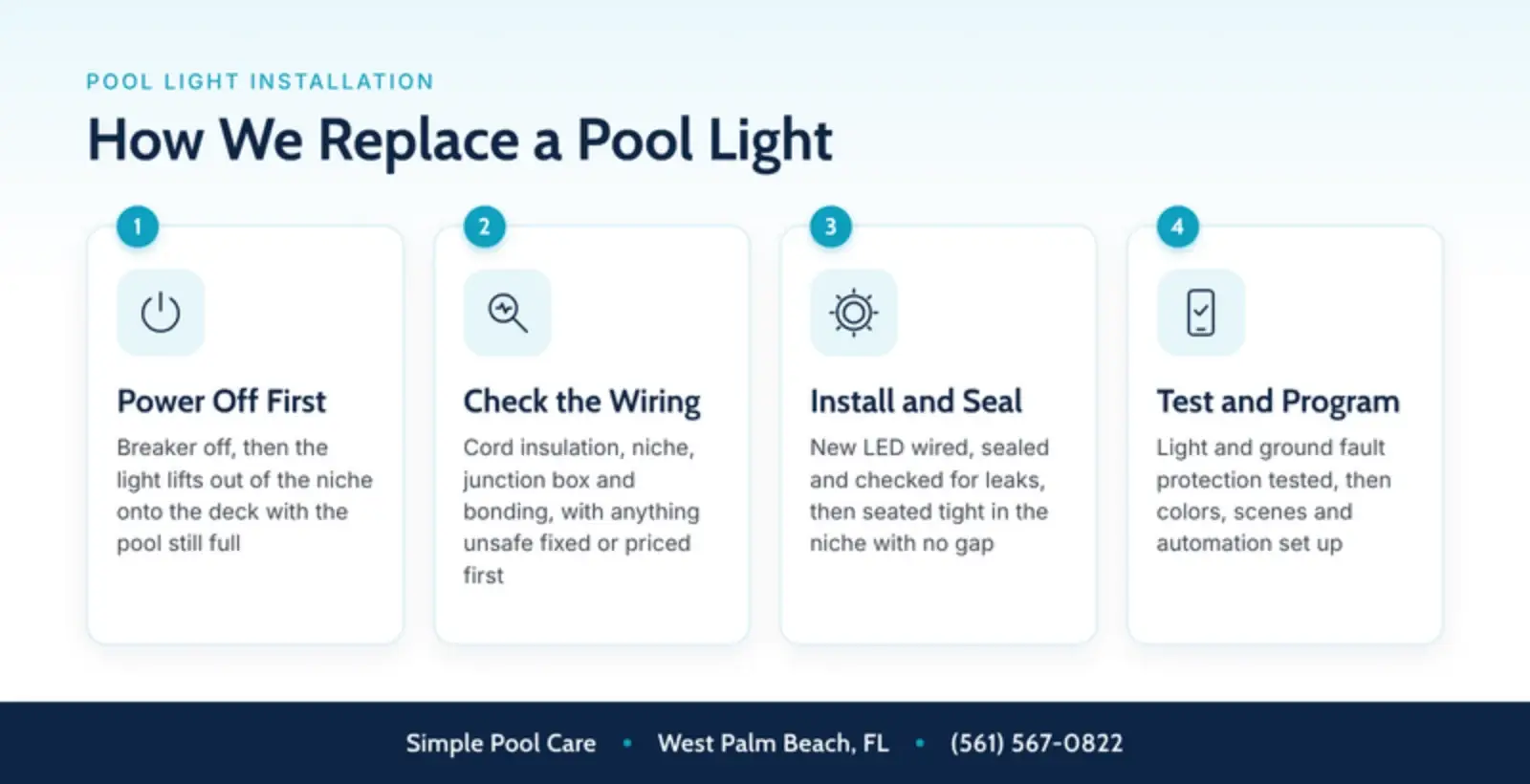
First, we switch the circuit off at the breaker. Nobody touches the fixture until that’s done. Then the light comes out of the niche and up onto the deck.
With the fixture out, we look at the cord insulation, the niche, the junction box and the bonding. Cracked insulation and corroded connections are the usual finds on older pools, and we fix anything unsafe, or price it, before the new light goes in.
Next, we wire and seal the new fixture and check it for leaks. It goes back into the niche and sits tight, with no gap around the rim.
Last, we test the light and the ground fault protection, set up colors, scenes and automation if you have them, and show you how to run it.
Pool Light Safety: Grounding, Bonding and GFCI
When something goes wrong with an underwater light, it becomes one of the most dangerous pieces of equipment in a pool. That’s why only qualified, licensed people should install, repair or replace electrical equipment around a pool. Three protections do most of the work.
Grounding
Grounding gives a fault current a low-resistance path to earth, so a short goes to ground instead of through a person. The electrical code calls for it on equipment within five feet of the pool wall, anything tied to the circulation system, junction boxes, transformer enclosures and both wet and dry niche lights.
Bonding
Bonding does a different job. A solid copper wire ties the metal around the pool to the same electrical potential: the steel in the shell and deck, ladders and handrails, pump motors and the underwater light. Any fixed metal within five feet of the pool wall needs bonding too, so there’s no voltage difference between two things a swimmer can touch.
The classic injury bonding prevents is one hand on a metal ladder and one foot against the metal ring of a faulty light. If those two sit at different voltages, the swimmer becomes the path between them.
How a GFCI Protects Swimmers
A ground fault circuit interrupter compares the current going out on a circuit with the current coming back. When the difference reaches about 5 milliamperes, it opens the circuit and cuts the shock short. For scale, at around 18 milliamperes the chest muscles can contract hard enough to stop someone breathing.
The electrical code requires GFCI protection on any underwater light running at more than 15 volts. That covers every 120-volt fixture. A 12-volt light on a transformer sits below that line.
When the Water Itself Is the Hazard
A defective underwater light can also put a charge into the water around it. Someone swimming in that water can then get a shock by touching a grounded object, without going anywhere near the light. If you ever feel a tingle in the pool, move away and get out, and avoid grabbing a metal ladder on the way. The CPSC page on electrical safety in and around pools lists the other warning signs.
Storm season brings its own rule. Get out of the pool at the first sound of thunder. A storm can also knock the power out, and a pool that suddenly goes dark at night is no place to be swimming.
Pool Light Installation on Older Pools
If your pool is more than about 30 years old, the light circuit may have no GFCI protection at all. It wasn’t always required, and plenty of pools around Palm Beach County are older than that. Spas are a similar story, because the code provision covering them only took effect in 1981, so even a fairly modern spa may not be protected.
Nothing looks wrong when this is the case. The light works, the breaker holds and nobody has a reason to look. A light replacement is the natural time to check, because the fixture is already out and we’re already working on the circuit. If you have an attached spa on the same equipment pad, we look at that light circuit too.
Code updates mostly apply to new pools, and to older ones when they’re renovated. Bringing an older pool up to current requirements is still worth doing when you can. Done a piece at a time, it costs less than doing it all at once later.
We check this on every older pool we quote. If the circuit is already protected, we’ll say so. If it isn’t, you get a price for fixing it before any work starts.
Can You Change a Pool Light Yourself?
People ask us this a lot, and the honest answer is that it’s not a good DIY job. Pool lights are electrical work in water, and the standard safety advice is to leave that to electricians and other specialists.
The trouble is what you can’t see from the deck: a cord with cracked insulation, a corroded junction box, a missing bond wire or a circuit with no GFCI. Get one of those wrong and the light can work perfectly while the pool becomes unsafe to swim in.
What Pool Light Installation Costs
The fixture itself runs roughly $200 to $1,500, depending on the type. White LEDs sit toward the lower end, and color-changing fixtures sit at the top.
On older pools, a corroded junction box or tired wiring can add $200 to $400 to the job. We check it and tell you before any work starts, so the price doesn’t change halfway through.
A few other things move the price. Can we reuse the niche and cord? Is the light 12-volt or 120-volt? It also depends on how many lights you have and whether you want them tied into automation. A new LED lamp in a sound fixture costs much less than a full pool light replacement.
We price it after we’ve seen the light and the wiring, and the quote is free.
Pool Light Installation Alongside the Rest of the Pad
A new light is often one piece of a bigger refresh. If the pad is getting older, it can make sense to look at pool pump installation, pool heater installation or pool filter installation at the same visit. Pool automation can then run the lights, pump and heater on one schedule.
Light work is part of our pool equipment installation services and our wider pool service in West Palm Beach. Call (561) 567-0822 or request a quote online, and we’ll look at the light before we give you a number.
Pool Light Installation FAQs
Here’s what people ask us most about pool lights. Don’t see yours? Call (561) 567-0822.
Cost, Upgrades and Choosing an Installer
Pool light installation cost depends mostly on the fixture, which runs roughly $200 to $1,500. Color-changing models cost the most. On older pools, replacing a corroded junction box or tired wiring can add $200 to $400. Simple Pool Care quotes free after seeing the light, niche and wiring.
Yes, in most cases. Most residential pools here have wet niche lights, and the fixture lifts out of the wall on a coil of cord long enough to reach the deck. We work on it there and reseat it with the pool full. The water only needs lowering if the niche itself has damage.
For most pools, yes. An LED uses up to 80 percent less power than an old incandescent or halogen light, and it typically runs for years where the old bulb lasted months. Color-changing models add scenes and light shows, and pool automation can run them on a schedule.
Yes, with the right lights and controller. Color-changing LEDs from Pentair, Hayward and Jandy work with those brands' automation systems, so you can change colors, run scenes and set schedules from your phone. Simple Pool Care installs and programs both, often on the equipment you already have.
Simple Pool Care is owner-operated, licensed and insured, holds a 5.0 Google rating and is factory trained on Hayward, Pentair, Jandy and Zodiac. On every light job we shut the power off first and check the cord, junction box and bonding. On older pools, we also check for GFCI protection. The quote is free.
Pool Light Safety and Common Problems
It can if the light is defective and the circuit isn't protected. A faulty underwater light can charge the water around it, so a swimmer touching a grounded object can get a shock. Proper bonding, grounding and a GFCI that cuts power at about 5 milliamperes are what keep a pool light safe.
The usual causes are a failed bulb or LED, water inside the fixture, a tripped GFCI, a bad transformer on a 12-volt light, or corroded connections in the junction box. If the GFCI trips every time the light comes on, leave it off. Current is leaking somewhere and needs finding before anyone swims.
Yes. Water in the fixture means the seal has failed, and it can let current leak where it shouldn't. Turn the light off at the breaker, keep everyone out of the pool and have it checked. We usually replace a flooded fixture rather than reseal it.
Some are, but many aren't. Newer installs often use 12-volt lights on a transformer, while for decades the standard residential light was a 120-volt incandescent or halogen fixture. The electrical code requires GFCI protection on any underwater light running above 15 volts, which includes every 120-volt light.
We don't recommend it. Pool lights are electrical work in water, and the standard safety advice is to leave that to electricians and other specialists. The risk sits in what you can't see: cracked cord insulation, a corroded junction box, a missing bond wire or an older circuit without GFCI protection.
