
Pool Services in Riviera Beach, FL
Pool services in Riviera Beach, from Singer Island condos to mainland homes along the Lake Worth Lagoon. Weekly care runs from $170 a month, chemicals included. Every visit, we check the equipment pad for salt damage.

Pool Service in Riviera Beach, on the Island and the Mainland
For a pool, Riviera Beach is really two places. Most of Singer Island sits inside the city, with the Atlantic on one side and the Lake Worth Lagoon on the other. The mainland starts on the lagoon’s west shore and runs inland from there. Both sides share a water utility and a hurricane season, but not the same salt exposure.
That split decides a lot of the work. Ocean water mixes into the lagoon through the inlet. So an equipment pad on the island takes salt air from both directions. Mainland pads near the shoreline get it from one side, while streets further inland see less of it.
We’re owner-operated, licensed and insured, and rated 5.0 on Google. Every tech is factory trained on Hayward, Pentair, Jandy and Zodiac gear. Whatever pump, heater or automation sits on your pad, it’s equipment we know well.
Each week we balance the water and clean the pool. Then we inspect the pump, filter, heater and salt cell, which is where salt air does its damage. A written report follows every visit. That helps when you spend part of the year somewhere else, as plenty of owners here do.
Plans run from $100 a month for chemical-only to $170 for full service, and the chemicals are part of the price either way. If something on the pad has already failed, we diagnose it first. You get a price before any work starts.
What Shapes Pool Services in Riviera Beach
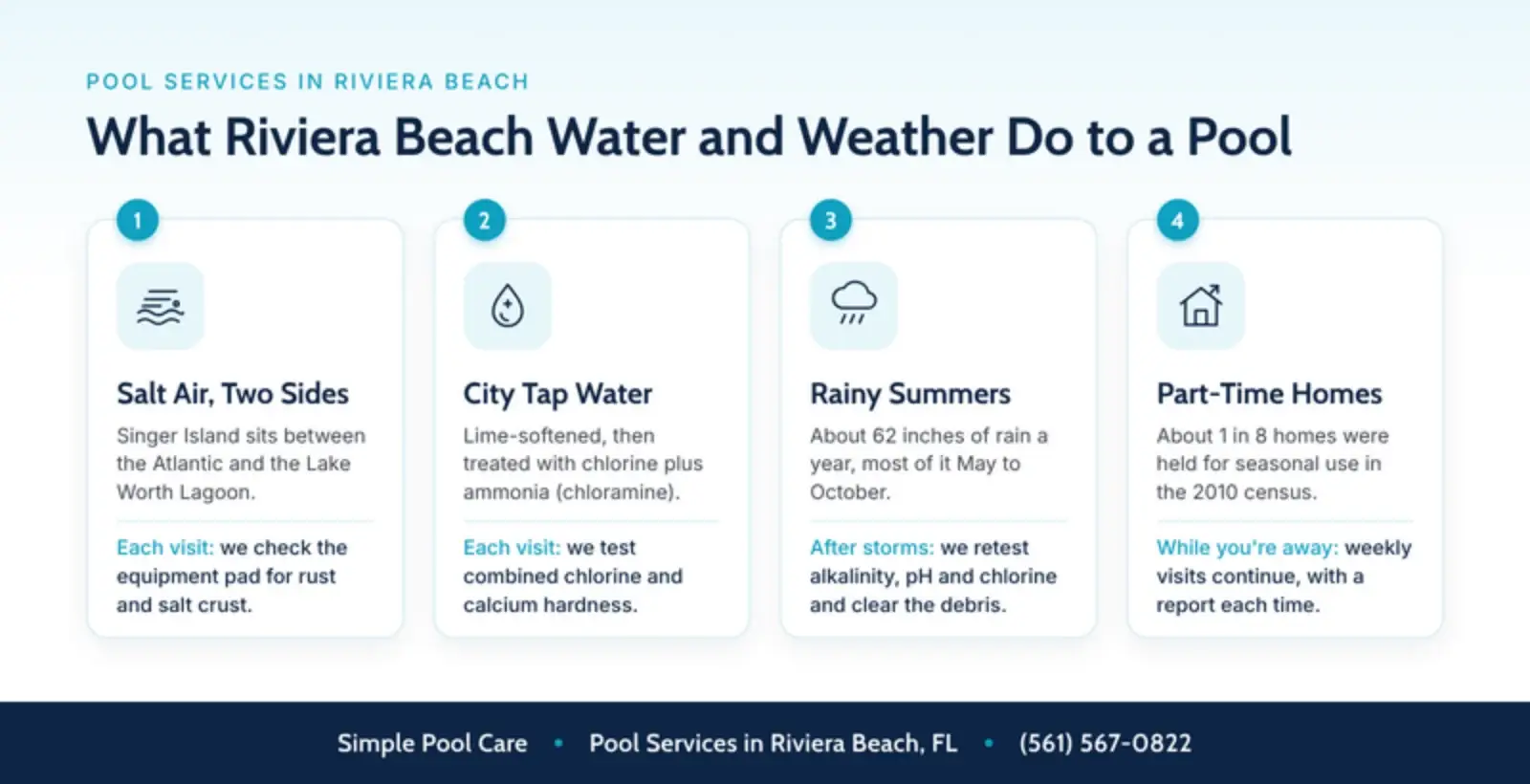
Four local conditions decide how a pool here behaves between visits. Salt air and the way the city treats its water come first. Then add the summer rain and the number of part-time homes. Each one changes what a weekly visit has to cover.
Salt Air From Two Directions
On Singer Island, the wind crosses salt water whichever way it blows. An east wind carries spray off the Atlantic. A west wind comes across the lagoon, which takes in seawater through the inlet. Lagoon-front homes on the mainland get the same exposure from one side.
Salt air corrodes exposed metal on an equipment pad: screws, heater cabinets, motor housings and electrical boxes. It also builds up on the fins of a heat pump coil. That matters, because a heat pump makes its heat by pulling it out of the air moving across the coil. So on the island and along the water, we look at the pad every visit. When rust starts, we tell you then, instead of waiting for a part to quit.
Lime-Softened City Water and Chloramine
Riviera Beach pumps its water from 27 wells in the surficial aquifer and treats it at a lime-softening plant. Softening strips out part of the calcium before the water reaches your hose. So fill water here starts softer than raw well water.
That cuts both ways. Evaporation still leaves minerals behind as you top up through the summer, so calcium slowly climbs. Let it run too low, though, and the water turns corrosive. It etches plaster and attacks heater parts. So we never guess at calcium hardness. We test it every visit and hold it around 200 to 400 ppm.
The city also disinfects with chlorine and ammonia, which forms chloramine. On a pool test kit, chloramine shows up as combined chlorine. Chlorine takes that same form once it has reacted with sweat and other swimmer waste. Chloramine does fine in a water main, where the water spends days in the pipes. In a pool it’s far too slow to keep up with swimmers. A one or two inch top-up barely registers. After a drain and refill, the new water can show combined chlorine from day one. So we shock it to breakpoint. That means pushing free chlorine up to about ten times the combined chlorine number.
Topping Up Between Visits
Sun and wind pull water out of a pool every day, and more of it in summer. The water that leaves is pure, so its minerals and salts stay behind in the pool. Each top-up then adds a little more. Over a season, total dissolved solids creep up. Once TDS reads about 1,500 ppm higher than it did at start-up, part of the water needs replacing.
If the level drops much faster than usual week after week, the pool may be leaking rather than evaporating. A bucket of pool water set on the steps tells you which. Mark both water lines and compare them a day later. When the pool drops faster than the bucket, the extra loss is a leak. If both drop the same, it’s just the weather, and you don’t need us for that.
Heavy Rain From May to October
This stretch of coast averages about 62 inches of rain a year. Most of it falls from May through October. One hard afternoon storm waters the chlorine down, and it can drag total alkalinity with it. With the buffer gone, the pH swings. Storms also wash leaves, grass clippings and fertilizer into an open pool.
So after heavy rain we test alkalinity first, then pH and chlorine. We also skim out the debris before it sinks and feeds algae. Rain dilutes the salt in a saltwater pool too. That’s why the salt reading drifts down through the wet season.
Riviera Beach Tap Water Next to Pool Targets
These figures come from the city’s 2025 water quality report for your top-up water. The right column shows the range we balance a pool to.
| Reading | Riviera Beach tap water (2025 report) | Pool target |
|---|---|---|
| Disinfectant | Chlorine plus ammonia (chloramine), running annual average 2.87 ppm | Free chlorine 2 to 4 ppm; combined chlorine 0, never above 0.2 ppm |
| Hardness | Lime-softened at the plant; no figure in the report | Calcium hardness 200 to 400 ppm |
| Stabilizer | Not listed in the report | Cyanuric acid 30 to 50 ppm |
| Sodium | 25.6 ppm (2023 sample) | Salt pools 3,000 to 3,500 ppm |
The chlorine in tap water is combined chlorine, so it doesn’t count toward the free chlorine a pool needs. A fresh fill can show plenty of total chlorine on a test and still need a shock. Draining also sends the stabilizer out with the old water. In full sun, unprotected chlorine is half gone inside an hour. So after any big refill we add cyanuric acid back, aiming for 30 to 50 ppm.
Pool Care on Singer Island and the Mainland
Which side of the lagoon you live on changes how much of each visit goes to the equipment pad.
Singer Island Pools
Most of Singer Island lies inside Riviera Beach. That runs from the condo towers on the ocean to the homes near Ocean Reef Park and the municipal beach. Pools out here range from single-family backyards to the shared pools at oceanfront condos.
Salt exposure is constant on the island, and a lot of owners are only here part of the year. The 2010 census put about one Riviera Beach home in eight in its seasonal-use category. An empty house still has a pool that needs chlorine every week. That’s especially true in the hot, wet months, when many seasonal owners are up north.
The city’s code enforcement guide also expects a pool to be kept clean and sanitary. So a pool left to turn green behind a closed-up house can become a code matter as well as a cleanup. We keep the same weekly schedule while you’re away and send the report after each visit.
Mainland Pools Along the Lagoon
On the mainland, homes near the marina and the lagoon shore get salt air off the water, just from one side. Inland streets see less of it. There, the weekly work leans more toward leaves, pollen and the summer rain.
A screened pool keeps most of that out of the water. The city requires either a fence or a screen enclosure around a pool. Gates and screen doors have to close and latch on their own, and torn or missing screens should be repaired.
Hurricane Prep for Riviera Beach Pools
The city’s homeowner guide lists four pool steps before a hurricane. Don’t drain the pool completely. Turn off power to the pool equipment, cover the pump if it sits in the open and add extra chlorine.
The first rule matters more than it sounds. Near the coast the water table sits high, and heavy rain pushes it higher. Groundwater presses up on the underside of the shell. With the water gone, an empty shell can pop up out of the ground. Many in-ground pools have a hydrostatic relief valve at the deepest point to release that pressure. Still, a storm is not the time to count on it.
After the storm passes, we clear the debris and look the pad over for water damage before the power goes back on. Then we rebalance the water, starting with alkalinity and chlorine.
Our Pool Services in Riviera Beach
Weekly visits are the core of the work. On this stretch of coast, though, the equipment side earns more of our attention than it would a few miles inland.
Pool Cleaning in Riviera Beach
Our weekly pool service means a tested and balanced pool, a skim, brush and vacuum, emptied baskets and a look over the equipment. It’s the backbone of our pool cleaning work. Full service also adds filter cleaning twice a year. On the island, the equipment check includes looking for fresh rust and salt crust on the pad.
Pool Repairs in Riviera Beach
When a pump hums but won’t start, or a heater shows an error code, we find the cause first. Then we quote the fix, and most pool repairs run $100 to $800. Pumps and heaters lead the repair searches in this city. The pool pump repair page covers the usual pump faults, and heaters have their own page on pool heater repair.
Equipment Installations
Salt air shortens the life of metal parts, so sometimes a replacement makes more sense than another repair. A variable speed pump costs $1,500 to $2,800 with installation. A heat pump runs $3,000 to $7,500, and a new filter $300 to $1,000. Quotes for pool equipment installations are free.
Salt Pools and Green Pool Recovery
A salt pool holds a salt level of about 3,000 to 3,500 ppm, roughly a tenth of seawater. That salt raises total dissolved solids. High TDS raises the odds of galvanic corrosion where two different metals share the water, for example a copper heat exchanger and the metal impeller in a pump. So a salt pool near salt air needs balanced water inside and a close eye on the pad outside.
Salt systems also need the cell inspected and the salt topped up, since backwash, rain and splash-out all carry salt away. A pool that went green while the house sat empty starts with green to clean. Most are clear enough to swim in 24 to 72 hours, usually with no draining. Acid washes, automation and other specialty pool services have their own pages.
What a Weekly Visit Covers Here
Every visit starts with the water. Our test covers chlorine, both free and combined, plus pH, alkalinity, stabilizer, calcium hardness and, on salt pools, salt. Then we correct whatever has drifted. We’re after free chlorine of 2 to 4 ppm, pH sitting at 7.4 to 7.6 and alkalinity close to 80 to 120 ppm.
Cleaning comes second: skimming, a full brush of the walls, steps and waterline tile, a vacuum of the floor, then both baskets emptied, skimmer and pump. Brushing does more than it looks, because it breaks up biofilm. That’s the slime layer that shields bacteria from chlorine.
Last is the pad. The filter gauge comes first there: we backwash or clean once it reads 8 to 10 psi higher than it did when clean. We also check the pump, heater, timer, salt cell and water level. A level below the skimmer lets the pump pull air. On Singer Island and lagoon-front pads, this is where salt damage shows up first.
When we leave, you get a written report showing the test results and every chemical dose.
What Pool Services in Riviera Beach Cost
Full weekly service costs from $170 a month. Chemical-only, from $100, suits owners happy to do their own skimming and brushing. Routine chemicals come with both plans, and full service also includes a filter cleaning every six months.
The monthly price moves with how big the pool is, whether it’s screened, how many trees hang over it and what state the water is in when we take it on. If it’s green, that’s a recovery job first, at $250 to $800, and a weekly account after that.
Most repair bills come to $100 to $800. Swapping a pump capacitor costs about $150 including labor, while replacing a motor or shaft seal runs $250 to $600. Heater repairs fall between $200 and $800. We diagnose every repair and quote it first.
Request Pool Services in Riviera Beach
Request a quote or call (561) 567-0822. Tell us whether you’re on Singer Island or the mainland and whether the pool runs on salt or chlorine. Let us know when you’re in town, too. We’ll look at the pool before we price it.
For the bigger picture, the home page for our pool service company covers every service we run.
Pool Services in Riviera Beach FAQs
Questions Riviera Beach homeowners ask us about pool care. Don’t see yours? Call (561) 567-0822.
Cost and Weekly Service in Riviera Beach
Full weekly pool service in Riviera Beach costs from $170 a month, and chemical-only from $100. Routine chemicals come with both plans, and on full service we clean the filter twice yearly. Most repair bills come to $100 to $800, quoted before we start.
Yes. Most of Singer Island is inside Riviera Beach, and we look after pools there every week. Island pads catch salt air off the Atlantic and off the lagoon. So on every visit we check the equipment for rust and salt crust, along with testing, brushing and vacuuming.
Yes. Plenty of Riviera Beach homes are closed up for months at a time, and the pool still needs chlorine every week. We keep the same weekly schedule whether you're home or not. After each visit we send a report, so you can see the readings from anywhere.
Summer downpours thin out the chlorine, pull total alkalinity down and rinse leaves and fertilizer into the pool. Warm water lets algae grow fast, so a pool that misses a week in the rainy season can turn. Green to clean recovery costs $250 to $800, and most pools clear up in 24 to 72 hours.
Simple Pool Care is a licensed, insured and owner-operated company, rated 5.0 on Google. Our techs carry factory training on Hayward, Pentair, Jandy and Zodiac. The monthly price includes chemicals, and every visit ends with a report. On island and lagoon-front homes, we also check the pad for salt damage each week.
What Local Water and Weather Do
Less than raw well water would be. The city lime-softens its water, which removes part of the calcium before it reaches your tap. Evaporation still concentrates minerals as you top up through the summer. So we test calcium hardness every visit and hold it near 200 to 400 ppm to avoid scale and corrosive water.
Yes, mostly after a big refill. The city disinfects with chlorine and ammonia, which forms chloramine, and a pool test reads that as combined chlorine. It sanitizes too slowly for a pool. Small top-ups barely matter, but after a drain and refill we shock past breakpoint and add stabilizer back.
Yes, especially on Singer Island, where the wind comes off salt water from both sides. Salt air corrodes exposed metal on the pad, like fasteners, cabinets and motor housings. It also builds up on heat pump coils. We check the pad every visit and flag rust before a part fails.
No. The city's hurricane guidance says not to drain the pool completely. Near the coast the water table sits high, and groundwater can push an empty pool up out of the ground. Instead, cut power to the pool equipment, cover an exposed pump and add extra chlorine.
Yes. Pump and heater repairs are the jobs Riviera Beach homeowners search for most. A pump capacitor costs about $150 including labor, and replacing a motor or shaft seal $250 to $600. Heater repairs fall between $200 and $800. We diagnose every job and quote it first.
