Pool Service in Palm Beach, FL for Island Homes
Pool service in Palm Beach for homes on the island, which is never more than three-quarters of a mile wide. Weekly cleaning, water testing and equipment care in salt air, with chemicals included.

Pool Service on Palm Beach Island, Ocean to Lagoon
This page covers pool service in Palm Beach, the island town between the Atlantic and the Lake Worth Lagoon. In places the island narrows to 500 feet, and no part of it is more than three-quarters of a mile across. So every pool here lives close to salt water on both sides.
That changes the job in small ways that add up. Salt air reaches the equipment from the ocean and from the lagoon. Wind across an open deck pulls water out of the pool faster. Then the tap water used to top it up carries chloramine from the treatment plant, and that shows up on a pool test.
The calendar matters too. About 9,200 people live in town year-round, and the count climbs to around 25,000 from November through April. So plenty of pools sit with nobody home through the hot, rainy months, when algae has the easiest time. Weekly visits keep going either way, with a report after each one.
Licensed, insured and owner-operated, Simple Pool Care holds a 5.0 average on Google. Our technicians trained at the factory with Hayward, Pentair, Jandy and Zodiac. You get one technician on your pool every week, so the person testing the water also knows how your pump normally sounds.
Our plans start at $100 a month for chemical-only and $170 for full service, with routine chemicals in the price. On full service we also clean the filter twice a year at no extra charge. That covers the whole town, from the North End above The Breakers down past Sloan’s Curve.
What the Island Means for Pool Service in Palm Beach
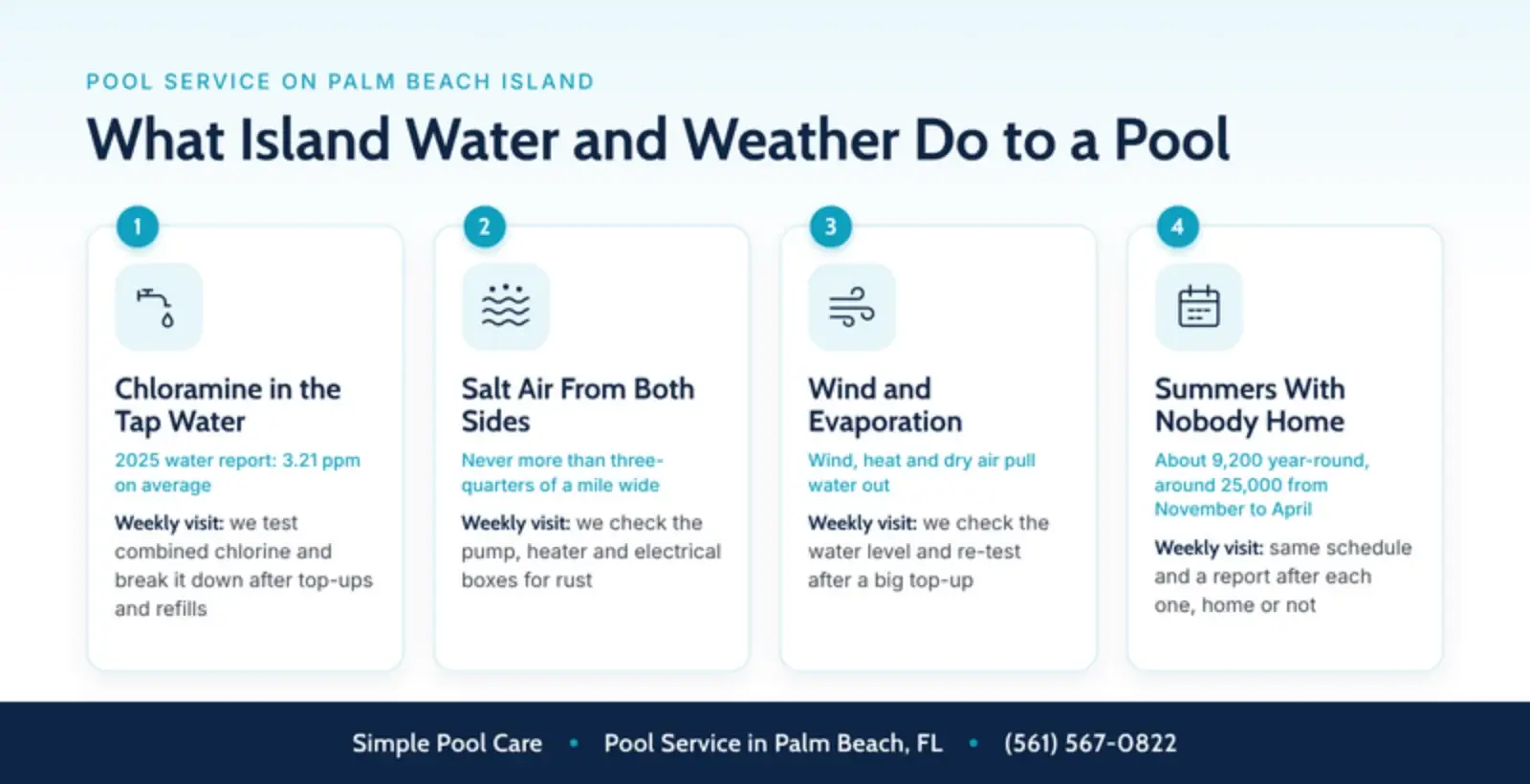
Four things set island pools apart: the tap water, the salt air, the wind and the calendar. None of them is a crisis alone. Together, though, they decide what we test on each visit and what we look for on the equipment pad.
Tap Water That Arrives With Chloramine
The island’s water supplier collects rain in lakes on the mainland, softens it with lime, filters it, then disinfects it with UV light and chloramine. Chloramine is chlorine bound to ammonia. It lasts through the long trip from the plant to your tap, which is why utilities use it. Pool water needs a faster sanitizer, so in a pool chloramine is mostly dead weight.
Pool tests count chloramine as combined chlorine, and a pool should carry close to none. The limit is 0.2 ppm. The supplier’s 2025 water quality report puts chloramine in island tap water at 3.21 ppm on average, with readings from 0.5 to 4.2 ppm. Topping up a few inches brings in a small dose. Refill the whole pool after a drain or an acid wash and every gallon starts at that level.
So we test combined chlorine as well as free chlorine. When it shows up, the fix is breakpoint chlorination: lifting free chlorine to roughly ten times whatever the combined reading is, which burns the chloramine off.
The report doesn’t list hardness, so we don’t guess at it. We test calcium at the pool and aim for 200 to 400 ppm, because water short on calcium etches plaster and water with too much leaves scale on the tile and inside the heater.
| What the island’s tap water carries (2025 report) | Island tap water | Pool target |
|---|---|---|
| Chloramine (total chlorine residual) | 3.21 ppm average, 0.5 to 4.2 ppm range | Combined chlorine near 0, no more than 0.2 ppm |
| Total dissolved solids | 243 ppm | No more than 1,500 ppm above the start-up reading |
| Sodium and chloride | 30.3 ppm and 39.5 ppm | Salt pools run 3,000 to 3,500 ppm salt |
| Hardness | Not listed in the report | Calcium hardness 200 to 400 ppm, tested at the pool |
Dissolved Solids Start Low
The same report lists total dissolved solids at 243 ppm. That’s a clean starting point, since some source water arrives with 400 ppm or more. From there the number only climbs. Evaporation takes pure water out and leaves the minerals behind, and every top-up brings in a little more.
The usual rule is to keep dissolved solids within 1,500 ppm of the start-up reading. For a salt pool, the start-up reading includes its salt. Past that line the water turns tired, chlorine has more to fight, and the risk of galvanic corrosion rises wherever dissimilar metals meet, such as a copper heat exchanger. A partial drain and refill brings it back down.
Spray Off the Atlantic and the Lagoon
No spot on the island is more than about a third of a mile from salt water, and plenty of pools sit within sight of it. Spray comes off the ocean on an east wind and off the lagoon on a west wind, and it settles on everything outside, including the equipment pad.
Salt and damp air work on metal. Pump motor housings, heater cabinets, electrical boxes, timer clocks, ladder bolts and light niches all feel it. So on each visit we look over the pad as well as the water, and we tell you when rust starts instead of waiting until a part quits.
Heat pumps deserve a closer look. A heat pump pulls a steady stream of outside air across its coil to warm the pool, so on the island that coil breathes salt air whenever it runs. Keeping the coil clean and the airflow path clear of leaves and stored furniture helps it last.
Wind, Evaporation and Top-Ups
Wind, heat, low humidity and warm pool water each push evaporation up. An open deck facing the ocean or the lagoon catches a lot of wind, so the water line drops faster than it would behind a hedge or a wall.
Water that leaves by evaporation leaves its minerals in the pool, and the top-up brings new chloramine in. That’s why we re-test after a big top-up, because last week’s numbers no longer describe the water. If the level keeps falling faster than the weather explains, we’ll tell you it may be a leak.
Long Summers With Nobody Home
When the season ends in April, the town drops back toward its year-round population, and plenty of houses sit empty until fall. Those are the months with the hottest water, the most rain and the fastest algae growth. Rain thins out chlorine and can move pH and alkalinity, so an unchecked pool can turn within a week.
Weekly service doesn’t pause when you leave. Each visit ends with a written report: test numbers, chemicals used and anything odd on the pad. You can read it from wherever the summer takes you. If equipment fails while you’re away, we find the cause and send you a quote before any repair starts.
Storms also wash leaves and fertilizer from planted beds into the water, and the phosphate in fertilizer is food for algae. After a heavy rain we recheck alkalinity along with chlorine and pH, because rain can move all three.
Town Rules That Shape Pool Work on the Island
The Town of Palm Beach sets its own rules for when work can happen, and the whole island has a storm plan of its own. Both decide when certain pool jobs can happen.
Construction Hours for Equipment Jobs
Weekly cleaning is routine maintenance. Replacing equipment can be different. Under the town’s rules, any work that needs a building permit counts as construction work, and so does running construction tools.
From November 1 through April 30, the town’s posted working hours allow construction only Monday to Friday, 8 a.m. to 5 p.m., with no site noise before 9 a.m. Saturdays, Sundays and town holidays are off limits, and nothing happens from December 24 through January 1. From May through October, weekday hours run longer.
So if a heater or pump swap needs a permit, we plan the install day inside those hours and confirm the date with you first.
Hurricane Season in Evacuation Zone B
The whole town sits in Evacuation Zone B, and a forecast hurricane often means an evacuation order. When conditions turn unsafe, the town can set up roadblocks that limit access to the island.
The town’s hurricane guide asks residents to bring in or tie down loose outdoor items, and that includes pool furniture. It also runs an Emergency Re-Entry List, and you need to apply at least two days before expected landfall.
For the pool itself, the big rule is simple: don’t drain it. Groundwater can push an empty shell up and out of the ground, while a full pool stays put. After a storm, expect debris, a loaded filter and chlorine thinned out by rain. Once access reopens, that’s where the first visit starts.
What Weekly Pool Service in Palm Beach Includes
Our weekly pool service is the same visit every week, with the island’s conditions built in. Chemistry comes first.
We test free chlorine and hold it around 2 to 4 ppm, check combined chlorine for tap-water chloramine, and keep pH inside the 7.4 to 7.6 band. We also check alkalinity, calcium and stabilizer on a regular schedule. Stabilizer matters here because unprotected chlorine can lose half its strength to the sun in under an hour. We hold it around 30 to 50 ppm. Below that the sun burns chlorine off; well above it, chlorine slows down, and draining part of the pool is the only real way to bring stabilizer back down.
Then the cleaning: skimming the surface, brushing the walls and the tile line, vacuuming the floor and emptying both baskets, skimmer and pump. At the equipment we check the filter’s pressure gauge, because a filter is due for cleaning once its pressure climbs 8 to 10 psi past where it sat when clean. Our filter cleaning page covers that job in detail.
Last comes the equipment check, with an eye on corrosion, and a report with every reading and every chemical we added. That’s the pool maintenance routine, every week, whether you’re home or not.
Our Pool Services in Palm Beach
Weekly service is the base. When something on the pad breaks, or the water gets away from you, the same company handles it.
Pool Cleaning on Palm Beach Island
Our pool cleaning work on the island covers full service, chemical-only visits, filter cleaning and spa care. Evaporation leaves a mineral ring at the waterline over time, and when brushing stops shifting it, pool tile cleaning removes it with the water still in.
Pool Repairs in Palm Beach
Our pool repairs cover pumps, filters, heaters and the parts around them. Expect most repairs to land between $100 and $800. We don’t replace anything until we’ve found the fault and you’ve seen the price. On the island, corroded fittings and electrical parts are part of that list.
Pool Pump Repair in Palm Beach
If the pump hums without starting, won’t hold prime or trips the breaker, our pool pump repair service finds out why. Expect about $150 for a failed capacitor, labor included, and $250 to $600 for a new motor or shaft seal.
Pool Heater Repair on Palm Beach Island
Heaters sit outside in ocean air all year, and their cabinets, igniters and control boards feel it. Our pool heater repair work covers gas heaters and heat pumps, and most heater jobs fall in the $200 to $800 range.
Pool Equipment Installations in Palm Beach
When a part isn’t worth fixing, we handle pool equipment installations with a free quote first. Installed, variable speed pumps run $1,500 to $2,800, filters $300 to $1,000, gas heaters $2,000 to $4,000 and heat pumps $3,000 to $7,500. Permit work follows the town’s hours above.
Hot Tub Repair in Palm Beach
A spa shares the pool’s equipment pad and its salt air. For heaters, jets, blowers and pumps on a spa, see our hot tub repair service.
Green Pool Recovery in Palm Beach
If a pool turns green while you’re away or after a storm, green pool recovery is a separate job. Budget $250 to $800 for it. In most cases the water is clear and swimmable again inside 24 to 72 hours, with no drain.
Salt Systems in Palm Beach
Our salt systems work covers conversions and the salt cells that make the chlorine. A salt pool carries 3,000 to 3,500 ppm of salt, and that salt counts toward its dissolved solids from day one. A saltwater conversion is a $1,500 to $3,000 job.
What Pool Service in Palm Beach Costs
Pool service in Palm Beach starts at $100 a month on the chemical-only plan, and full service, with all the cleaning, starts at $170. Routine chemicals come with both. On full service we also clean the filter twice a year without a separate bill.
The monthly price for your pool depends on its size, whether it has a screen, and how much falls into it. An oceanfront pool with an open deck and a screened courtyard pool are different jobs, so the quote comes after a look at the pool.
Chemical-only works when someone at the house skims and brushes between visits. If the house sits empty all summer, full service makes more sense, because nobody else is there to net the leaves or brush the steps.
Repairs, installs and green pool cleanups sit outside the monthly plan. We quote each one first, using the price ranges above, so nothing shows up on a bill that you didn’t approve.
Request a Quote for Pool Service on the Island
Tell us where the pool is, who uses it and when you’re in town. Request a quote through our form, or call (561) 567-0822, and we’ll set up a time to look at it.
If you’d like the background first, start with our pool service company page.
Pool Service in Palm Beach FAQs
Answers for island pool owners on cost, tap water, storms and equipment.
Prices, Seasons and Hiring on the Island
Pool service in Palm Beach with Simple Pool Care starts at $100 a month for chemical-only and $170 for full service. Routine chemicals come with either plan, and full service folds two filter cleans a year into the price. We quote repairs and installs separately, after we find the problem.
Yes. Weekly visits continue whether anyone is home or not, and each one ends with a report listing test results and chemicals used. Summer brings the hottest water and the most rain. If equipment fails, we quote the repair before starting.
Chloramine. The island's water supplier disinfects with it, and its 2025 report shows 3.21 ppm on average. Pool tests read it as combined chlorine, which should stay at or under 0.2 ppm. So after big top-ups and refills, we test for it and break it down.
Yes, within the town's rules. Permit work counts as construction, and from November 1 to April 30 the town allows it only on weekdays, 8 a.m. to 5 p.m., with no site noise before 9 a.m. Nothing happens December 24 through January 1.
Simple Pool Care is owner-operated, local, licensed and insured, and our Google rating is 5.0. You get one technician every week and a report after each visit, and Hayward, Pentair, Jandy and Zodiac have trained us at the factory. We also test for chloramine and check equipment for salt corrosion.
Island Water, Weather and Equipment
Yes, over time. The island is never more than three-quarters of a mile wide, so spray from the ocean or the lagoon reaches every equipment pad. Salt and moisture corrode motor housings, heater cabinets and electrical boxes. We look for rust on every visit.
Leave it full, because an empty pool can float out of the ground when the water table rises. Bring in or tie down pool furniture, as the town's hurricane guide asks. The town is in Evacuation Zone B, so join its Emergency Re-Entry List early.
Heavy rain thins out chlorine and can shift pH, while wind blows in leaves that use up what's left. In warm water, algae moves fast. Budget $250 to $800 for a green pool recovery. Expect clear, swimmable water one to three days after we start.
Mostly evaporation. Wind, heat, low humidity and warm water each push it up, and open island decks catch plenty of wind. Each top-up adds chloramine, so we re-test afterward. If the level drops faster than the weather explains, a leak check comes next.
Yes. We repair gas heaters, heat pumps and hot tub equipment from Hayward, Pentair, Jandy and Zodiac. Most heater jobs fall between $200 and $800, and we diagnose and quote every job first. Salt air is hard on heater cabinets, so we check them weekly.
