
Pool Filter Cleaning in West Palm Beach, FL
Filter cleaning in West Palm Beach for cartridge, sand and DE pool filters. Every pool filter cleaning is a full teardown: we degrease and descale the media, check the seals and log a fresh clean pressure.

Pool Filter Cleaning That Goes Past a Rinse
The filter is the one piece of pool equipment most owners never open. It just sits there loading up until something gives. First the returns get weaker, then the water loses its sparkle. Meanwhile, the pump works a little harder every week to push water through it.
That’s why filter cleaning is part of our pool cleaning work. We handle cartridge, sand and DE filters, and each type needs a different job. Sand needs a backwash, DE needs a backwash and fresh powder, and cartridges come out of the tank for a wash and a soak.
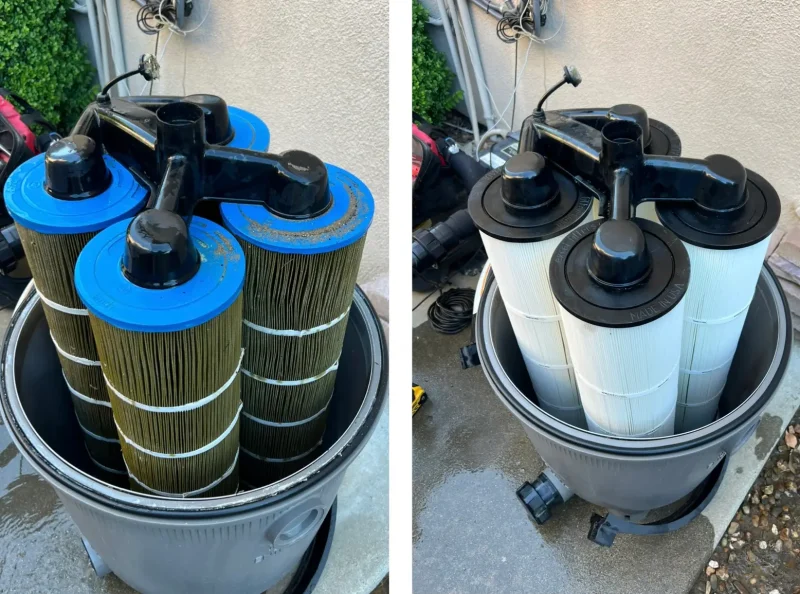
A proper clean means taking the filter apart. We pull the cartridges or grids, clean them in the right order and look over the manifold, the laterals and the tank O-ring while everything is open. Then it goes back together, and we write the new clean pressure on the tank so the gauge means something again.
If you’re on our weekly pool service, filter cleaning twice a year is already part of the plan. We quote standalone cleans by filter type and size before we start.
Sometimes the teardown turns up a torn grid, a cracked manifold or a broken lateral. That’s pool filter repair, not cleaning, so we show you the part and quote the fix before doing anything.
When a Pool Filter Needs Cleaning
There’s a number for this, and it isn’t on the calendar. It’s on the pressure gauge on top of the filter tank. Most homeowners never look at it, which is a shame, because it tells you more than the water does.
Reading the Pressure Gauge
Clean the filter once the gauge sits 8 to 10 psi higher than its clean starting pressure. That’s the trigger for sand and DE filters, unless the manufacturer says otherwise. Cartridge filters are due at about 10 psi over their starting point. Wait for cloudy water instead, and the filter has usually been struggling for weeks.
The catch is knowing the starting number. Every filter has its own, depending on the pump and the plumbing. After each pool filter cleaning, we write the clean pressure on the tank with a marker. Without that baseline, a reading of 20 psi could be perfectly normal or badly overdue.
Backwash by Pressure, Not by the Calendar
Plenty of people backwash a sand filter every week out of habit. It feels like good maintenance, but it works against you. A sand bed actually filters better as it loads up, because the gaps between the grains shrink and catch finer dirt. Right after a backwash, sand mostly traps particles of 50 microns and up. Late in the cycle, it gets down to about 25.
Backwash on a schedule and the bed never reaches that point, so the fine stuff passes straight back into the pool. The water stays a little dull no matter what you add. So wait for the gauge, then backwash until the water in the sight glass or waste line runs clear.
Low Pressure Is a Different Problem
High pressure and strong flow tell you the filter is loaded. Low pressure with weak returns usually points the other way, to the suction side before the pump. A full skimmer basket, a clogged pump basket, a closed valve or a suction leak can all cause it. Cleaning the filter won’t help.
Air bubbles in the pump basket are the clue for a leak, often at the pump lid O-ring or a low water level. A pump starved of water cavitates. You’ll hear it change pitch, and if it keeps going like that, you risk the pump and the motor.
Filter Cleaning for Cartridge, Sand and DE Filters
Each filter type traps dirt differently, so each one needs its own cleaning method. The table shows how they compare, and the sections below cover what each one needs.
| Filter type | Traps particles down to | How we clean it | Clean it at | Media life |
|---|---|---|---|---|
| Cartridge | About 10 to 25 microns | Hosed, degreased, descaled if needed | About 10 psi over clean | Replaceable element |
| Sand | About 25 microns late in the cycle | Backwashed until clear | 8 to 10 psi over clean | 5 to 15 years |
| DE | About 2 to 6 microns | Backwashed and recharged, grids soaked | 8 to 10 psi over clean | Powder replaced at every backwash |
For scale, a human hair is about 70 microns across. Most people can’t see anything much smaller than 40 microns.
Cartridge Filters
A cartridge is pleated polyester fabric wrapped around a core. It catches particles down to about 10 to 25 microns, and you never backwash it, so no pool water goes to waste when you clean it. Cartridge filters also take about half the floor space of a sand or DE filter, which is why so many newer equipment pads have one.
Their weak point is water speed. Cartridges handle high flow worse than any other type. Push too much water through and dirt gets driven so deep into the pleats that cleaning won’t release it. That’s one reason a bigger pump isn’t automatically better. Added to an existing system, it can push more flow than the filter is rated for.
Sand Filters
Sand filters use a bed of #20 silica sand. Water enters at the top, works down through the bed and leaves through slotted laterals at the bottom. To clean it, you backwash. That reverses the flow, lifts and churns the sand and flushes the trapped dirt out the waste line.
Sand is the longest lasting media, usually 5 to 15 years. New grains have sharp edges that grab dirt, while old grains wear smooth, which is the sign it’s time. Body oil and lotion also bind the grains into clumps called mud balls, and then water channels around them unfiltered. With our heat and year-round swimming, we usually replace it every 5 to 7 years, and that job is a sand change.
DE Filters
DE filters give the finest filtration you can get on a home pool, down to about 2 to 6 microns. The powder itself is diatomaceous earth, made from fossilized diatoms, which are tiny sea plankton. It coats fabric-covered grids inside the tank in a cake about 1/16 to 1/8 inch thick, and that cake does the filtering. The water flow is what holds it on the grids.
When the pressure climbs 8 to 10 psi, it’s time to backwash. The old cake breaks off and goes out with the dirt, so fresh powder goes back in every time. Backwashing doesn’t remove the oils and minerals that work into the grid fabric, though. That’s why DE grids also need a full teardown and soak now and then.
What Our Filter Cleaning Includes
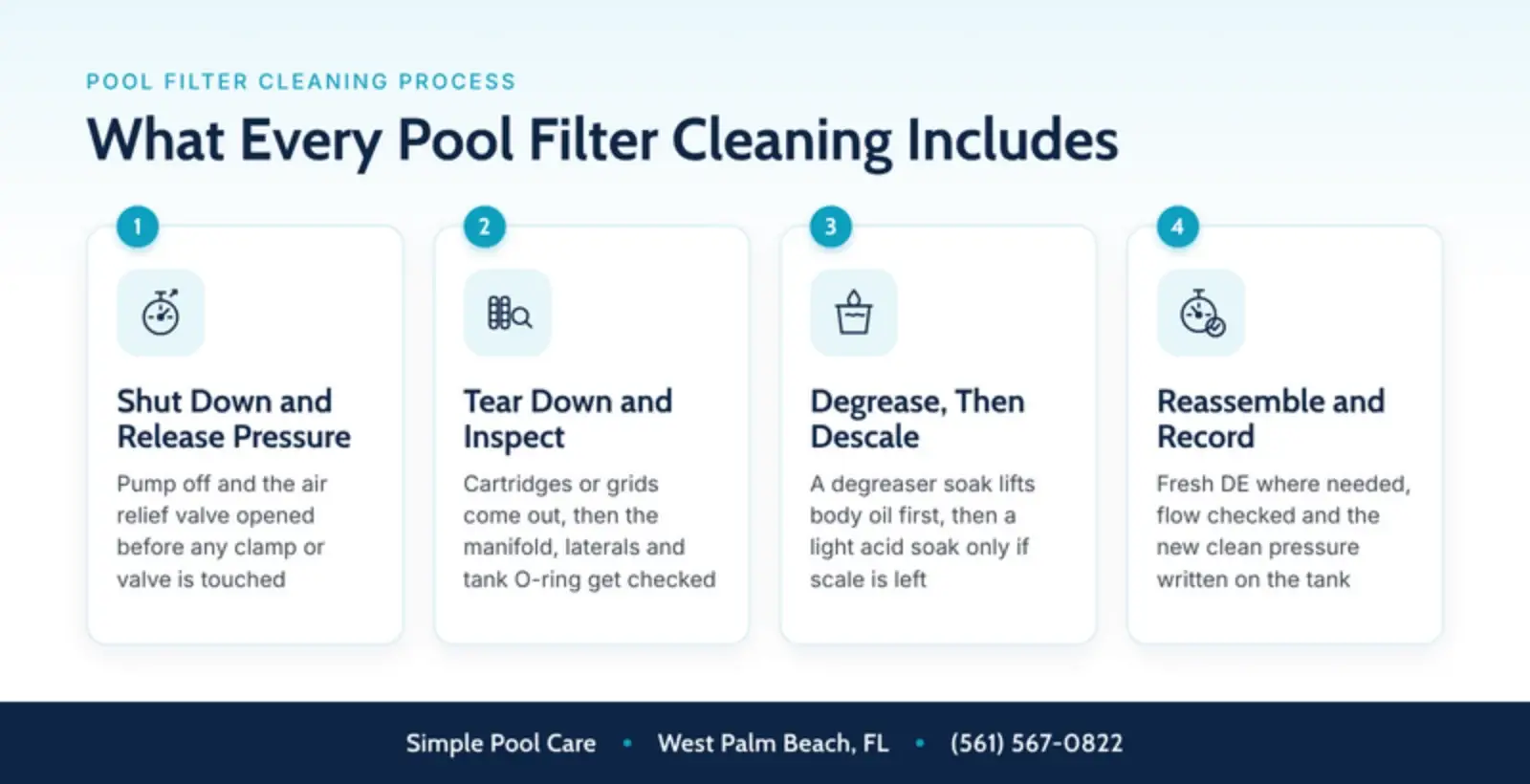
Every filter cleaning follows the same four steps, whatever the filter type. Here’s what happens on the equipment pad.
Pump Off, Pressure Out
A pressure filter is a sealed tank of pressurized water. Open a clamp or turn a valve with the pump running, and the lid can blow off hard enough to cause serious injury. So the pump goes off first. Then we open the air relief valve on top of the tank and let the pressure bleed down before anything else gets touched.
Tearing Down the Filter
Next, the tank comes apart. Cartridges or grids come out, along with the manifold. We check each piece while it’s open: the grid fabric for tears, the manifold for chips and cracks, the cartridge pleats and end caps, and the air bleed sock inside the tank. On a sand filter, sand turning up on the pool floor usually means a broken lateral.
The tank O-ring gets a close look too. A worn one lets water out or lets air in, and air in the system causes problems that look like something else entirely. We clean it and lubricate it before the lid goes back on.
Degrease First, Then Descale
This is the step that decides whether a cartridge survives. A dirty filter usually carries two kinds of buildup. Sunscreen, body oil and lotion leave a greasy film, while our hard water leaves mineral scale. Each needs its own cleaner, and the order matters.
The degreaser always goes first. Soak an oily cartridge in acid before degreasing it, and the acid sets the oil into the fabric for good. The element looks clean but never filters properly again. After degreasing and a thorough rinse, a light acid soak takes off any scale that’s left. DE grids get the same treatment in the same order. We stick to a hose and a soak. A pressure washer is faster, but hard spray can fray the pleats.
Reassembly, DE Recharge and a New Baseline
Once everything is clean and we’ve flagged any damaged parts, the filter goes back together. A DE filter then gets fresh powder. A typical dose is about 1.25 pounds for every 10 square feet of filter area, so a 60 square foot filter takes about 7.5 pounds. You’ll find the filter area on the tank’s data label.
The amount matters both ways. Too little leaves the fabric bare, so oils clog it and the grids wear out early. Too much and the cake on one grid touches the next, which techs call bridging. Finally, we restart the pump, bleed out the air, check the flow and write the new clean pressure on the tank.
Cleaning a Pool Filter Yourself
Plenty of owners hose off their own cartridges between professional cleans, and for light dirt that’s fine. A spare set of cartridges makes it easier still. Swap the clean set in, and the dirty one can soak without the pool sitting idle. Where DIY usually goes wrong is heavy buildup and DE.
Rinsing Isn't Deep Cleaning
A hose takes off leaves and loose dirt. It won’t touch the oil worked deep into the pleats. Rinse-only cleaning brings the pressure down a little, but the starting pressure creeps higher after each one. When a freshly rinsed cartridge comes back well above its old baseline, it needs a degreaser soak, or it has reached the end of its life.
Handling DE Powder Safely
Treat DE powder with care. It’s crystalline silica, and breathing the dust over time can cause silicosis, a lung disease that can be fatal. Supplier labels call for breathing protection, and OSHA regulates crystalline silica as a workplace hazard. The dust is also microscopically sharp. Stored next to the pump, it can get drawn into the motor windings and shorten the motor’s life.
Used DE needs proper disposal too. It should never go into a sewer, a storm drain or a canal. If you’re not sure of the local rules, leave the DE filter to us.
Where the Chlorine Goes In
One more thing worth checking on your equipment pad is where the chemicals enter the plumbing. Chlorinators and chemical feeders should feed after the filter and heater, never before them. Feeding chemicals ahead of the filter is a known cause of short filter cycles and high pressure. If yours feeds the other way, it’s worth fixing.
Problems a Filter Cleaning Won't Fix
Some filter problems come straight back however well we clean the filter. These are the ones we run into most.
Pressure That Climbs Back Fast
If the pressure climbs again within days, something else is loading the filter. Algae is a common one, so we test free and total chlorine. Too much flow is another: a pump pushing more water than the filter can handle packs dirt in faster. On sand filters, a bed crusted with minerals may need its top inch or two replaced, or a chemical sand cleaner.
Sand or DE Back in the Pool
Sand on the pool floor usually means a broken lateral at the bottom of the tank. DE in the pool points to a torn grid, a damaged manifold or a split air bleed sock. Both need parts, so it’s a repair job, and most filter repairs run $100 to $500.
Cloudy Water After a Clean
A clean filter fixes most cloudy water, but not all of it. The usual causes are filtration, circulation and water chemistry, and algae in its early stages makes water hazy before any green shows. So once the filter is clean, we check the run time and the balance.
Run time matters more than people expect. A pump that moves the pool’s full volume through the filter once has only filtered about 63 percent of the water, since the clean water mixes straight back in. Four passes gets you to roughly 98 percent. If the water is still hazy after all that, the particles are too small to catch, and a clarifier clumps them into pieces the filter can trap.
When Replacing Beats Cleaning
There’s a point where cleaning stops paying. A cartridge with torn pleats, cracked end caps or a clean pressure that stays high has reached the end. So has sand that has worn smooth. We’ll tell you when that’s the case rather than charge you to clean it. A new filter runs $300 to $1,000 installed, and pool filter installation includes sizing it to your pump.
How Often Pool Filters Need Cleaning Here
Going by the gauge, most pools here need a full pool filter cleaning every three to six months. Some need it sooner. These are the things that move it.
Storms, Pollen and Trees
Rainy season is the hard stretch. Storm runoff carries dirt and leaves into an unscreened pool, and spring oak pollen coats the surface. A pool under trees loads a filter far faster than a screened one with nothing overhead.
Sunscreen Is the Hardest Load
Sunscreen and body oil are tougher on a filter than leaves or dirt, because they coat the media instead of sitting on top of it. A pool that gets daily use in summer, or a rental with new guests every week, fills a cartridge with oil quickly. Spas are worse again, with a small volume of hot water carrying the same oils. That’s why our spa cleaning covers the spa filter too.
After an Algae Cleanup
When algae dies, it ends up in the filter. Clean the filter once the water clears, or the pressure stays high and the next cycle starts out dirty.
Twice a Year on Weekly Service
On our weekly service, filter cleaning comes twice a year as part of the plan, and we check the gauge on every visit in between. If the pressure says the filter needs it sooner, we tell you.
What Filter Cleaning Costs
Our weekly service includes filter cleaning twice a year. Full weekly service starts at $170 a month and chemical-only at $100, and both come with the chemicals.
We quote a standalone pool filter cleaning by filter type and size before we start. A single cartridge and a four-cartridge filter are different jobs, and a DE teardown adds the grid soak and fresh powder.
If the teardown turns up damage, we quote the repair before any work. Filter repairs usually run $100 to $500, a new filter is $300 to $1,000 installed, and sand is due for changing every 5 to 7 years.
When you compare quotes, ask what’s included. A rinse and a full teardown with a degrease soak are not the same service, even if both go by the name filter cleaning.
Filter Care That Fits Your Pool
Not every filter needs the same schedule. A screened pool with a large cartridge filter can go longer between cleans than an open pool under oaks running a small sand filter.
We also clean filters for seasonal homes and rentals, where nobody’s around to watch the gauge. Filter cleaning is one piece of our pool cleaning service, and our pool service in West Palm Beach handles the repairs and new equipment too. Call (561) 567-0822 or request a quote, and we’ll look at the filter before giving you a number.
Pool Filter Cleaning FAQs
Here’s what people ask us most about pool filters. Don’t see yours? Call (561) 567-0822.
Cost, Scheduling and Choosing a Company
Simple Pool Care includes filter cleaning twice a year in weekly service, with full service from $170 a month and chemical-only from $100. We quote a standalone clean by filter type and size first. If the teardown finds damage, filter repairs usually run $100 to $500.
Clean it when the gauge shows 8 to 10 psi more than its clean starting pressure, not on a fixed date. For most pools in West Palm Beach, that works out to a full clean every three to six months. Trees overhead and heavy summer use both shorten the gap.
Yes. Simple Pool Care's weekly service includes filter cleaning twice a year as part of the monthly price. We also check the filter pressure on every visit in between. If the gauge shows it loading up early after storms or heavy use, we tell you.
Replace a cartridge when the pleats tear, the end caps crack or the pressure stays well above its old baseline after a proper clean. Sand usually lasts 5 to 15 years and is due once the grains wear smooth. Simple Pool Care tells you before charging to clean something that's finished.
Simple Pool Care is owner-operated, licensed and insured, rated 5.0 on Google and factory trained on Hayward, Pentair, Jandy and Zodiac equipment. Every clean is a full teardown, degreased before any acid, with a new clean pressure written on the tank. We quote repairs before any work.
Filter Problems and Maintenance
Check the pressure gauge. Once it sits 8 to 10 psi over the clean starting pressure, the filter needs cleaning, and cartridges are due at about 10 psi over. Weak returns and dull water come later. Low pressure with weak flow points to a blockage before the pump instead.
Backwash once the pressure has risen 8 to 10 psi over the clean starting point, not on a weekly schedule. Sand traps finer dirt as the bed loads, so backwashing too often lets small particles through and leaves the water dull. Run each backwash until the sight glass runs clear.
Hose the cartridge off, soak it in a filter degreaser to lift sunscreen and body oil, then rinse it well. Only after degreasing should you use a light acid soak for mineral scale, because acid first sets the oil into the fabric for good. Inspect and lubricate the tank O-ring before reassembling.
Usually because the filter was only part of the problem. Short run times, poor circulation, water balance and early algae all cloud water. One turnover filters only about 63 percent of the pool, so a short pump schedule leaves haze. After that, a clarifier helps the filter catch very fine particles.
Use about 1.25 pounds of DE for every 10 square feet of filter area, or 2 ounces per square foot. A 60 square foot filter takes about 7.5 pounds; check the tank's data label for your area. Too little lets oils clog the grids, and too much causes bridging.
