
Pool Services in Lake Park, FL
Pool services in Lake Park, where more than half the homes went up before 1980. Weekly cleaning from $170 a month, chemicals included, plus repairs and new equipment from an owner-operated, licensed and insured company.

Pool Service in Lake Park Starts With an Older Pool
Lake Park started out in 1923 as Kelsey City, a town the Olmsted Brothers helped plan. Most of what stands here now came later, though. Census figures put the median home at 1977, and the 1950s and 1970s added the most houses.
For pool service in Lake Park, that age matters. An older pool usually has an equipment pad that has changed one part at a time. The plumbing rarely matches any drawing, and the surface has held water for decades. So we look at what’s actually there before we touch anything.
The town also has its own pool rules. Lake Park’s code manual says a pool must be cleaned at least once each week, which is the same rhythm our weekly visits run on.
Your tap water comes from Seacoast Utility Authority. Seacoast treats it with membranes and disinfects it with chloramines, and both of those change how a pool behaves after a refill. On the east side of town, the Lake Worth Lagoon adds salt air to the list for lots near the water.
Weekly full service costs $170 a month and up with chemicals included, or $100 and up for chemical-only. We’re owner-operated, licensed and insured, factory trained by Hayward, Pentair, Jandy and Zodiac, and rated 5.0 on Google. For a quote, call (561) 567-0822 and we’ll come take a look at the pool.
What Lake Park's Homes, Water and Lagoon Mean for a Pool
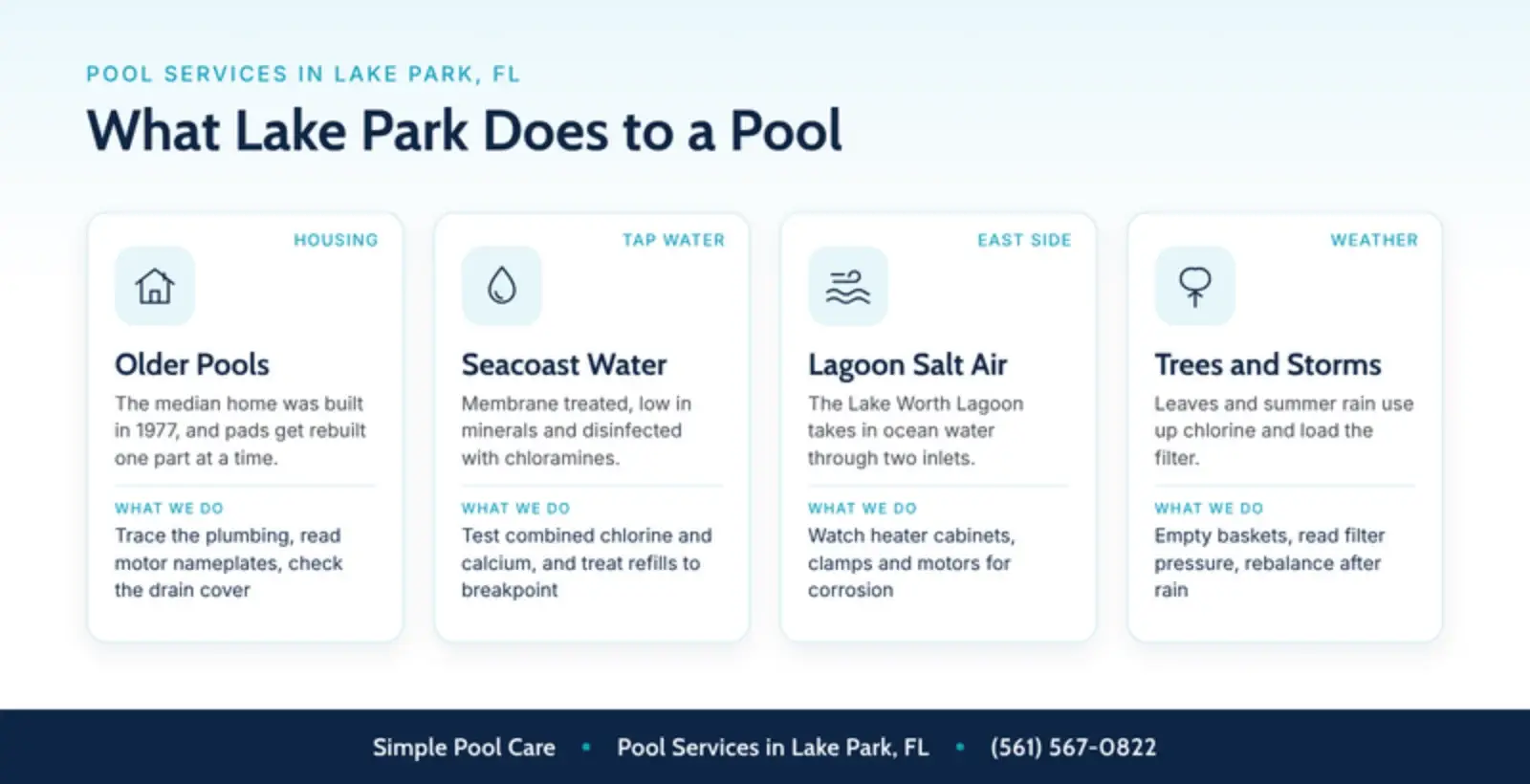
Most of what we deal with on Lake Park pools comes from four places: the age of the housing, the water Seacoast sends through the pipes, the lagoon on the east side and the big trees on lots that were landscaped decades ago.
A Town Built Mostly Before 1980
Census estimates for Lake Park put the median year built at 1977. Roughly 57 percent of homes date from before 1980, and very few have gone up since 2010. Many of the pools we see here are as old as the houses. Others went in years after the house did.
Most older pools have had parts replaced over the years. The pump might be fairly new while the plumbing is original. One contractor may have added the heater and another swapped the filter. So on a first visit, we trace the lines and read the motor nameplates, because a nameplate holds the information a replacement part has to match.
We also look hard at the main drain cover. A cover over every suction outlet is the first defense against someone being held down by suction, and old plastic does not last forever. If yours is cracked, loose or missing, you hear about it that day.
Older lights deserve a look too. A light installed long ago may not be on ground fault protection. If yours flickers or trips the breaker, leave it off until someone checks it. Our pool light installation page covers replacements.
Seacoast Water: Membrane Treated and Chloraminated
Lake Park is a Seacoast Utility Authority town. According to Seacoast’s 2025 water quality report, its main plant treats fresh water from the shallow aquifer with nanofiltration and brackish Floridan aquifer water with reverse osmosis. Both push water through a membrane, and the report calls the nanofiltration step demineralization.
For a pool, that means fill water with little dissolved in it. Water like that is aggressive. When calcium hardness runs low, the water pulls calcium out of plaster and grout, and over time it can etch the surface. So we test calcium on every visit instead of assuming, and we raise it when it drops below range.
Seacoast also disinfects with chloramines. The report lists an average of 3.7 ppm in 2025. A chloramine is a form of combined chlorine. It works in drinking water because the water spends a long time in the pipes, but it acts too slowly to keep a pool sanitized.
A top-up of an inch or two barely moves the numbers. A big refill is another story. After a drain for an acid wash, fresh Seacoast water can test high for combined chlorine before anyone has even been in it. Clearing it takes breakpoint chlorination, a free chlorine dose of about ten times the combined reading, and a smaller dose may not finish the job.
| Reading | Seacoast tap water (2025 report) | Where we keep a pool |
|---|---|---|
| Disinfectant | Chloramines, 3.7 ppm average (reads as combined chlorine) | 2 to 4 ppm free chlorine; combined at 0, never above 0.2 |
| Minerals | Treated by nanofiltration and reverse osmosis | 200 to 400 ppm calcium hardness |
| Sodium | 35.5 ppm (2023 sample) | 3,000 to 3,500 ppm salt on a salt pool |
Salt Air on the Lake Worth Lagoon Side
Lake Park’s east side sits on the Lake Worth Lagoon, the largest estuary in Palm Beach County. Ocean water flows into it through two inlets, and the Intracoastal Waterway runs right through it. The town’s own Lake Park Harbor Marina, with 112 slips, sits on that same water.
Salt in the air is hard on exposed metal. On lots near the water, we pay closer attention to heater cabinets, clamps, fasteners and motor housings. Rust on a bracket is cheap to deal with this month. A seized part next year is not.
Big Trees and Afternoon Storms
Lots that have been landscaped for decades usually come with big shade trees, and Lake Park has plenty of them. Leaves sink, break down and use up chlorine. They also stain. Dark leaf stains come from tannins, and chlorine will often bleach them out if we catch them early.
All that debris loads the filter faster, too. We read the pressure gauge on every visit. Measured against a clean filter, an extra 8 to 10 psi tells us the filter is due for a backwash or a cleaning. Our filter cleaning page explains how we handle each filter type.
Summer storms add their own load. A heavy afternoon rain waters down the chlorine and can drag the alkalinity low, which lets the pH bounce around. When a storm has come through between visits, we net out the debris and rebalance before anything has a chance to grow.
What Lake Park's Town Code Says About Pools
Lake Park publishes a code manual that sums up the rules homeowners run into most. A few of them apply to pools directly.
Weekly cleaning is the rule. Pools must be kept clean and sanitary and be cleaned at least once each week. The water also has to be clear and completely circulated at least twice each week.
Twice a week is a minimum, not a goal. Filtered water mixes back in with the rest, so one pass of the full volume through the filter catches only about 63 percent of it. Getting to roughly 98 percent takes four passes. That’s why we set timers so the pump runs every day.
For fences, the manual calls for a safety barrier between 5 and 6 feet tall, with gates that close automatically. If a gate on your pool fence no longer swings shut and latches, we’ll point it out.
A pool or deck needs a building permit, and the rim of a pool has to sit at least 10 feet from the side and rear property lines. If a project touches the pool shell or deck, the permit question comes first.
What Weekly Service Looks Like on a Lake Park Pool
A weekly visit here follows our usual routine. A few of the checks just carry more weight in Lake Park, because of the water and the age of the pools.
The water test covers free and combined chlorine, pH, total alkalinity, calcium hardness and stabilizer. Two of those readings matter more here. Combined chlorine shows whether chloramines from a top-up or from swimmers are building. Calcium shows whether low-mineral fill water has started working on the plaster.
Then comes the cleaning. We skim, vacuum and brush down the walls, the steps and the tile line. Brushing breaks up the slime layer that bacteria build on pool surfaces, where chlorine has a hard time reaching them. Under big trees, the skimmer and pump baskets can fill in a few days, so we empty both on every visit.
At the equipment pad, we listen to the pump, read the filter gauge and look over the heater, plus the salt cell on a salt pool. A clogged basket starves the pump of water and makes it cavitate, and that wears out the pump and motor early. On an older pad, small leaks at unions and valves also get noted before they grow.
After each visit, a short report shows the test results and the chemicals added. If something on an older pad is starting to go, it shows up there before it turns into a repair call.
Storm Season on a Lake Park Pool
Every hurricane season, someone asks whether they should drain the pool before a storm. Don’t. A full pool is heavy and stays put. Lowering the water where groundwater runs high can damage the structure, and an empty shell can lift.
Before a storm, bring in loose furniture and toys so they don’t end up in the water or through a screen. If flooding is likely, switch off power to the pool equipment at the breaker. Lake Park’s code manual also says hurricane shutters need a permit and can’t go up until a watch is in effect, so plan the house side early.
Once the storm passes, the pool needs the debris out, a filter check and a full rebalance. Rain waters everything down, and leaves and runoff add a heavy load at the same time. We net it, check the filter and bring the chemistry back on the first visit after the storm.
Our Pool Services in Lake Park
Most of our pool services in Lake Park are weekly visits. The rest is fixing or replacing whatever an older equipment pad throws at us.
Weekly Pool Cleaning in Lake Park
Our weekly pool service covers water testing and balancing, skimming, vacuuming, brushing, emptying the baskets and an equipment check. Chemicals come with the monthly price, and filter cleaning twice a year is included. It’s the center of our pool cleaning work, and it’s what keeps a pool inside the town’s weekly rule.
Pool Repairs in Lake Park
Pumps and heaters are the usual failures on older pads. When a pump will not start, the capacitor is one of the first parts we test, and replacing one runs about $150 with labor. A leaking shaft seal or a worn motor runs $250 to $600. Heater repairs cost $200 to $800, and filter repairs $100 to $500. We diagnose and quote every job before any work starts. Our pool repairs page covers the rest, including pool pump repair and pool heater repair.
Equipment Upgrades for Older Pads
When a part is too old to be worth fixing, we replace it. A variable speed pump, at $1,500 to $2,800 with installation, lets the pool run longer at low speed while drawing far less power. New filters run $300 to $1,000. When the original heater on an older pad finally quits, a gas replacement costs $2,000 to $4,000 with installation, and $3,000 to $7,500 buys a heat pump. Quotes on pool equipment installations are free.
Acid Wash and Tile Cleaning for Older Plaster
Older plaster collects stains and scale over the years. When brushing and balanced water stop bringing it back, an acid wash takes off a thin layer to expose a cleaner surface underneath. It costs $300 to $700, and draining adds $150 to $250 when the job needs it. Calcium crust at the waterline is a separate job, covered by pool tile cleaning.
Green Pool Recovery in Lake Park
If a pool has already turned, recovery comes first. A green to clean runs $250 to $800, and most pools are swimmable within 24 to 72 hours without draining. After that, weekly visits and a daily pump schedule keep it from turning again.
Salt Systems in Lake Park
A conversion to a salt system runs $1,500 to $3,000. The cell makes chlorine only while the pump runs, and it needs salt held around 3,000 to 3,500 ppm. Seacoast tap water carries only a small fraction of that, so after any big refill the salt has to go back in. Conversions and cell work sit with our specialty pool services.
Before You Drain or Refill a Lake Park Pool
Draining comes up with acid washes, big repairs and water that has drifted too far to save. It’s not a job to start with a garden hose and a borrowed pump.
Groundwater can lift an empty pool. Where the water table is high, water pressing up under the shell can push an empty pool out of the ground. A hydrostatic relief valve in the lowest part of the pool opens to let groundwater in and relieve that pressure, so we confirm it works before draining. After a week of heavy rain, we may wait.
The refill needs work too. Seacoast water arrives low in minerals and carrying chloramines. The first days after a refill go to clearing combined chlorine, building calcium and alkalinity and adding stabilizer. On a salt pool, the salt goes back in as well, since tap water carries far less than a cell needs.
What Pool Services in Lake Park Cost
Full weekly service is $170 a month and up. That price covers the visits, the routine chemicals and two filter cleanings a year.
Chemical-only service is $100 a month and up, for owners who would rather skim and brush on their own while we look after the water.
Repairs mostly fall between $100 and $800, and quotes on new equipment are free. Pool size, tree cover, the age of the equipment and the state of the water on day one all move the price. With older pools especially, we look before we quote.
Request Pool Services in Lake Park
To get a number for pool services in Lake Park, request a quote or call (561) 567-0822. We’ll come out, look over the pool and the pad, and give you a number based on what’s actually there.
Simple Pool Care pool service is owner-operated, licensed and insured. Our techs carry factory training on the major equipment brands. Weekly care, repairs and new equipment all come from the same company, so you only deal with one.
Pool Services in Lake Park FAQs
Straight answers to what Lake Park homeowners ask us most about their pools.
Pool Service in Lake Park: Cost and Scheduling
Full weekly pool service in Lake Park costs $170 a month and up, and chemical-only is $100 and up. Both include routine chemicals, and full service adds filter cleaning twice a year. Repairs usually run $100 to $800. Pool size, tree cover and the pool's condition set the final quote.
Yes. The Town of Lake Park's code manual says pools must be kept clean and sanitary and be cleaned at least once each week. The water also has to be clear and fully circulated at least twice a week. Weekly service covers the cleaning, and a daily pump schedule covers circulation.
Yes. Besides weekly plans, we take one-time jobs: green to clean recoveries, acid washes, tile cleaning, equipment repairs and new installs. A green recovery runs $250 to $800, and most pools are swimmable in 24 to 72 hours. We quote every one-time job before work starts.
Each visit covers water testing and balancing, skimming, vacuuming, brushing and emptying the baskets. The pump, filter pressure, heater and salt cell get looked over too. On older Lake Park pools, we keep an eye on the drain cover and any equipment showing its age. You get a report afterward.
Our pool services in Lake Park come from an owner-operated, licensed and insured company rated 5.0 on Google. Hayward, Pentair, Jandy and Zodiac have all factory trained our techs, which helps on older Lake Park pads with mixed brands. Weekly plans include chemicals, and we diagnose and quote every repair first.
Lake Park Water, Older Pools and the Lagoon
Not in the usual hard water way. Seacoast Utility Authority treats Lake Park's water with nanofiltration and reverse osmosis, which take minerals out. Water low in calcium can etch plaster and grout rather than scale it. So we test calcium hardness and keep it between 200 and 400 ppm.
Seacoast disinfects Lake Park's tap water with chloramines, which read as combined chlorine on a pool test. Its 2025 report lists an average of 3.7 ppm. Chloramines act too slowly to sanitize a pool, so after a big refill we shock to breakpoint, about ten times the combined reading.
Yes, and in Lake Park it's common, since the median home here dates from 1977. We trace the plumbing, read every nameplate on the pad and check the drain cover before quoting. Then we repair what's worth repairing and replace what isn't, with free quotes on new equipment.
It can. The lagoon is an estuary that takes in ocean water through two inlets, so homes near it get more salt in the air. That's hard on exposed metal like heater cabinets, clamps and motor housings. On lagoon-side pools we check those parts and flag corrosion early.
Usually because the chlorine runs out between visits. Heat, sun, summer rain and leaves from big trees all use it up, and short pump run times leave water unfiltered. A green pool needs a recovery first, at $250 to $800, then weekly service and daily run time to stay clear.
