
Pool Pump Installation in West Palm Beach, FL
Premium Pool Pump Installation for Homeowners Across West Palm Beach, FL and surrounding areas

Schedule Service!
Your Pump Runs All Year Down Here
Down here your pump runs eight to twelve hours a day, every day, all year. That makes it the single biggest energy hog on your equipment pad, and if you’re still running an old single-speed pump, it’s quietly padding your electric bill every month. A new pump fixes that fast. Simple Pool Care installs and replaces pool pumps all over West Palm Beach and Palm Beach County, sized right, wired to code, and dialed in to save you money. Call (561) 567-0822 or request a free quote to get started.
Why a variable-speed pump is almost always the move now
If you’re replacing a pump today, a variable-speed model is usually a no-brainer, and here’s the honest reason:
- It slashes your electric bill. Running on low speed for daily filtration, a variable-speed pump uses roughly 75 to 80 percent less power than an old single-speed. For most West Palm Beach pools, that’s somewhere around $600 to $1,200 a year back in your pocket.
- It pays for itself fast. Those savings usually cover the cost of the pump in one to three years, often under two. After that, it’s money in your pocket every month.
- It’s quiet. No more loud motor humming across the patio every evening.
- It’s basically the law now. Federal energy rules phased out most single-speed pumps, so if your pump is over a certain size, you’re required to go variable-speed on a replacement anyway. We make sure every install we do is compliant.
We’ll still walk you through your options honestly, but for the vast majority of pools around here, a variable-speed pump is the right call.
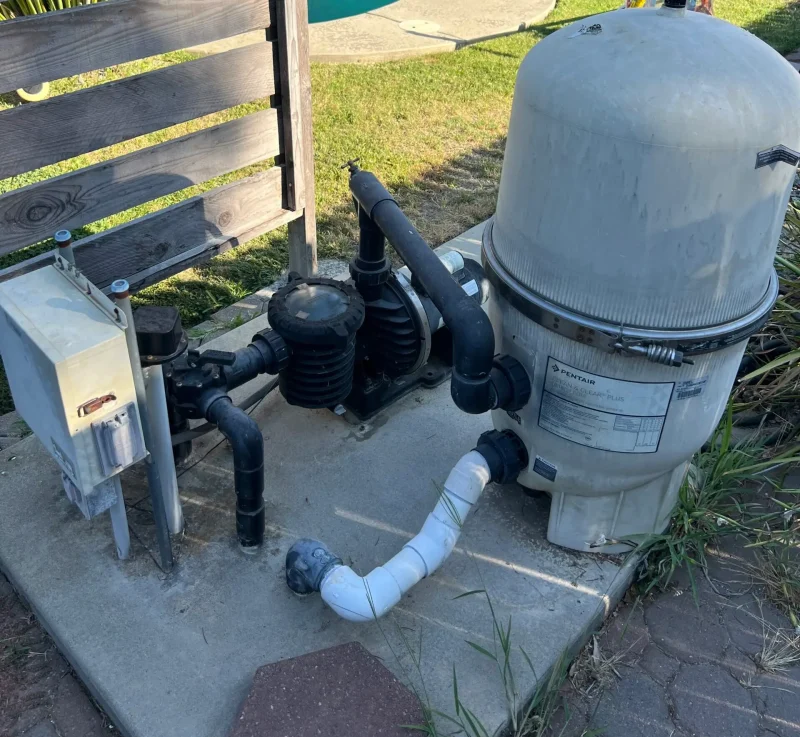
Need pool service? Get in touch with us and schedule your FREE pool service quote from Simple Pool Care
What pool pump installation costs in West Palm Beach
Honest answer: it depends on the pump and your setup. Ballpark for our area:
- A straightforward pump replacement runs about $500 to $2,000 installed, with the unit itself usually $600 to $1,800 and labor $300 to $800.
- A variable-speed pump installed typically lands $1,500 to $2,800, depending on size and any plumbing or electrical work.
We give you a clear, itemized quote with the pump, the install, and any electrical or permit costs spelled out. No surprises, and we’ll show you the energy-savings math so you can see the payback for yourself.
It actually pays for itself
This is the part that surprises people. A variable-speed pump isn’t just an upgrade, it’s one of the few pool investments that puts money back in your pocket. Run the numbers: if your old pump costs $80 to $120 a month to run and the new one drops that to $20 or $30, you’re saving real money every single month, year-round. In our climate, where the pump never gets a winter break, those savings stack up faster than almost anywhere else in the country.
Signs it's time for a new pump
You’re probably due for a replacement if your pump is:
- More than 7 to 10 years old.
- Loud, leaking, or rattling on the pad.
- Driving an electric bill that keeps creeping up.
- Giving you weak flow even after a filter cleaning.
- Refusing to start or shutting off on its own.
- Holding you back from adding a heater, salt system, or automation.
Not sure it’s time yet? Sometimes a pool pump repair gets you more life out of it, and we’ll tell you honestly which way to go instead of pushing a sale.
Sizing It Right: Bigger Is Not Better
A lot of folks assume a more powerful pump means a better pool. It’s the opposite, and the reason is worth two minutes of your time.
Sizing doesn’t start with horsepower. It starts with flow. Your pool is supposed to move its entire volume through the filter in about six hours. That gives you the number directly:
Gallons in your pool divided by 6, divided by 60, gives the gallons per minute you need.
A 20,000 gallon pool needs around 56 GPM. A 15,000 gallon pool needs around 42. That’s the target. Everything else is about hitting it efficiently.
The pump then has to deliver that flow against total dynamic head, which is the combined resistance of your pipes, fittings, filter, heater, outlets and returns. Every one of those parts fights the water a little. Add them up and you get a number that’s specific to your pool and nobody else’s.
Here’s why going bigger backfires. For a given pipe diameter, doubling the flow rate roughly quadruples the friction loss. Push twice as much water through the same plumbing and you’re not working twice as hard, you’re working about four times as hard. An oversized pump spends its life fighting a resistance curve that climbs far faster than the flow does, and you pay for every bit of it.
It costs you downstream too. Too much flow through a cartridge filter drives dirt into the pleats instead of catching it on the surface, so the water gets worse and the cartridges get replaced sooner. Too much flow through a heater causes its own set of problems. Cloudy water on a big pump is a classic sign the pump is oversized, not undersized.
One more thing worth knowing before you shop. Don’t use your old pump’s horsepower as the target. Before 2021 motor horsepower ratings weren’t standardized, so the same motor could be sold at two different horsepower numbers depending on the manufacturer, and plenty of pools were oversized on day one anyway. Newer pumps also move water more efficiently, so a smaller motor often delivers the same flow. If we recommend a pump with a smaller number on the label than the one you have, that’s usually us doing the job properly. The EPA makes the same point plainly in Are Bigger Pool Pumps Better?
If you want to compare two pumps on paper, look at the Weighted Energy Factor (WEF). It works like miles per gallon. Higher is better.
And one thing we’ll tell you that most installers won’t: large-diameter pipe with as few elbows as reasonable is what makes a system efficient, and once that plumbing is in the ground you can’t really change it. Install day is the only day that decision is cheap. If your pad is a maze of tight fittings, we’ll say so while we can still do something about it.
The Number We Measure Before We Quote
Total dynamic head sounds like something you take on faith. It isn’t. It’s a measurement, and it takes two gauges that are already sitting on your equipment pad.
With a clean filter running, we read the vacuum gauge on the suction side and the pressure gauge on the discharge side, then convert them:
- Vacuum gauge reading times 1.133 gives the suction side head.
- Pressure gauge reading times 2.31 gives the pressure side head.
- Add the two together and that’s your system’s actual operating total dynamic head.
That number, paired with the flow your pool needs, is what picks the pump. Not the badge on the old one.
We write it down, and that turns out to matter later. A head reading that drifts over time is telling you something. Usually a wearing impeller, or filter media that’s reached the end of its life. Most pools have never had this measured once. Yours will have it on record from day one, which makes every future service call faster and more honest.
Our installation, start to finish
- We inspect your equipment pad, plumbing, filter, and electrical, measure your system’s total dynamic head off the gauges, and talk through how you actually use your pool.
- We recommend the right pump and size, and show you the operating cost and savings of each option.
- We pull any required permit, remove the old pump, make plumbing adjustments, and wire the new one safely to code.
- On a variable-speed pump, we program your speed schedules to maximize savings, and integrate it with your automation (Pentair, Hayward, or Jandy) if you have it.
- We prime it, test flow and pressure, record the finished head reading so you have a baseline, and walk you through running it so it’s saving you money from day one.
Bonding, and Why This Is Not a DIY Swap
Swapping a pump looks like unscrewing two unions and moving a wire. There’s a third connection people forget, and it’s the one that matters most.
Every pump motor on a pool has to be bonded. Bonding ties the metal parts of your pool and its equipment to the same electrical potential using a solid copper wire, so there’s no voltage difference between the things a swimmer can touch. The National Electrical Code requires it for the pool’s reinforcing steel, its metal fittings, ladders and handrails, underwater lighting, and the metal parts of the circulating equipment, which means your pump motor.
Here’s the problem. A pump that isn’t bonded works perfectly. It primes, it pushes water, it’s quiet, and nothing about the pool looks wrong. The bonding lug is the easiest thing on the job to leave off, and there’s no symptom to catch it.
That’s why we handle the whole install rather than swapping a head and leaving. We pull the permit, connect the plumbing, wire the motor to code, and reconnect the bond. If we find the existing bond was already compromised, we’ll tell you, because that’s a real problem that has nothing to do with selling you a pump.
Brands we install
We install the pumps built to last in South Florida pools, including Pentair (IntelliFlo, SuperFlo VS), Hayward (TriStar VS, Super Pump VS), and Jandy. Whatever you choose, we install to manufacturer spec so your warranty stays intact, and we’ll point you to the model that genuinely fits your pool and budget instead of overselling.
Ready to cut your pool's energy bill?
Stop feeding an old, hungry pump. We install pool pumps across West Palm Beach and most of Palm Beach County, and the full list of areas is at the bottom of this page. Call Simple Pool Care at (561) 567-0822 or request your free quote online. Local, licensed, insured, and 5-star rated by your neighbors all over Palm Beach County. Pump installation is part of our full pool equipment installation lineup, right alongside filter, heater, and light installs, and once your new pump is in we keep it humming with weekly pool service.
We Are Experts With:




Your Trusted Pool Service Partner
It’s easy to get started with Simple Pool Care.
Trusted by 100+ homes throughout West Palm Beach and neighboring cities.
We treat our customers like family, which is why we crafted our Pool Service plans to service our customers with the utmost professional service so you can enjoy your pool worry free.
Built Around Reliable Service
We show up when we say we will, we quote before we start, and we tell you what your pool actually needs rather than what’s easiest to sell. That’s most of it.
Over 10 years of experience in the pool service industry spanning across 2 counties.
Servicing over 100+ customers a year while maintaining a 5 star rating from our clients.
When you choose Simple Pool Care, you have a friend in the industry you can trust.
We are available day and night for our customers. We take your business seriously.
Frequently Asked Questions
The questions we get asked most often about pool pump installation.
A straightforward pool pump replacement usually runs about $500 to $2,000 installed, with the unit itself around $600 to $1,800 and labor $300 to $800. A variable-speed pump installed typically lands $1,500 to $2,800, depending on size and any plumbing or electrical work. We give you an itemized quote up front, including any permit and electrical costs, and you approve it before we start.
For most pools here, yes. A variable-speed pump uses roughly 75 to 80 percent less electricity than an old single-speed model, which adds up to about $600 to $1,200 a year in savings for a typical West Palm Beach pool. That usually pays back the cost of the pump in one to three years, often under two, and since our pumps run year-round, the savings stack up fast.
In most cases, yes. Federal energy conservation standards for pool pumps took effect in July 2021, and above a small horsepower threshold single-speed units are no longer manufactured for the US market. So if your old single-speed pump dies, a like-for-like replacement often isn't something you can buy any more. The good news is that variable-speed is also the option that saves you the most money, so it works out in your favor. We make sure every install is compliant, and we'd rather tell you this now than at the quote.
Sizing starts with flow, not horsepower. Your pool should move its whole volume through the filter in about six hours, so the math is pool gallons divided by 6, divided by 60. A 20,000 gallon pool needs roughly 56 gallons per minute. The pump then has to deliver that flow against total dynamic head, which is the combined resistance of your pipes, fittings, filter, heater and returns. We measure that off the vacuum and pressure gauges on your pad rather than guessing at it. Bigger is not better: for a given pipe diameter, doubling the flow rate roughly quadruples the friction loss, and too much flow pushes water through your filter too fast to clean it well. Don't be surprised if we recommend a pump with a smaller number on the label than the one you have.
A standard pump swap is usually done the same day, often in just a few hours. If we need to update plumbing, add or upgrade electrical, or pull a permit, it can take a bit longer, and we'll give you a clear timeframe before we begin.
If your pump is 7 to 10-plus years old, loud, leaking, costing you on energy, or won't start, replacement is usually the smarter spend, especially with the energy savings of a new variable-speed unit. If it's newer and the problem is minor, a repair often makes more sense. We inspect it and give you an honest recommendation either way.
Yes. We pull any required permits and complete the plumbing and electrical connections to local code, done by a licensed, insured team. Pool pump wiring isn't a safe DIY job, so we handle the whole install start to finish and make sure it's done right.
Usually, yes, and there are two reasons. First, horsepower ratings for pool pump motors weren't standardized before 2021, so the same motor could be sold at two different horsepower numbers depending on who built it. Second, a lot of pools were oversized when they were first built, because installers went bigger to be safe. Newer pumps also move water more efficiently, so a smaller motor often delivers the same flow for less power. We size to the flow your pool actually needs and the resistance of your plumbing, then show you the numbers. If you want to compare two pumps yourself, look at the Weighted Energy Factor, or WEF, which works like miles per gallon. Higher is better.
Yes, every time. The National Electrical Code requires the metal parts of your pool's circulating equipment, including the pump motor, to be bonded, which means tied to the same electrical potential as the pool shell, the ladders, the handrails and the lights using a solid copper wire. The catch is that a pump which isn't bonded runs perfectly. It primes, it circulates, it's quiet, and nothing looks wrong, so it's the easiest connection on the job to leave off and there's no symptom to catch it. We reconnect the bond as part of every install, and if we find the existing bonding was already compromised we'll tell you, because that's a safety issue rather than a sales opportunity.
