
Pool Sand Changes in West Palm Beach, FL
Pool sand changes in West Palm Beach for sand filters that backwashing no longer fixes. Each pool filter sand replacement covers emptying the tank, checking the laterals, refilling to spec and flushing the new sand.

Pool Filter Sand Replacement in a Couple of Hours
Most people call us about a sand filter for the same reason. The water looks dull, the test kit says the chemistry is fine, and backwashing doesn’t change a thing. Often the pressure gauge creeps back up within days of a backwash, too.
That usually means the sand has done all it can. Pool sand changes swap the old bed for fresh filter media. They’re one of the specialty pool services we handle as a job of their own, outside the weekly visit.
On most home filters, the work takes a couple of hours. We shut the system down, empty the tank and look over the laterals and standpipe. Then we refill with the right grade and weight of sand, and we flush the new bed until the water runs clear before the filter goes back in service.
New sand only lasts if the small stuff is right. Too much sand, the wrong grade or a skipped flush can leave the water cloudy again within a season, and the owner usually blames the sand.
If the tank, the valve or the laterals are worn out too, we’ll tell you before we start. Sometimes the filter needs a repair along with the sand. Sometimes a new filter makes more sense than new sand, and we’ll show you why.
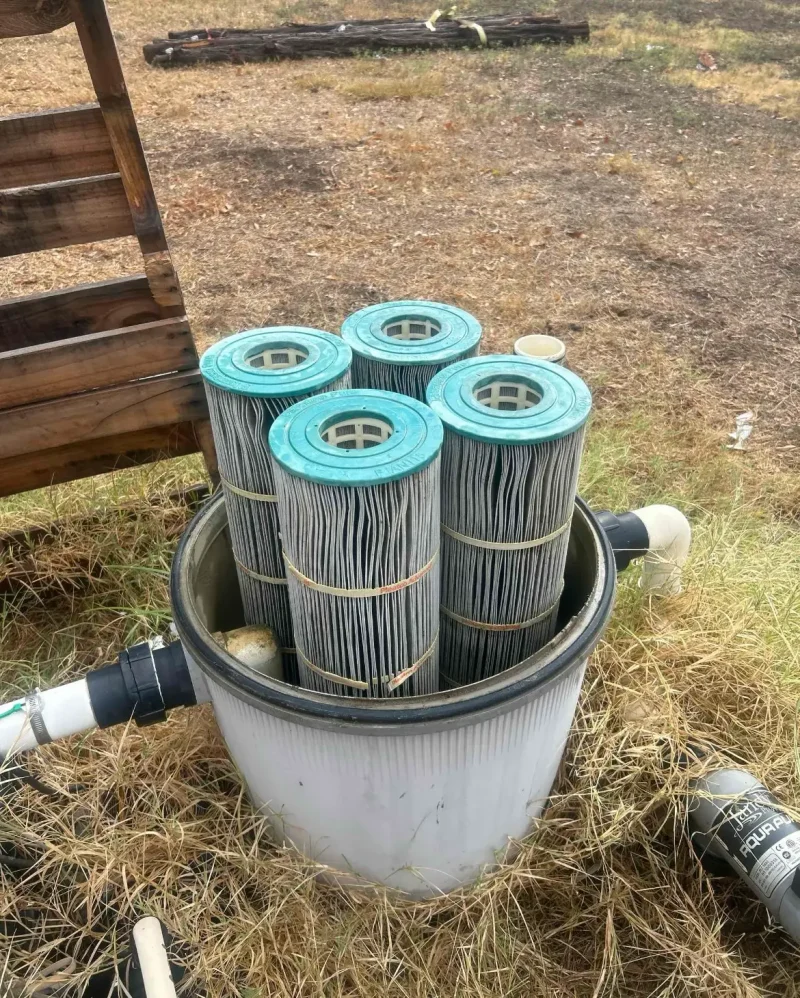
How Pool Filter Sand Stops Working
A sand filter looks simple from the outside. Inside, it’s a tank of graded silica sand with a set of slotted pipes, called laterals, at the bottom. Water comes in at the top, works down through the sand and leaves through the laterals.
Sharp Grains Do the Filtering
New filter sand has sharp, jagged edges. Dirt catches on those edges and in the gaps between grains. Most of it gets trapped in the top few inches of the bed, not down through the whole depth.
Right after a backwash, the bed only stops fairly large particles, around 50 microns and up. As dirt fills the gaps, the openings shrink and the filter starts catching finer material. Late in the cycle, a healthy bed traps particles down to about 25 microns. That’s smaller than the eye can see, which bottoms out around 40 microns.
Over the years, those sharp edges wear smooth. Rounded grains don’t grab dirt the way new ones do, so the bed filters coarser even when it looks clean. When we find smooth grains in a sample, the sand has reached the end of its life.
Oils and Scale Coat the Grains
The other way sand fails is coating. Sunscreen, body oil and lotion stick to the grains. Hard water adds a second layer when the pH, alkalinity and calcium run high, because the same scale that crusts a tile line also calcifies filter media.
Coated grains clump together. Over time they form mud balls, dense lumps of sand and grease that water can’t pass through. Backwashing flushes out loose dirt, but it won’t break those lumps apart.
Channeling Lets Water Skip the Sand
Once the bed clumps or cracks, water takes the easy route. It cuts a path straight down to the laterals and skips most of the sand. That’s called channeling, and it sends unfiltered water back to the pool.
Channeling fools people because the pressure gauge can read normal. The water isn’t pushing through a clogged bed, it’s flowing around it. Running more flow through a filter than it’s rated for makes channeling worse. It also drives dirt deeper into the sand, where a backwash can’t reach it.
Floc and Clarifier Can Cake the Bed
Flocculants like alum work by filling the gaps between sand grains. In the short term, that means sharper filtering and higher pressure. Used often, though, floc can bind the bed into one solid mass that filters poorly.
If you find yourself flocking the pool every few weeks to keep it clear, the floc is covering for a filter problem. We’d check the sand. We’d also check it after a green to clean recovery, when the filter carried a heavy algae load for days.
Signs Your Filter Sand Is Done
Sand rarely fails overnight. These are the signs we look for, and they usually show up in this order.
Cloudy Water With Balanced Chemistry
Cloudy water has three common causes: poor filtration, weak circulation and off chemistry. Early algae clouds the water too. The filter is the first thing we check, then the flow, then the balance. If the pool stays dull after a proper backwash, with the pump running long enough and the chemistry right, old sand is the usual answer.
Short Runs Between Backwashes
A healthy bed runs a good while between backwashes. When the pressure climbs back within days of a proper backwash, something is clogging it. After a summer storm dumps leaves and grit into the pool, a short run is normal. Day after day, it isn’t. Algae can do it too, so we rule that out first. Otherwise the bed is blocked, sometimes by mineral buildup in the top layer and sometimes because the whole bed is finished.
Sand on the Pool Floor
Fine sand collecting near the return jets usually means a broken lateral. Those slotted pipes hold the sand in the tank while letting water through, so a cracked one lets sand escape. High filter pressure is a known cause of lateral damage. That’s why a blocked bed and a broken lateral often show up together.
The wrong grade of sand causes the same symptom, even when the laterals are fine. Either way, it’s pool filter repair as well as a sand change, and we sort out both while the tank is empty.
How Often Pool Sand Changes Are Needed
Filter sand is a long life media. It’s rated to last somewhere between 5 and 15 years before it needs replacing, and where a pool lands in that range depends on how hard the filter works.
Here, most sand filters want changing every 5 to 7 years. Our pools run all year, the sun means plenty of sunscreen in the water, and our water is hard. A screened pool with light use and good balance can go longer. An open pool under oaks or ficus, with kids in it every afternoon, tends to sit at the short end.
So we go by the sand, not the calendar. We dig into the bed and look for clumps, mud balls and grains worn smooth. Then we watch how the pressure behaves after a proper backwash. If it drops and holds, the bed has more life in it. If it climbs right back, it’s done, and we’ll say so.
When Cleaning the Sand Is Enough
Not every tired filter needs new sand. A bed blocked with mineral deposits can often come back with a chemical sand cleaner, soaked in and then flushed to waste. If the blockage sits near the top, replacing just the top inch or two of sand can work, since that’s where most of the filtering happens.
Both are part of pool filter cleaning, and both cost much less than a full change. We’ll tell you which one your filter needs before we quote either. If the grains are smooth or the bed is full of mud balls, though, cleaning won’t bring it back.
How We Handle Pool Sand Changes
All our pool sand changes follow the same four steps, whatever brand of filter you have. Hayward, Pentair, Jandy and Zodiac are the brands we’re factory trained on, and they cover most of the filters we see here.
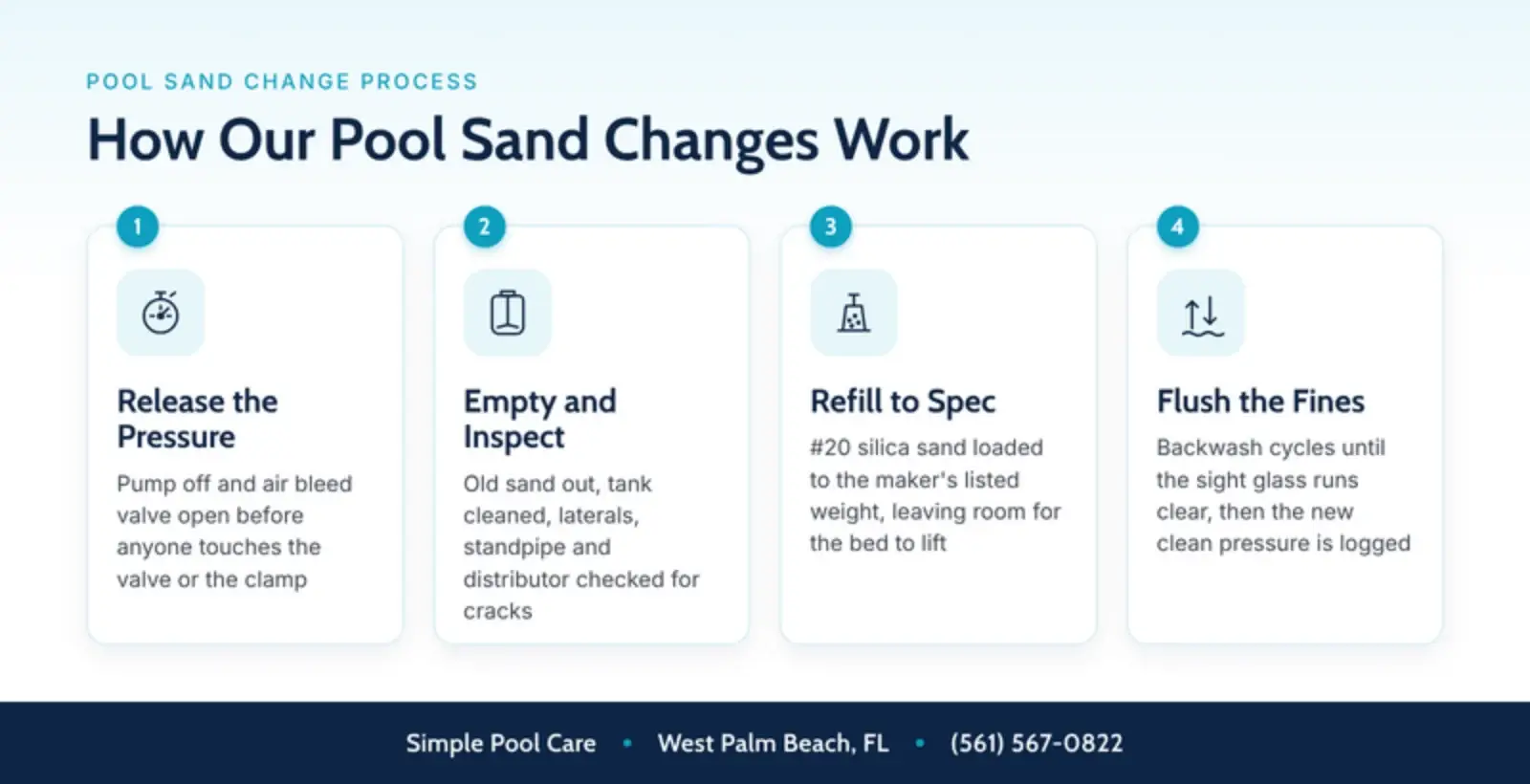
Shut Down and Release the Pressure
A sand filter is a pressure vessel, so safety comes first. We turn the pump off and open the air bleed valve before touching the valve or the clamp. A pressure filter opened while it’s still under pressure can come apart with enough force to badly hurt someone. That’s the main reason we’d rather owners leave this job to us.
Empty the Tank and Check the Laterals
We drain the tank, take off the valve or top assembly and dig out the old sand. Then we clean the tank and check the parts the sand was hiding: the laterals, the standpipe and the distributor at the top.
This is the only time those parts are visible, so we look closely. A hairline crack in one lateral today means sand in the pool next month. If anything is damaged, we replace it before any new sand goes in.
Refill to the Manufacturer's Weight
More sand isn’t better. Above the bed sits an open space called the freeboard, usually about half as deep as the sand itself. It gives the bed room to lift and expand when the flow reverses during a backwash. Without that room, the sand can’t scrub itself clean.
That’s why manufacturers list a weight of sand for each model rather than a depth. Loading the listed weight leaves the right freeboard. Add extra and every backwash takes longer to run clear, and over time the sand can shift around inside the tank.
We use #20 silica sand, the grade most pool sand filters call for, unless the manufacturer specifies something else. It’s screened to a narrow grain size. Play sand or the wrong grade can cloud the water, wash into the pool or ruin the filter.
Flush the Fines Before Normal Service
New sand comes with fines, tiny particles left over from processing at the supplier. They have to come out before the filter goes back in service, so we run a series of backwash cycles at start-up until the sight glass runs clear.
Skip that step and body oils stick to the fines. Then mud balls start forming in a bed that’s only weeks old. Once the water runs clean, we set the valve back to filter and write down the new clean starting pressure. That number is your baseline for every backwash after.
Sand, Zeolite or Crushed Garnet
Pool sand changes are also your chance to choose what goes back in. Most filters run on #20 silica sand, and it does the job well. Zeolite and crushed garnet can both go in the same tank instead.
Zeolite is the one people ask about. It’s a porous volcanic mineral that catches particles down to about 5 microns, where sand stops at roughly 25. Manufacturers also say activated zeolite absorbs ammonia. That matters because chlorine reacts with ammonia to form chloramines, the compounds behind stinging eyes and that strong chlorine smell.
Zeolite costs more per fill than sand, and it isn’t right for every filter. We check the filter maker’s guidance first, then load it to their weight. If your water has never looked as clear as you want, ask us about it.
Sand Filter Numbers We Work To
These are the figures we work to on pool sand changes.
| Filter sand | #20 silica, unless the manufacturer says otherwise |
| What sand catches | 25 to 100 microns |
| What zeolite catches | About 5 microns |
| Freeboard | About half the depth of the sand bed |
| When to backwash | 8 to 10 psi over the clean starting pressure |
| Backwash flow | About 15 gpm per square foot of filter area |
| Sand life | 5 to 15 years rated, 5 to 7 typical here |
Backwashing Between Sand Changes
Backwashing is the routine clean in between pool sand changes. The valve reverses the flow, so water comes up through the laterals, lifts the bed and carries trapped dirt out to waste. Run it until the sight glass runs clear, usually a couple of minutes, then rinse to settle the bed.
Backwash When the Pressure Says So
Backwash once the pressure sits 8 to 10 psi above the clean starting pressure. If your filter has gauges on both the inlet and outlet, the trigger is a 10 to 20 psi difference between them. Check the filter manufacturer’s instructions too.
Backwashing on a schedule makes the water worse. A slightly loaded bed filters finer than a freshly cleaned one, because the gaps between grains have tightened up. Backwash every few days whether it needs it or not, and the bed never gets there. Over time the water loses its sparkle, and you’ve wasted water doing it.
Enough Flow to Lift the Bed
A sand bed needs strong flow to fluidize during a backwash, around 15 gallons a minute per square foot of filter area. If you run a variable speed pump, backwash on a high speed. On a low setting, the sand barely moves and most of that water goes to waste.
Backwash water goes straight down the drain, and the South Florida Water Management District asks residents to conserve water year round. Backwashing only when the gauge calls for it is an easy place to start.
Sand Change or a New Filter?
Sometimes the sand isn’t the only thing that’s worn out. If the tank is cracked, the multiport valve leaks or parts for your model are hard to find, new sand in an old filter doesn’t make much sense.
That’s when we talk about pool filter installation. A new filter runs about $300 to $1,000 installed. Some owners switch to cartridge at that point, since a cartridge filter needs no backwashing and catches finer particles than sand.
If the tank and valve are sound, though, a sand change is the cheaper fix by a long way. We’ll show you what we found and let you decide.
What Pool Sand Changes Cost
The sand itself is the cheap part, roughly $50 to $350 depending on the size of your filter. Smaller filters take about 100 pounds of sand, while big ones take up to 600.
The rest is labor. A pool filter sand replacement covers emptying the tank, cleaning it, checking the internals, refilling to spec and flushing the new bed. Most pool sand changes are finished within a couple of hours.
If a lateral or the valve needs replacing, that’s added as a filter repair, which usually runs $100 to $500 depending on the part. A new filter, if it comes to that, is $300 to $1,000 installed.
You get an itemized quote before any work starts, so you know what the job costs and why.
Options for Keeping New Sand Working
New sand lasts longest when somebody watches the gauge. Backwash by pressure, keep the water balanced so scale doesn’t form in the bed, and skip the floc unless the pool truly needs it.
If you’d rather not keep track, our weekly pool service checks filter pressure on every visit, and full service includes filter cleaning twice a year.
If the flow stays weak and the filter pressure reads low even with new sand, the problem sits before the filter. That’s usually a blockage on the suction side or a damaged impeller, and it’s a job for pool pump repair.
Simple Pool Care handles pool sand changes from Jupiter to Boynton Beach, as part of a full pool service in West Palm Beach that also covers weekly cleaning, repairs and new equipment. To get a price, request a quote or phone (561) 567-0822. We’ll look at the filter before we put a number on the job.
Pool Sand Changes FAQs
Homeowners ask us these most often about sand filters and pool sand changes. Don’t see yours? Call (561) 567-0822.
Cost, Timing and Choosing a Company
The sand itself runs about $50 to $350, depending on filter size. The rest is labor for emptying, checking, refilling and flushing the tank, and Simple Pool Care gives an itemized quote before starting. A broken lateral or valve adds a filter repair, usually $100 to $500.
Filter sand is rated to last 5 to 15 years, but most sand filters in South Florida want changing every 5 to 7. Year-round swimming, sunscreen and hard water wear the bed down faster. We judge it by the sand itself, checking for clumps and smooth grains.
Most pool sand changes are finished within a couple of hours. That covers releasing the pressure, emptying and cleaning the tank, checking the laterals, refilling to the manufacturer's weight and flushing the new sand. A broken lateral or a stuck valve can add time, and we'll tell you before we fix it.
Changing the sand is far cheaper when the tank and valve are sound. Sand runs about $50 to $350, while a new filter is about $300 to $1,000 installed. Replacing the filter makes sense when the tank is cracked, the valve leaks or parts for your model are hard to find.
Simple Pool Care is a licensed, insured, owner-operated West Palm Beach company, rated 5.0 on Google. Our factory training covers Hayward, Pentair, Jandy and Zodiac. On every job we check the laterals, load sand to the manufacturer's weight and flush the fines out before the filter goes back in service.
Sand Filter Problems and Media
The usual signs are cloudy water when the chemistry is balanced, pressure that climbs back within days of a backwash, and sand on the pool floor. Inside the tank, mud balls or grains worn smooth confirm it. If backwashing changes nothing, the bed is usually finished.
Usually a broken lateral, one of the slotted pipes at the bottom of the filter that hold the sand in. High filter pressure is a known cause. Sand that's too fine for the filter shows the same symptom, so we check both while the tank is empty.
Only while the bed is healthy. Backwashing flushes out trapped dirt, but it can't fix mud balls or grains that have worn smooth. If the bed is just blocked with minerals, a chemical sand cleaner or replacing the top inch or two can help. Otherwise, it's time for new sand.
Use the weight on your filter's label or in the manual, not a depth. That weight leaves the right freeboard, the open space above the sand that lets the bed lift during a backwash. Overfilling makes every backwash take longer to run clear and lets the sand shift around the tank.
Most pool sand filters take #20 silica sand, a graded filter sand, not play sand. The wrong grade can cloud the water or wash into the pool. Zeolite and crushed garnet also work in the same tank, and zeolite catches particles down to about 5 microns.
