Pool Service in Jupiter, FL
Pool service in Jupiter from $170 a month, chemicals included. Every weekly visit is set up for salt air near the ocean and the Inlet, and for the town’s membrane-treated tap water.

Pool Services in Jupiter, From the Inlet to Abacoa
Jupiter pools deal with two things at once that most towns only get one of. On the east side, salt air comes in off the Atlantic, the Inlet and the river. It goes after anything metal on the equipment pad. Across town, the water in your hose has already been softened by membrane filters at the town’s own treatment plant.
That mix decides what we test and what we look at on each visit. A pool on the water near the Inlet and a pool in Abacoa share the same tap water, but they don’t wear out the same way. So pool services in Jupiter start with knowing which of those two problems your pool has, or whether it has both.
The owner runs Simple Pool Care day to day. It’s licensed and insured, with 5.0 stars on Google. We’re factory trained on Hayward, Pentair, Jandy and Zodiac.
Full weekly service costs from $170 a month with the chemicals included, and filter cleaning twice a year is part of the plan. If you’d prefer to do the netting and brushing yourself, chemical-only plans start at $100 a month.
Some Jupiter pools sit unused for months while the owners are away. Each visit ends with a written note of the test numbers and every chemical that went in. That way you know where the water stands without driving by to check on it.
How Jupiter Water and Weather Wear Down a Pool
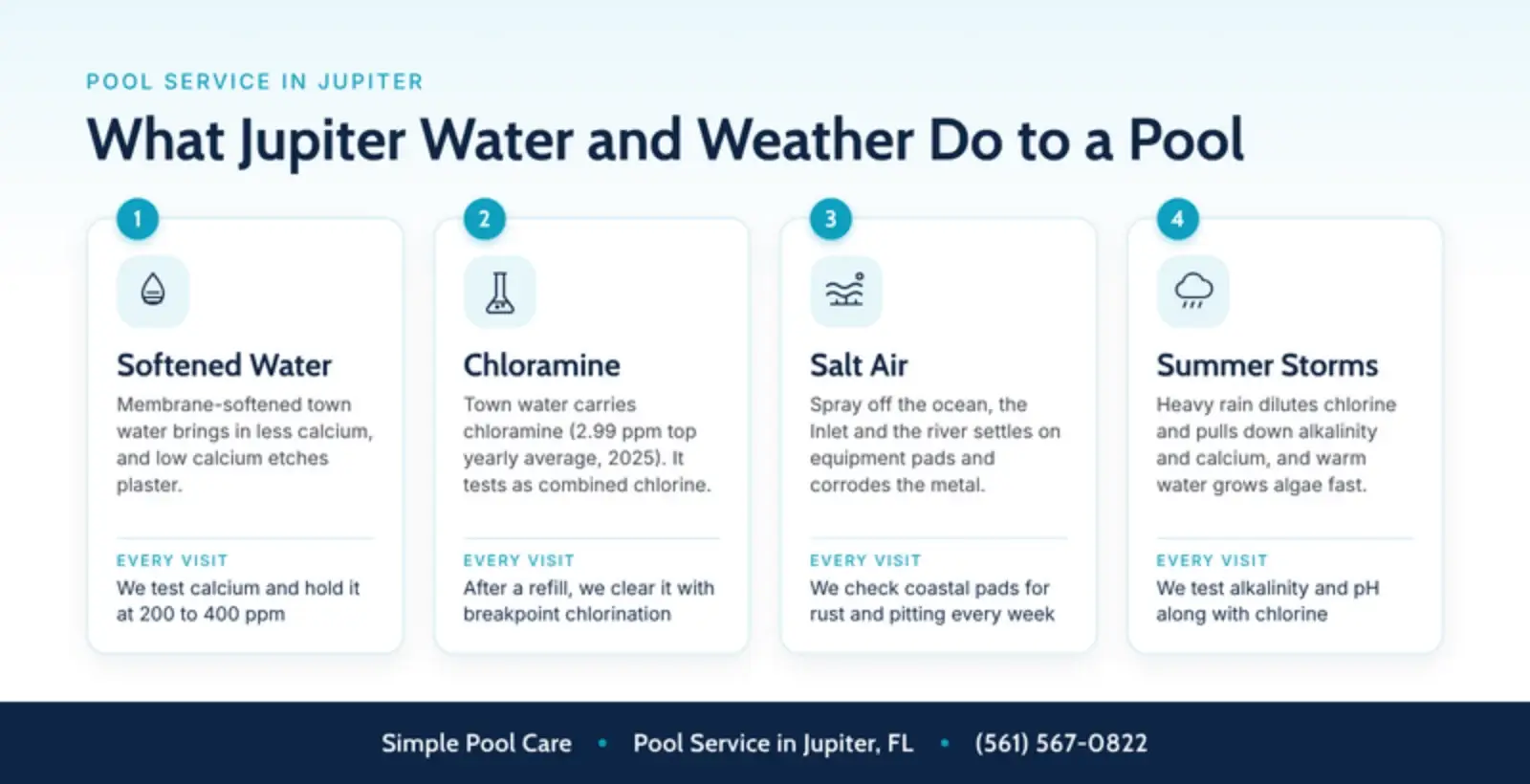
Four local conditions shape pool service in Jupiter more than anything else. The town softens its water with membranes, and it disinfects with chloramine. Salt air hangs over the coastal side of town, and the summer storm season runs for months. Each one leaves marks you can see in the pool if nobody is watching for them.
The Town's Membrane-Treated Tap Water
Jupiter Utilities pulls its water from 63 wells. According to the town’s 2025 water quality report, 12 of those wells reach the brackish Floridan Aquifer more than 1,500 feet down. The other 51 draw from the shallow surficial aquifer at about 150 feet. Reverse osmosis treats the deep, salty water, and nanofiltration treats the shallow water. Both are membrane processes.
Nanofiltration replaced the town’s old lime softening plant, so the water that reaches your hose has already been softened. That’s good news for shower heads and coffee makers. For a pool, though, it means the fill water brings in less of the calcium that plaster and tile grout need to stay intact.
Calcium Hardness Matters More With Softened Fill Water
Water that is short on calcium is aggressive. It pulls what it’s missing out of whatever it touches, which means plaster, grout and the copper and iron inside heaters and pumps. Plaster turns rough and etched over time. The metal it dissolves doesn’t disappear either, because it can come back later as stains.
So we test calcium hardness instead of assuming it, and we hold it between 200 and 400 ppm. When it runs low, calcium chloride brings it back up. Heavy rain and topping off with softened water both pull the number down over a summer. That’s why a reading from April tells you very little about the pool in September.
Chloramine When You Top Off or Refill
Jupiter disinfects its drinking water with chloramine instead of plain chlorine. The 2025 report lists 2.99 ppm as the highest running annual average, with single samples from 0.6 to 4.4 ppm. On a pool test kit, chloramine reads as combined chlorine. That’s the same number you’d see after a busy weekend with a pool full of swimmers.
A normal top-off adds so little that it barely moves the test. A full refill is different, since the pool starts out with combined chlorine already in it. We want combined chlorine at zero and won’t let it pass 0.2 ppm. Clearing it takes free chlorine at about ten times the combined number, and that’s breakpoint chlorination. Stop short of that number and the combined chlorine stays put.
| What | Jupiter tap water (2025 report) | What we hold in your pool |
| Disinfectant | Chloramine, 2.99 ppm highest annual average (samples 0.6 to 4.4 ppm) | Combined chlorine at 0 (never over 0.2 ppm), free chlorine between 2 and 4 ppm |
| Treatment | Reverse osmosis and nanofiltration, softened | Calcium hardness 200 to 400 ppm |
| Sodium | 46.8 ppm (sampled in 2023) | Salt cells need 3,000 to 3,500 ppm of salt |
Salt Air Near the Ocean, the Inlet and the River
Jupiter sits on the Atlantic where the river meets the Inlet, with the Intracoastal running through town. Near the water, salt spray settles on the equipment pad and stays there. Stainless screws rust at the heads, heater cabinets pit, and electrical connections start to corrode. We look for it on coastal pads every week, because corrosion caught early means replacing a fitting, not a heater.
Summer Storms and Heavy Rain
From June through September, afternoon thunderstorms are part of almost every week. A heavy one dilutes the chlorine, knocks total alkalinity down fast and fills the skimmer with leaves. Once alkalinity drops, the pH bounces around with every chemical you add. Add warm water and low chlorine, and algae gets going quickly.
After a big storm we test alkalinity along with chlorine and pH, not chlorine alone. Rain also lowers calcium. With softened fill water on top of that, the calcium number can slide all summer long if nobody measures it.
Metal Staining, TDS and Bonding in Jupiter Pools
Coastal pools here get a second kind of corrosion, and this one happens under the water. As total dissolved solids (TDS) climb, dissimilar metals in the system start reacting with each other. Picture a copper heat exchanger, stainless rails, a metal pump impeller and a light niche, all in one body of water. That’s galvanic corrosion. It shows up as discolored metal parts, or as copper staining on stainless steel.
TDS has no fixed maximum. The working rule is that it shouldn’t rise more than about 1,500 ppm over its level at start-up, and that start-up level includes the salt in a salt pool. Evaporation leaves solids behind every time the pool gets topped off, so older water keeps creeping up. In Jupiter, replacing part of the water works well, because membrane-treated fill water carries far less in it.
One caution near the water, where ground water sits high. Nobody should empty a pool before checking the hydrostatic relief valve. Ground water pushing up on an empty shell can crack it or even lift it out of the ground.
Tannin Stain or Metal Stain?
Dark stains under oaks and sea grapes are usually tannins from the leaves, and chlorine tends to bleach them out. Metal stains won’t budge for chlorine. So if you shocked the pool and the stain is still there, it’s metal. The fix starts with finding where the metal is coming from. Then a sequestering agent goes in first, and we balance the water after, not the other way round.
The Town of Jupiter's Pool Water Bonding Rule
Bonding ties the metal parts of a pool together so there’s no voltage difference between them. The Town of Jupiter Building Department requires a bond in contact with the pool water itself, with at least 9 square inches of conductive surface, under National Electrical Code 680.26(C). The town won’t count the pump or heater as that bond unless the paperwork on site shows it meets that rule. Its inspectors check for the bond before a new pool is filled.
That rule matters for stains, too. Copper staining on stainless can come from high TDS, and it can also come from poor bonding and grounding. If the water is balanced and the stain keeps coming back, have a licensed electrician check the bonding before you spend more on chemicals.
Pool Service in Jupiter: What Every Weekly Visit Covers
Each visit runs the same checklist, whether the pool looks perfect or not. The full routine is on our weekly pool service page. In Jupiter, these are the parts that matter most.
Six Readings on Every Visit
We test pH, free and combined chlorine, alkalinity, calcium hardness and cyanuric acid on each visit. Free chlorine should sit at 2 to 4 ppm and pH from 7.4 to 7.6, with alkalinity at 80 to 120 ppm and stabilizer at 30 to 50 ppm. Calcium gets more attention here than it would in a hard-water town, for the reasons above.
Stabilizer, or cyanuric acid, is worth a sentence of its own. Without it, sunlight can wipe out half the chlorine in an unprotected pool in under an hour. Add stabilizer and that chlorine survives the sun three to ten times as long. Too much, though, and chlorine stops doing its job. That’s a common way tablet-fed pools go green while the chlorine test still looks fine.
Brushing, Vacuuming and Baskets
Each visit covers skimming, vacuuming the floor, brushing walls and steps, and dumping the skimmer and pump baskets. Brushing scrubs off biofilm, a slimy film bacteria build to shelter in, and lets chlorine get at them. Under oaks and palms, the baskets fill fast in spring, and a packed basket starves the pump of water. That’s the part of pool cleaning in Jupiter that changes most with the seasons.
Equipment and Filter Checks
Every visit includes a look at the pump, filter, heater and timer, and at the salt cell on salt pools. Sand and DE filters get a backwash once the gauge has gained 8 to 10 psi on its clean reading. On coastal pads we also look for rust, loose fittings and pitted heater cabinets, the early signs of salt air at work.
Pools That Sit Empty for Part of the Year
A pool with nobody swimming in it still needs chemistry, because sun, rain and leaves keep working on it. Frost is rare here and winters are mild, so Jupiter pools run year-round and don’t get closed for the season. Weekly service keeps going while you’re away, and each report shows you where the water stands.
Our Pool Services in Jupiter
Weekly service is the base. Beyond that, our pool services in Jupiter fall into four groups, and each group has its own page with the details.
Pool Cleaning in Jupiter
Our pool cleaning work covers weekly service plus the jobs that come up around it. That means filter cleaning, tile cleaning to take calcium and body oil off the waterline, and spa cleaning for attached spas. Pool cleaning in Jupiter also means more netting after storms and in spring.
Pool Repair in Jupiter
Most equipment trouble comes down to the pump, the filter or the heater. We handle pool repairs on all the major brands, from pool pump repair to pool heater repair. We find the cause and price the job before touching anything. On coastal pads the heater’s heat exchanger deserves a close look, since salt air works on it from outside and water chemistry from inside.
Equipment Installation in Jupiter
When a repair stops making sense, we handle equipment installations, including variable speed pumps, gas heaters, heat pumps and filters. For new pools, the town’s permit checklist calls for a separate gas permit when a gas heater goes in.
Green Pools, Acid Washes and Salt Systems in Jupiter
The bigger one-off jobs come under our specialty pool services. Green to clean recovery gets most pools swimmable within 24 to 72 hours, and without draining, which counts for a lot near the water. An acid wash does need a drained pool, so the hydrostatic relief valve comes first. Salt systems need their cells cleaned as scale builds on the plates.
What Pool Service in Jupiter Costs
Full weekly pool service in Jupiter starts from $170 per month. Chemical-only plans start at $100. Chemicals are built into both prices. On the full plan, the filter gets cleaned twice a year. If you’ve been shopping for monthly pool service in Jupiter, this is it: a visit every week, one bill each month, and no separate chemical charges.
Most repairs fall between $100 and $800. Replacing a pump capacitor is about $150 including labor. Motor and shaft seal jobs land at $250 to $600, heater repairs at $200 to $800, and filter repairs at $100 to $500. We find the problem and price it before any work begins.
Installed prices run $1,500 to $2,800 for a variable speed pump. Gas heaters are $2,000 to $4,000 installed, heat pumps $3,000 to $7,500, and filters $300 to $1,000. Installation quotes are free.
Specialty work is priced by the job. Green pool cleanup runs $250 to $800. An acid wash costs $300 to $700, and a drain, when one is needed, adds $150 to $250. A saltwater conversion costs $1,500 to $3,000, and automation is $2,000 to $5,000 with installation.
Request Pool Service in Jupiter
Tell us about your pool, and we’ll tell you what it needs and what it costs. Use the form to request a quote, or call (561) 567-0822 and talk it through. You can also read more about how our pool service company works and what each plan includes.
Pool Service in Jupiter FAQs
What people ask before they book pool service in Jupiter, with short answers. Don’t see yours? Call (561) 567-0822.
Pool Service in Jupiter: Prices, Plans and Timing
In Jupiter, Simple Pool Care's full weekly plan starts at $170 a month, and the chemical-only plan starts at $100. Both plans cover the chemicals, and the full plan adds a filter cleaning every six months. Repairs get diagnosed and priced before any work starts, and most fall between $100 and $800.
Yes. Simple Pool Care bills weekly service as one monthly price, so you get a visit every week and one bill each month. Chemicals are part of that price, so there are no separate chemical charges. We also don't ask you to sign a contract for weekly service.
Yes. Jupiter winters are mild and frost is rare, so pools stay open and run all year. Chlorine demand drops as the water cools, but leaves, rain and sun still work on the chemistry. Cooler water also leans toward corrosive conditions, so we keep checking the balance every week.
Yes. Simple Pool Care services homes anywhere inside Jupiter, from Abacoa to Admirals Cove and the oceanfront and riverfront neighborhoods. In a gated community such as The Bear's Club, add us to your gate or vendor list, so the technician can reach the pool and equipment while you're away.
Simple Pool Care is owner-run, licensed and insured, rated 5.0 on Google, and factory trained on Hayward, Pentair, Jandy and Zodiac equipment. We test for what Jupiter pools actually face, from low calcium in softened fill water to salt air on coastal equipment, and send a report after every visit.
Jupiter Water, Weather and Common Problems
Scale isn't the problem here. Jupiter Utilities uses reverse osmosis and nanofiltration, which took over from the old lime softening plant, so fill water comes in softened. Etching is the bigger worry, since calcium-poor water eats into plaster and grout. Our calcium target is 200 to 400 ppm.
Yes, a little. Jupiter disinfects with chloramine (a 2.99 ppm high annual average in the 2025 water quality report), and your test kit will log it as combined chlorine. A routine top-off hardly changes the reading. After a full refill, we shock to roughly ten times the combined reading, which clears it.
Salt spray off the ocean, the Inlet and the river settles on equipment pads and corrodes fasteners, heater cabinets and wiring connections. Inside the pool, rising TDS adds galvanic corrosion between dissimilar metals. Simple Pool Care checks coastal equipment every visit and tracks TDS against your pool's start-up level.
Storm rain thins out the chlorine, drags total alkalinity down and carries leaves in, and warm water lets algae grow fast. Clear water on a Friday can be green by Monday. Our green to clean service usually has it swimmable within 24 to 72 hours, for $250 to $800.
It depends on your equipment. A salt cell turns dissolved salt, kept at roughly 3,000 to 3,500 ppm, into chlorine, so you stop buying it. Conversion runs $1,500 to $3,000. Near the water, check the bonding and metal parts first, because higher TDS speeds galvanic corrosion.
