
Weekly Pool Service in West Palm Beach, FL
Weekly pool service in West Palm Beach with the chemicals included, from $170 a month. Each weekly pool maintenance visit covers water testing, brushing, vacuuming and an equipment check.

Weekly Pool Maintenance on One Monthly Plan
A week is roughly how long a pool here can go without attention before something starts moving the wrong way. Chlorine and pH are the two readings that change fastest, and in summer both can drift by Thursday.
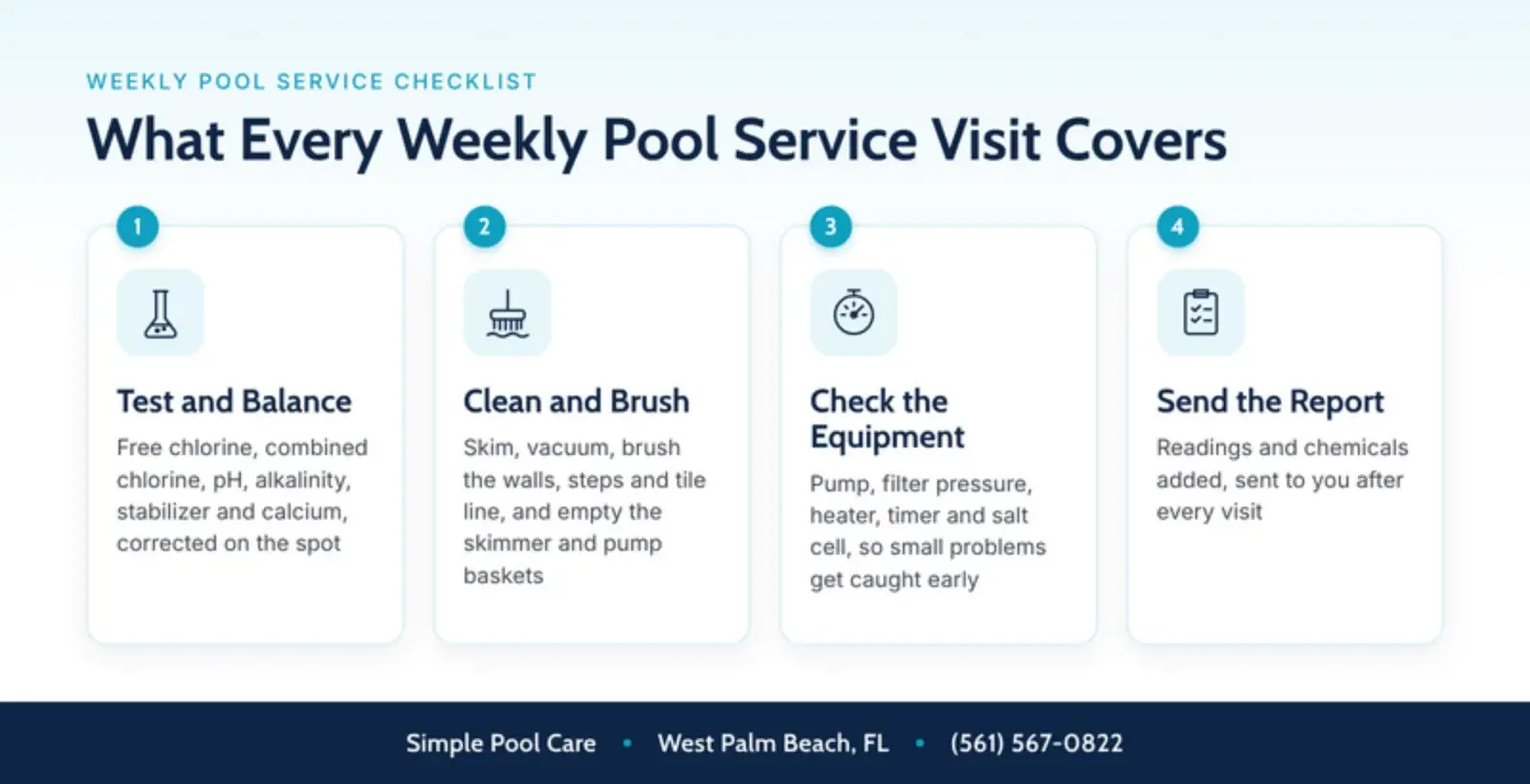
That’s why weekly pool service is the core of our pool cleaning work. One visit covers four jobs: we test the water and correct it, clean the pool, check the equipment, and leave you a report with the readings, so you always know what we found and what we added.
The same technician comes every week, so somebody actually knows your pool. They’ll hear the pump change pitch or see the filter pressure creep up long before either one turns into a repair bill. And if you spend the summer up north, the pool doesn’t sit unattended while you’re gone.
You pay one price a month, and the chemicals are part of it. Full service starts at $170 a month, while chemical-only starts at $100 if you’d rather net and brush the pool yourself. Either way, it works like monthly pool service: one visit every week and one bill at the end of the month, with no separate chemical charges.
If the pool is already green when you call, we start with a green to clean recovery. Most green pools are swimmable again within 24 to 72 hours, usually without draining. After that, the weekly visits keep it from happening again.
Why a Week Is the Limit for a South Florida Pool
Four things in our climate work against a pool in Palm Beach County, and they stack on top of each other. None of them is dramatic alone. Together, though, they’re why a pool that looked fine last Tuesday is cloudy by the next one.
Sun and Heat Burn Off Chlorine
Sunlight here eats chlorine at a rate that catches people off guard when they move down from up north. Without stabilizer, the sun can destroy half the chlorine in a pool in under an hour. Warm water also grows algae faster, so the margin for a missed week is thin.
Stabilizer, or cyanuric acid, makes chlorine last three to ten times longer in the sun, which is why we test it on every visit. It doesn’t kill anything by itself, though. Too little and the sun wins. Too much and the chlorine stops doing its job, which we explain further down.
Hard Water Builds Scale
Our water is mineral heavy. As it evaporates in the heat, the calcium stays behind and settles on the heater, the salt cell and the tile line. Calcium also gets less soluble as water warms up, so the heater is often the first place scale forms. A pool that sits out of balance for a few weeks starts laying down scale you can see, plus scale you can’t see inside the heat exchanger.
Once calcium hardness is high, the only practical way to lower it is to drain part of the pool and refill. So with hard water, we hold the pH and alkalinity where they need to be to keep the water balanced. Doing that every week stops the buildup early, and it’s why a well-kept pool needs an acid wash far less often.
Leaves, Pollen and Palm Fronds
The landscaping people move here for drops leaves, flowers and pollen into the skimmer all year. Oaks shed in spring, palms drop fronds and seed pods, and ficus hedges never seem to stop. Meanwhile, every leaf that sinks feeds algae and uses up chlorine while it breaks down. Lawn fertilizer and bird droppings add phosphates, and algae feed on those too.
A screen enclosure keeps most of that out. That’s why a screened pool is genuinely less work than an open one under trees.
Afternoon Storms in the Rainy Season
From June through September, the afternoon storms come almost daily. A heavy one dumps fresh rainwater into the pool and dilutes the chlorine. It can also drop total alkalinity fast, which leaves the pH free to swing. At the same time, it blows debris in and loads up the filter.
When a big storm passes through, we net out the debris and bring the chemistry back where it belongs. Between storms, weekly pool service catches the drift before algae gets a foothold.
Swimmers, Sunscreen and Pets
Then there’s how the pool gets used. Every swimmer brings sweat, sunscreen and body oil into the water, and all of it uses up chlorine. A holiday weekend with a full pool can burn through more sanitizer than the rest of the week combined. A quick rinse before getting in cuts down how much of that ends up in the water.
Dogs add plenty of organic load too. So if yours swims every day, the pool needs closer watching, and the weekly test shows us when to raise the chlorine before the water turns.
What Happens If You Stretch It to Every Two Weeks
Plenty of people ask whether every other week would do. In a South Florida summer, it usually doesn’t. Two weeks unattended in August often means a green to clean instead of a cleaning, and that recovery usually costs more than the visits you saved.
Every two weeks can work for a screened pool with no trees overhead, light use and cooler winter weather. Even then, the chemistry swings further between visits. So for most pools here, weekly pool service is the schedule that actually holds. Our pool maintenance schedule guide breaks down what to check daily, weekly and monthly.
The first warning signs are easy to miss. The steps feel slippery, the water loses a little sparkle, or the corners look faintly dull. Algae usually starts in corners and other spots where the water barely moves. And when conditions are right, it can turn a clear pool green in less than a day.
What We Do on Every Weekly Pool Service Visit
Every weekly visit follows the same routine, so nothing gets skipped just because the pool looks fine. Here’s what the visit covers.
Water Testing and Balancing
On every visit, we test free chlorine, combined chlorine, pH, total alkalinity, cyanuric acid and calcium hardness. Then we correct whatever has drifted, using chemicals that are already part of your monthly price.
Total alkalinity is the buffer that holds pH steady. When it runs low, the pH swings with every rainstorm. When it runs high, the pH drifts up and gets very hard to bring down, and the water can turn cloudy. The right number also depends on your chlorine. Liquid chlorine pools do best at the low end, around 80 to 100 ppm, while trichlor pools need the higher end. Getting alkalinity right first makes every other reading easier to hold through the week.
pH is the one most people underestimate. Free chlorine comes in a strong form and a weak form, and the strong one kills germs 60 to 100 times better. The pH decides the split. At 7.5, about half your free chlorine is in the strong form. At 7.8, only about a third is. So a pool can read 3 ppm of chlorine and still sanitize poorly, just because the pH drifted up. The CDC guidance for home pools makes the same point. We aim for 7.4 to 7.6, close to the pH of your eyes, which is why balanced water doesn’t sting.
Combined Chlorine and When We Shock
Combined chlorine is the other one worth knowing. It forms when chlorine reacts with sweat, urine and other waste swimmers bring in, and once it does, it’s a poor sanitizer. When a pool smells strongly of chlorine, that smell is combined chlorine, not free chlorine. It means the pool needs shocking, not less chlorine, and it’s the most common thing homeowners get backwards.
Ideally, combined chlorine reads zero, and we don’t let it climb past 0.2 ppm. To clear it, the free chlorine has to reach about ten times the combined reading. That’s called breakpoint chlorination, and stopping short of it doesn’t finish the job. The weekly test tells us when it’s due, so the pool gets shocked when it needs it rather than on a fixed day.
Cleaning and Brushing
We skim the surface, vacuum the floor, empty the skimmer and pump baskets, and brush the walls, steps and tile line. The tile line gets extra attention, because body oils collect there and algae often gets its start in the grout.
Brushing isn’t cosmetic, and it’s the step that gets skipped. It lifts biofilm off the walls. That’s a slime layer bacteria build to protect themselves, and bacteria inside it can take up to 100 times more chlorine to kill. On a surface that already has algae, brushing breaks it open so the chlorine can reach it. Dose a pool perfectly, skip the brushing, and you can still watch it go green.
Emptying the baskets matters more than it looks. A basket packed with leaves starves the pump of water, which is called cavitation. You’ll hear the pump change pitch, and if it keeps running that way, it can damage the pump and motor. In fall, when the oaks drop, a basket can fill in a few days.
One caution if you brush it yourself: stainless bristles are for plaster, while plastic bristles are for vinyl or fiberglass. Used regularly on the wrong surface, a steel brush will damage the finish.
Equipment and Filter Checks
We look over the pump, filter, heater, timer and the salt cell if you have one. What we’re after are the things that are cheap this week and expensive next month: rising filter pressure, air in the pump basket, a motor that has changed pitch or a cell scaling up.
Filter pressure is the useful one to watch. Rising pressure with good flow means the filter is loading up. On sand and DE filters, we backwash once the gauge reads about 8 to 10 psi above its clean starting point, unless the manufacturer says otherwise. Cartridges get hosed off at about the same point, and deep cartridge cleans fall under filter cleaning. Low pressure with a full basket is a different problem: something is restricting the suction side.
Run time matters more than people think. One full turnover, where the pump moves the pool’s whole volume through the filter, only cleans about 63 percent of the water. That’s because filtered water keeps mixing back in with the rest. It takes about four turnovers to filter 98 percent. In our summer, most home pools need 8 to 12 hours of run time a day. Plenty of the stubborn algae problems we get called to aren’t chemistry problems at all. They’re a timer somebody shortened to save power. If that sounds like your setup, a variable speed pump lets you run longer and slower for less than you’re paying now.
On salt pools, we check the cell and the salt level. Most cells reverse their charge to shed scale, but hard water still builds it up on the plates, and chlorine output drops as it does. Salt usually sits around 3,000 to 3,500 ppm. Backwashing, rain and splash-out all carry some away, so it needs topping up.
Water Level and Evaporation
We check the water level on every visit and keep it around the middle of the skimmer opening. If it drops below the opening, the skimmer starts pulling air into the pump. Air in the line makes the pump cavitate, and that wears it out early.
During the summer, a pool here can lose about a quarter inch a day to evaporation, and more on windy days. If the level drops a lot faster than that week after week, it’s worth checking for a leak. A simple bucket test on the steps tells you whether it’s evaporation or something else.
The Numbers We Work To
These are the operating ranges we balance to on every weekly pool service visit.
| Free chlorine | 2 to 4 ppm |
| Combined chlorine | 0 (no higher than 0.2 ppm) |
| pH | 7.4 to 7.6 |
| Total alkalinity | 80 to 120 ppm |
| Calcium hardness | 200 to 400 ppm |
| Cyanuric acid | 30 to 50 ppm |
| Salt (salt pools only) | 3,000 to 3,500 ppm |
| Saturation index | between -0.3 and +0.3 |
Cyanuric acid is the one that quietly ruins pools around here. It’s the stabilizer that protects chlorine from the sun. If you sanitize with trichlor pucks or dichlor, you add more every single time. Once the chlorine in each dose is used up, the stabilizer stays behind and keeps building. Too much of it ties up your chlorine, so the test still reads fine while the chlorine does less and less work, and algae gets its chance. The usual way down is draining part of the pool and refilling, which is why we’d rather catch it at 60 than at 150.
High stabilizer also throws off the alkalinity reading. About a third of the cyanuric acid number shows up as alkalinity, so we subtract it before we work out the balance.
The saturation index rolls pH, temperature, calcium hardness, alkalinity and total dissolved solids into one number. Balanced water sits between -0.3 and +0.3. Below that, the water starts pulling calcium out of your plaster. Above it, the water lays scale on the heater and tile. Our hard water pushes pools toward the scaling side, so keeping it in range matters. If yours has already scaled at the waterline, that’s pool tile cleaning rather than chemistry.
Your Weekly Pool Service Report
After every visit, you get a digital report showing what we did, what the readings were, what we added and anything that needs watching.
It matters most if you travel or spend part of the year up north. You can see the pool was serviced and what state the water was in when we left. And if a reading looks off, the report tells you before the pool does.
What Weekly Pool Service Costs
Full weekly pool service starts at $170 a month. That covers the weekly visits, all routine chemicals and filter cleaning twice a year.
Chemical-only starts at $100 a month. It suits owners who are happy to net and brush themselves and just want the chemistry handled properly.
Both plans include the chemicals, so check that when you compare quotes. A rate that leaves out the chemicals isn’t the rate you end up paying.
What moves the price is pool size, whether you have a screen enclosure, how much tree cover sits over the water and what shape it’s in when we start. A pool that’s already green is a recovery job first and a weekly account after that.
There are no contracts. If we’re not doing the job, you can stop.
Plans That Fit How You Use the Pool
Not every pool needs the same visit. A screened pool with nothing overhanging it is less work than an open pool under ficus, and it shouldn’t cost the same.
We also look after seasonal homes, rentals and Airbnb properties where the pool has to be right on turnover day. Salt pools get their cell inspected instead of ignored, because salt systems are lower maintenance than chlorine, not no maintenance.
Weekly service is one part of our pool service in West Palm Beach, which also covers repairs and new equipment. Request a quote or call (561) 567-0822, and we’ll take a look at the pool before quoting a number.
Weekly Pool Service FAQs
These are the questions we get most from people deciding on weekly service. Don’t see yours? Call (561) 567-0822.
Cost, Plans and Scheduling
Simple Pool Care's weekly pool service starts at $170 a month for full service and $100 a month for chemical-only, with routine chemicals included in both. Full service also covers filter cleaning twice a year. Elsewhere in West Palm Beach, full weekly service usually runs about $130 to $230 a month.
In South Florida, yes. Sun, heat and summer storms burn through chlorine fast, and in the right conditions algae can turn a clear pool green in less than a day. Two weeks without a visit in August is often enough. Every other week can work for a screened, shaded pool with light use in winter, but the chemistry swings further between visits.
Every visit from Simple Pool Care covers six water tests and balancing, skimming, vacuuming, brushing the walls and tile line, and clearing out the skimmer and pump baskets. We also check the pump, filter, heater, timer and salt cell, then send a digital report with the readings.
No. Simple Pool Care doesn't use contracts for weekly service, so if we're not doing the job, you can stop.
Simple Pool Care is owner-operated and based in West Palm Beach, licensed and insured, with a 5.0 Google rating. The same technician handles your pool every week, chemicals are included, and you get a report after each visit showing what was tested and added.
Water Chemistry and Common Problems
We balance to free chlorine of 2 to 4 ppm, pH of 7.4 to 7.6, total alkalinity of 80 to 120 ppm, calcium hardness of 200 to 400 ppm and cyanuric acid of 30 to 50 ppm. Combined chlorine should be zero, and never above 0.2 ppm.
Because it doesn't have enough working chlorine. That smell is combined chlorine, which forms when chlorine reacts with sweat and urine and mostly stops sanitizing. So a strong chlorine smell means the pool needs shocking, not less chlorine.
Not automatically. Shock it when combined chlorine climbs above 0.2 ppm, after heavy use or a big storm, or at the first sign of algae. To clear combined chlorine, raise free chlorine to about ten times the combined reading. Weekly testing tells you when it's due.
Most cloudy water comes back to the filter, the circulation or the water balance. A loaded filter, a pump timer cut too short, or high alkalinity or calcium can all leave the water dull. Early algae clouds the water before it turns green, too. We check filter pressure and run time every visit, then fix the balance.
Plenty of people do, especially with a screened pool and nothing overhead. Where it usually goes wrong is stabilizer. Trichlor pucks add cyanuric acid every time, and it builds up until your chlorine reads fine while doing very little. That's when most DIY pools go green. The pucks are also acidic, so they drag pH and alkalinity down.
