
Green Pool Cleaning and Algae Removal in West Palm Beach, FL
Premium Green to Clean Pool Treatment Services for Homeowners Across West Palm Beach, FL and surrounding areas

Schedule Service!
Rapid Green to Clean Recovery in West Palm Beach, FL
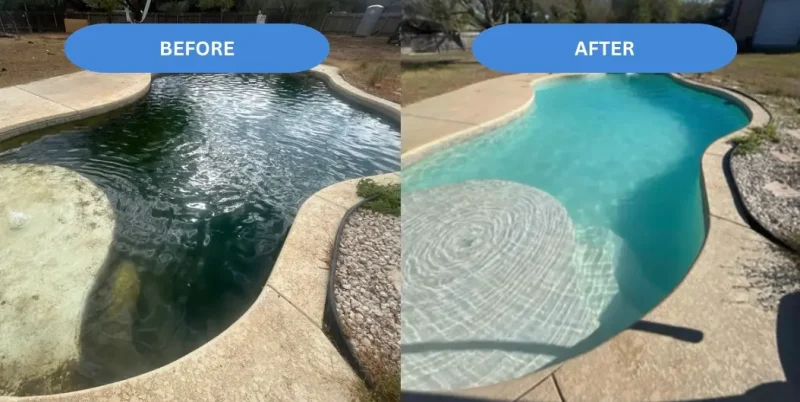
You come home from a trip, or your pump quits for a few days, and the pool has gone full swamp. Cloudy, green, maybe you can’t even see the bottom. It happens fast down here, and the good news is it’s fixable fast too. Simple Pool Care does green-to-clean recovery all over West Palm Beach and Palm Beach County, and we’ll get your water back to clear and swimmable, usually without draining a drop. Call (561) 567-0822 or request a free quote.
How a pool goes green so fast here
If yours turned green in a few days, you’re not imagining it, and there’s a specific reason rather than a vague one.
In an outdoor pool with no stabilizer in the water, sunlight can destroy half the free chlorine in under an hour. That’s what UV does to chlorine, and it’s why a pool can read fine on Friday and be green on Monday. Add water in the low nineties, a couple inches of rain a week, and pollen and debris blowing in, and the margin for error gets very thin.
After that it only takes one thing going wrong. A pump that stops circulating, a filter that has quietly clogged, or a week where nobody added chlorine. Algae spores arrive in your pool by the millions on the wind every day, and they’re only waiting for the sanitizer to hit zero. Once it does, a clear pool can turn green in less than a day.
A pool up north might take two weeks to do what yours does over a long weekend.
Need pool service? Get in touch with us and schedule your FREE pool service quote from Simple Pool Care
What it costs to clean a green pool in West Palm Beach
Honest answer: it depends on how bad it is. Most green-pool cleanups in our area run about $250 to $800, including the chemicals, the labor, and the follow-up visits it takes to get fully clear. A true “swamp” you can’t see into, or one that’s been sitting for weeks, runs higher, sometimes into the $1,000-plus range if it needs heavy treatment or a drain. We come look, tell you exactly where yours falls, and give you a flat quote before we start. No guessing.
How fast can you clear it?
Faster than most people expect. Rough timeline:
- 24 to 48 hours for a light green or early bloom that’s just starting to tint.
- 3 to 5 days for moderate to heavy green, depending on how hard your filter has to work.
- Up to a week for a full swamp or a pool with an equipment problem we have to fix first.
One thing that can add a day. When the particles left in the water are too fine for your filter to catch, we use a flocculant, which clumps them together so they sink instead. That means circulating to mix it in, then shutting the pump off for 12 to 24 hours while everything settles to the floor, then vacuuming the pile straight to waste rather than back through the filter. The pump sits idle for most of a day and it’s still the fastest route on a badly clouded pool.
We monitor it daily and keep you posted, and we don’t call it done until the water’s clear, balanced, and safe to swim in.
Good news: usually no draining required
Our green-to-clean process
- We test your water and inspect your filter and pump to find out why it went green in the first place.
- We hit it with a high dose of chlorine shock, plus professional algaecide for stubborn or thick blooms.
- We brush every wall, step, and corner to break the algae loose so the chemicals can finish it off.
- We run and clean the filter (and vacuum the dead algae off the bottom for bad cases) to clear the water.
- We rebalance everything (pH, alkalinity, chlorine, stabilizer) so it stays clear and doesn’t bounce right back.
For a really neglected pool, we’ll repeat the treatment over a couple of days until it’s genuinely done, not just looking a little better.
Why the Shock From the Pool Store Did Nothing
Almost always because the dose was too small, and there’s a real number behind that.
To push past the combined chlorine in a pool and reach the point where chlorine starts genuinely killing things, free chlorine has to be raised to roughly ten times the combined chlorine reading. That’s a threshold, not a sliding scale. Anything under it and you’ve spent money nudging the chlorine up without crossing the line where the chemistry changes. The water looks a little better for a day and then goes straight back.
A pool that’s been green for a week has a large chlorine demand sitting in it. One bag of shock in a fifteen thousand gallon pool isn’t close.
Then there’s what was in the bag. Some products sold as “shock” are oxidizers, not disinfectants. Non-chlorine shock built on potassium monopersulfate will clear haze and burn off organic waste, and it won’t kill algae, because there’s nothing in it that disinfects. If the label makes no disinfectant claim, it won’t clear a green pool no matter how much you use.
This is why so many people spend a weekend and a cart full of chemicals and call us anyway. It isn’t that they did it wrong. They were sold the wrong amount of the wrong thing.
Not All Algae Is Green Algae
This matters before you buy anything, because the three types don’t respond the same way.
Green algae is what most people have. It’s by far the most common and the easiest to kill. It clouds the water and coats the walls, and it gives way to chlorine and brushing.
Mustard algae, also called yellow algae, looks like a dusting of sand or dirt on shady walls and steps. It brushes away easily and is back in the same place two days later. It usually needs an algaecide formulated specifically for it, because an ordinary chlorine dose won’t finish it.
Black algae is the hard one. Dark spots with a protective layer over the top, growing where circulation is weakest, which is usually the deep end corners. The layer has to be broken open mechanically before any chemical touches the organism underneath. Killing black algae is as much brushing as it is chemistry.
If you’ve been shocking a pool for a week and the same spots keep coming back in the same places, you probably don’t have green algae. That’s why the treatment isn’t working.
One more place algae likes to start: the grout at your waterline. Grout is porous where the tile is not, so it holds body oils and sunscreen, and that residue is a nutrient base. If your waterline has a heavy band of scale and grime, cleaning the tile line is part of algae prevention and not just appearance.
The Algaecide Mistake That Ends in an Acid Wash
Be careful with copper.
Copper based algaecides work, and they work on almost everything, including black algae, which is genuinely difficult to kill. The problem is that copper ions stain, and a green pool is exactly the situation where somebody pours copper in and then shocks heavily on top of it.
Here’s what that combination does. Raising the pH or hitting the water with a large chlorine dose drives copper out of solution and onto your surfaces. High pH gives you black oxide staining. Copper bonding with carbonate gives you blue-green staining on plaster. If your stabilizer level is high, copper can bond with cyanurate and leave a purple stain. It will also turn blond hair green, which is how most people find out there was copper in their water in the first place.
None of that brushes off. Getting it back means draining and acid washing the plaster, which costs more than the green pool cleanup would have and takes the pool out of service for longer.
We do use algaecide, on stubborn black and mustard blooms where it earns its place, and we pick the chemistry around what’s already in the water. That decision is worth more than the product is.
Guests coming? We move fast for rentals and home sales
A green pool right before a closing, an inspection, or an Airbnb check-in is a special kind of stress. We get it, which is why we offer priority scheduling for rental and vacation-property owners, real estate agents, and anyone with people showing up soon. Tell us your deadline and we’ll do everything we can to have it sparkling before they arrive.
Why it happened, and keeping it from coming back
Clearing the green is step one. Step two is making sure you’re not paying for it again next month, and most of that comes down to one number.
Cyanuric acid, which you probably know as stabilizer or conditioner, is what protects chlorine from sunlight. With it in the water at the right level, chlorine residuals last three to ten times longer than they do without it. Without it, half your free chlorine can be gone inside an hour on a sunny day.
The range is 30 to 50 ppm. Below that and you’re burning chlorine off faster than you can add it, which is the most common reason a pool here goes green. Well above it and more of your chlorine ends up bound to the cyanurate and doing less work than your test strip implies, which is why the CDC’s guidance for home pool owners raises its recommended minimum from 1 ppm free chlorine to 2 ppm as soon as stabilized chlorine is in use, at a pH between 7.0 and 7.8.
The part that catches people out: stabilizer doesn’t break down and doesn’t evaporate. It builds every time a trichlor tablet dissolves, and the only way to bring it down is to dilute the water. Easy to overshoot, hard to undo, worth testing rather than guessing.
One thing not to bother with. Pool stores will sell you a phosphate remover on the theory that starving algae of nutrients prevents it. Algae blowing into your pool from outside can already be carrying phosphate stored inside its own cells, so removing it from the water doesn’t starve anything. Keeping a sanitizer residual in the water at all times is what prevents algae. There’s no shortcut around that.
The rest of the causes are mechanical. A tired or clogged filter, a weak pump, or a gap in maintenance while life got busy. Once the water is clear, the cheapest insurance is staying on top of it. Our weekly pool service keeps the chemistry balanced and the equipment watched so a missed week doesn’t turn into a recovery bill. A salt system or automation makes it easier still.
Get your pool swimmable again
Don’t let a green pool sit and get worse, and harder to fix. We clear green pools across West Palm Beach and most of Palm Beach County, including Palm Beach Gardens. The full list of areas is at the bottom of this page. Call Simple Pool Care at (561) 567-0822 or request your free quote online. Local, licensed, insured, and 5-star rated by your neighbors all over Palm Beach County. Green-to-clean is one of our specialty pool services, and we’ll have your backyard back in no time.
We Are Experts With:




Your Trusted Pool Service Partner
It’s easy to get started with Simple Pool Care.
Trusted by 100+ homes throughout West Palm Beach and neighboring cities.
We treat our customers like family, which is why we crafted our Pool Service plans to service our customers with the utmost professional service so you can enjoy your pool worry free.
Built Around Reliable Service
We show up when we say we will, we quote before we start, and we tell you what your pool actually needs rather than what’s easiest to sell. That’s most of it.
Over 10 years of experience in the pool service industry spanning across 2 counties.
Servicing over 100+ customers a year while maintaining a 5 star rating from our clients.
When you choose Simple Pool Care, you have a friend in the industry you can trust.
We are available day and night for our customers. We take your business seriously.
Frequently Asked Questions
The questions we get asked most often about green pools.
Most green-pool cleanups in our area run about $250 to $800, including chemicals, labor, and the follow-up visits needed to fully clear the water. A severe "swamp" pool that's been neglected for weeks can run higher, sometimes $1,000 or more, especially if it needs heavy treatment or a drain. We assess your pool first and give you a flat, itemized quote before any work begins.
It depends on how bad the bloom is. A light green pool usually clears in 24 to 48 hours, a moderate to heavy one in about 3 to 5 days, and a full swamp or a pool with equipment problems can take up to a week. We monitor your pool daily and keep you updated, and we don't consider it finished until the water is clear, balanced, and safe to swim.
Usually not. The large majority of green pools here can be recovered with shock, algaecide, brushing, and filtration, no draining required. We only recommend draining for the rare pool that's too far gone for chemical recovery, or when heavy staining is left behind. Avoiding an unnecessary drain protects your plaster and saves water, so we always try to recover the water first.
In an outdoor pool with no stabilizer in the water, sunlight can destroy half the free chlorine in under an hour. That's the mechanism behind almost every fast bloom here. Add water in the low nineties, summer storms, and pollen blowing in, and there's very little margin left. After that it takes one thing going wrong, a pump that stops circulating, a clogged filter, or a week nobody added chlorine. Algae spores arrive by the millions on the wind every day and are only waiting for the sanitizer to reach zero. Once it does, a clear pool can go green in less than a day.
Almost always saved. The vast majority of green pools come back to clear, swimmable water with proper treatment, no draining or replastering needed. In rare cases of long-term neglect, a drain or, if the surface is stained, an acid wash may be recommended after the water is clear. We'll tell you honestly which path your pool actually needs.
No, you should stay out until it's properly cleared. Green water means algae and bacteria are present, which can cause skin, ear, and eye infections, and you can't see the bottom, which is a real drowning and safety hazard. It also breeds mosquitoes in our climate. We get the water sanitized, balanced, and safe before anyone gets back in.
Start with stabilizer, because it's the number most people never check. Cyanuric acid protects chlorine from sunlight, and with it in range your chlorine residual lasts three to ten times longer than without it. The range is 30 to 50 ppm. Below that you burn chlorine off faster than you can add it. Well above it, more of your chlorine sits bound to cyanurate and works less than the test suggests. Stabilizer doesn't break down or evaporate, so the only way to lower it is diluting the water, which makes it easy to overshoot. After that it's the ordinary things, keeping chlorine and pH in range, running the pump long enough especially after storms, and keeping baskets and filters clean. Weekly pool service is the simplest version of all of that.
Usually because the dose was too small. To break past the combined chlorine in a pool and actually start killing algae, free chlorine has to be raised to roughly ten times the combined chlorine reading. That's a threshold, not a gradual scale, and under it the chemistry doesn't change. A pool that has been green for a week has a very large chlorine demand, and one bag of shock in a fifteen thousand gallon pool doesn't come close. The other possibility is what was in the bag. Some products sold as shock are oxidizers rather than disinfectants. Non-chlorine shock based on potassium monopersulfate clears haze and burns off organic waste, and it won't kill algae, because nothing in it disinfects. If the label makes no disinfectant claim, it won't clear a green pool.
Be careful, especially with copper based products. Copper algaecides work well on almost every algae type, including black algae, but copper ions stain, and a green pool is exactly the situation where people add copper and then shock heavily on top of it. Raising pH or adding a large chlorine dose drives the copper out of solution and onto your surfaces. High pH produces black oxide stains, copper bonding with carbonate produces blue-green stains on plaster, and if your stabilizer is high, copper can bond with cyanurate and leave purple staining. It will also turn blond hair green. None of it brushes off, and removing it means draining and acid washing, which costs more than the cleanup would have. We do use algaecide where it earns its place, on stubborn black and mustard blooms, and we choose it around what's already in the water.
