
Pool Acid Wash West Palm Beach, FL
Premium Pool Acid Wash for Homeowners Across West Palm Beach, FL and surrounding areas

Schedule Service!
When Brushing and Shocking Stop Working
If your pool has gone dingy, blotchy, or a few shades darker than it used to be, and no amount of brushing or shocking brings it back, an acid wash is usually the fix. It strips away years of stains and calcium and leaves the plaster looking close to brand new. Simple Pool Care does professional acid washing all over West Palm Beach and Palm Beach County, safely, and only when your pool actually needs it. Call (561) 567-0822 or request a free quote.
What an acid wash actually removes
An acid wash is not a cleaning. It’s controlled etching, and that distinction is the whole reason we’re careful with it. We drain the pool, then work a diluted acid across the bare plaster to take off a very thin top layer of the surface, and whatever is stained into it comes off with the layer. Nothing is being lifted off the plaster. A small amount of plaster is being removed.
What comes off:
- Calcium scale on the plaster itself, on walls, steps and the floor.
- Algae stains and black-algae scars baked into the plaster pores.
- Mineral and metal stains like iron and copper that brushing won’t touch.
- Yellowing, graying, and blotchiness from sun and old chemical imbalance.
- Leftover marks from a green-pool episode or a filter that quit on you.
When we’re done you have a brighter surface and a pool that looks years younger.
One boundary worth knowing, because it saves people money. The white band on the tile at the waterline is a different job. That’s glazed tile, and it comes off with media blasting without draining anything and without touching your plaster. If the calcium is only on the tile, you don’t need an acid wash and we’ll tell you so. If it has crept below the tile onto the plaster, that’s when the two jobs get done together.
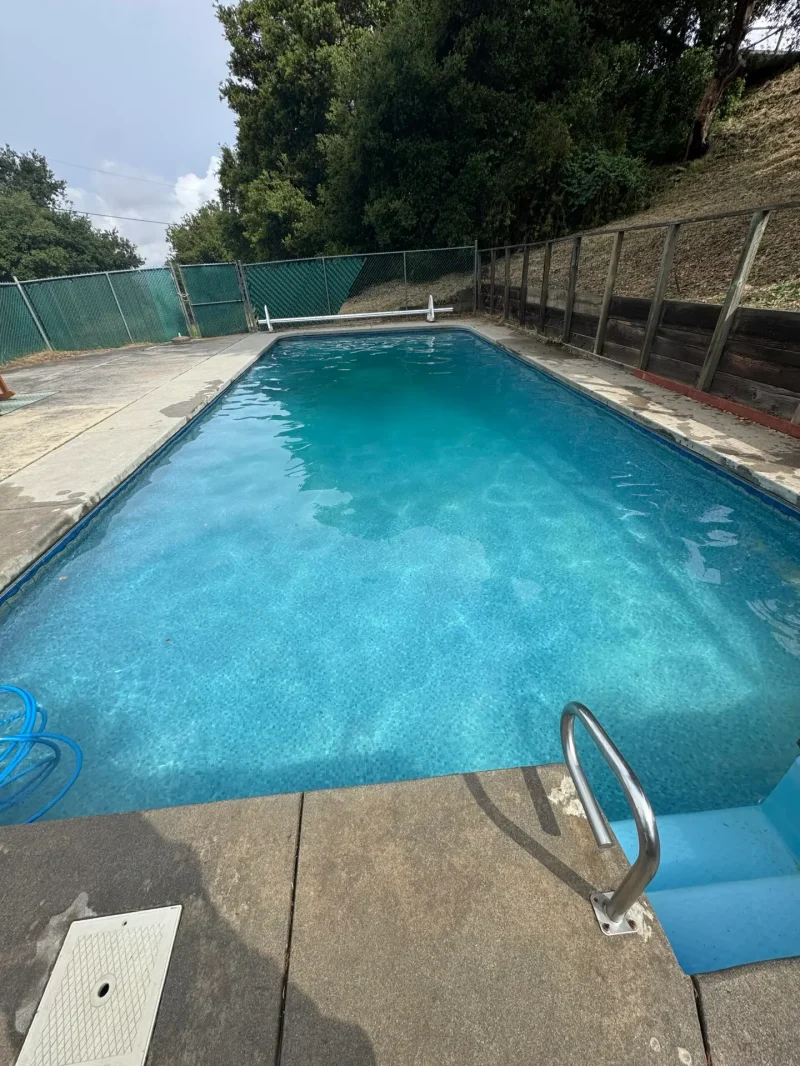
Need pool service? Get in touch with us and schedule your FREE pool service quote from Simple Pool Care
Signs it's time for an acid wash
You’re likely a candidate if you see:
- Stains that won’t lift no matter how much you brush, shock, or add algaecide.
- Heavy calcium scale on walls, steps, or the waterline.
- Black-algae spots or streaks stuck in the plaster.
- A dull, blotchy, uneven surface that just looks tired.
- Algae that keeps coming back even when your chemistry is fine (spores trapped in the plaster).
- A pool that hasn’t been drained or deep-cleaned in 5-plus years.
Not sure? We’ll come take a look and tell you honestly whether an acid wash is the right move or overkill for what you’ve got.
Why the Stain Is In the Plaster and Not On It
Because plaster is made partly of the same thing the water is trying to take out of it.
Pool plaster is a cement product, and calcium carbonate is one of its main ingredients. That’s why water chemistry matters far more on a plaster pool than on a fiberglass or vinyl one. Fiberglass has no calcium in it for the water to go after. Your plaster does.
When water tips corrosive it starts dissolving calcium out of the surface, and corrosive water can etch plaster in a surprisingly short time. The combination that causes it is low calcium hardness together with low pH or low alkalinity. Once the surface is etched it’s microscopically rough, and rough surfaces hold stains, hold algae spores, and stain faster next time. That’s why a neglected pool goes downhill at an accelerating rate rather than a steady one.
Our pool tile cleaning page explains the saturation index in full. The short version is that it’s one number combining pH, alkalinity, calcium hardness and temperature. Above +0.4 the water deposits calcium on your tile. Below -0.4 it takes calcium out of your plaster. Most pools around here drift toward the depositing end. The pools that need acid washing have usually spent time at the other one. Calcium hardness wants to sit between 200 and 400 ppm.
The other half is where the stain came from. Iron and copper stains have a source, and the source is usually fill water, a corroding piece of equipment, or an algaecide. If the source is still feeding metal into the water when the pool is refilled, the stain comes back on the new surface. Removing a stain without finding what caused it is the most common way an acid wash gets wasted, and it’s one of the first things we check.
And sometimes the answer is that you don’t need us. Dark stains under where a tree sits are usually tannin stains from leaves and acorns, and chlorine will often bleach those straight out. That’s worth trying before anyone empties a pool. What we will say is don’t leave it too long either way. Stains get harder to remove the longer they sit.
Draining a Pool in South Florida Is the Risky Part
The acid is the part you can be careful with. The drain is the part that can damage your house.
An empty pool in an area with a high water table can float out of the ground. Water in the ground presses up on the underside of the shell, and normally the weight of twenty thousand gallons sitting inside holds it down. Take the water out and the only thing left resisting that pressure is the shell itself. In much of Palm Beach County the water table is close enough to the surface for that to be a real number rather than a theoretical one, and it goes up after a wet week.
This is why in-ground pools built in high water table areas are supposed to have a hydrostatic relief valve set into the lowest point of the floor. Its entire job is this one situation. When pressure builds underneath, the valve opens and lets groundwater into the empty pool, which relieves the upward push and keeps the shell where it is. It only does that if it works, and plenty of them have been sitting under a plaster surface untested since the pool was built.
So before we drain anything, we check it. On some properties that isn’t enough on its own and well points go in around the pool, tied to a pump that draws the water table down around the shell while the pool sits empty.
The rule in the trade is short. Never lower the water in ground conditions where the pressure underneath can damage the structure, unless you have confirmed the pool is protected first. A rental trash pump doesn’t come with that check.
Then there’s where the water goes. Twenty thousand gallons of pool water isn’t rainwater. It carries chlorine, and after an acid wash it carries whatever we’ve just neutralized. The line taking it has to have the capacity for it, and the local water district sets what can be discharged and at what quality. That’s part of the job and part of the price, not something to sort out afterwards.
None of this is a reason to avoid acid washing a pool that needs one. It’s the reason it’s a scheduled job done by people who have looked at your pool first, and the reason our first question is never “when can we drain it.”
What an acid wash costs in West Palm Beach
Ballpark for our area, a standard residential pool runs about $300 to $700, with most homeowners landing around $450. It’s usually priced by surface area, roughly $0.40 to $0.60 a square foot, so a bigger pool costs more. Add $150 to $250 for draining if that’s part of the job. We give you a flat, itemized quote after we see the pool, with no surprises.
Important: an acid wash is a last resort, not routine
Here’s something a lot of companies won’t tell you. Every acid wash removes a thin layer of plaster, so your pool can only handle it a limited number of times over its life, usually one to two, maybe three for thicker plaster. That’s exactly why we don’t push it as regular maintenance. We only recommend an acid wash when stains genuinely can’t be removed any other way, and if your plaster is already thin, chipping, or brittle, we’ll steer you toward gentler options like a stain treatment, a chlorine wash, or, when it’s truly worn out, resurfacing. The goal is to make your pool beautiful without burning through plaster you can’t get back.
Worth putting a number on it. Most pool interior surfaces need replacing at some point regardless, and every acid wash brings that date closer. When we tell you your plaster is too thin for another one, we’re not upselling you a resurface. We’re telling you the cheaper job would take material off a surface that has none left to give.
Acid wash or chlorine wash?
Quick rule of thumb: acid wash for mineral problems, chlorine wash for living problems. If it’s calcium, scale, and hard-water stains, that’s an acid wash. If it’s algae, mold, or a pool that went green and grew a science experiment, that’s usually a chlorine wash to disinfect the surface. A pool that’s been neglected a long time sometimes needs a bit of both, and we’ll sort out the right mix when we inspect it.
The best time to acid wash in Florida
Timing matters down here. The ideal window is the cooler months, late fall through early spring, when water temps are down and algae growth slows. Draining and exposing the plaster in the dead of a South Florida summer is harder on the surface and invites quick re-staining. If your pool can wait, we’ll often suggest scheduling it for the cooler season for the best, longest-lasting result.
Done the safe way (this isn't a DIY job)
Muriatic acid is hydrochloric acid, and full strength it runs around 31 percent and fumes off the surface of the container. OSHA sets a ceiling exposure limit of 5 ppm for hydrogen chloride in air, and 50 ppm is the concentration considered immediately dangerous to life and health. Those are small numbers, and they’re the reason we work it diluted, in gear, and with the wind at our backs.
Handled wrong it does three things. It burns whoever is holding it, it cuts too deep and permanently etches the plaster in patches you’ll look at for the next ten years, and it goes into the ground or the storm drain unneutralized.
What we actually do: drain and inspect, confirm the pool is safe to leave empty, protect your fittings and equipment, work the acid across the surface in controlled passes, neutralize completely, and dispose of the wastewater properly. Then refill and rebalance, which matters more than most people expect.
The 28 Days After the Refill
Freshly acid washed plaster behaves like new plaster, and new plaster has a month where it decides how it’s going to look for the rest of its life.
A pool finish hydrates mostly within its first 28 days, and during that window it’s at its most vulnerable to staining, scaling and discoloration. You’ve just paid to expose a clean surface. This is the month where that either holds or gets undone.
The refill sequence isn’t the order most people use, and the order matters:
- Total alkalinity to about 80 ppm.
- pH to 7.2 to 7.6.
- Calcium hardness to at least 150 ppm, raised slowly and not past about 200 ppm across the 28 days.
Adjust them out of that order and you spend the month chasing your own corrections while the surface takes the damage. Alkalinity first is the part people skip, and it’s the part that makes the pH hold still.
The pool also gets brushed thoroughly, twice a day, to clear plaster dust off the new surface, and it gets watched rather than left alone. This is the strongest argument for putting a pool on weekly service straight after a wash rather than a month later.
One note if the answer for your pool turns out to be resurfacing instead of an acid wash. A brand new plaster surface takes no salt for 28 days, so if you run a salt system the cell stays off and the pool runs on liquid chlorine for the first month. It’s a small thing that gets missed and it damages a new finish.
Perfect before you sell, rent, or after a green pool
An acid wash is one of the fastest ways to make a pool look cared-for. It’s a favorite for homeowners getting ready to list or appraise, new owners who inherited a neglected pool, and rental and Airbnb owners who need it guest-ready in a hurry. And if your pool just came back from a rough green-to-clean battle but the stains stuck around, an acid wash is often the final step to truly reset it.
Make your pool look new again
Stop staring at a stained, tired pool. We cover West Palm Beach and most of Palm Beach County, and the full list of areas is at the bottom of this page. Call Simple Pool Care at (561) 567-0822 or request your free quote online. Local, licensed, insured, and 5-star rated by your neighbors all over Palm Beach County. Acid washing is one of our specialty pool services, and once your surface is bright again we’ll keep it that way with weekly pool service so it doesn’t stain right back up.
We Are Experts With:




Your Trusted Pool Service Partner
It’s easy to get started with Simple Pool Care.
Trusted by 100+ homes throughout West Palm Beach and neighboring cities.
We treat our customers like family, which is why we crafted our Pool Service plans to service our customers with the utmost professional service so you can enjoy your pool worry free.
Built Around Reliable Service
We show up when we say we will, we quote before we start, and we tell you what your pool actually needs rather than what’s easiest to sell. That’s most of it.
Over 10 years of experience in the pool service industry spanning across 2 counties.
Servicing over 100+ customers a year while maintaining a 5 star rating from our clients.
When you choose Simple Pool Care, you have a friend in the industry you can trust.
We are available day and night for our customers. We take your business seriously.
Frequently Asked Questions
The questions we get asked most often about acid washing.
A standard residential pool typically runs about $300 to $700, with most homeowners landing around $450. It's usually priced by surface area, roughly $0.40 to $0.60 per square foot, so larger pools cost more. If draining is part of the job, add about $150 to $250. We give you a flat, itemized quote after we see your pool, and you approve it before any work begins.
An acid wash is a last resort, not routine maintenance. Because it removes a thin layer of plaster each time, most pools can only handle it safely one to two times (occasionally three for thicker plaster) over the life of the surface. We only recommend it when stains truly can't be removed any other way, and we'll always tell you if your plaster is too thin to do it safely.
Yes. A traditional acid wash means working on bare plaster, so the water has to come out. That's also the part that needs the most care in South Florida, because an empty pool in a high water table area can float out of the ground if the pressure underneath isn't relieved. In-ground pools built in these conditions are supposed to have a hydrostatic relief valve in the floor for exactly this, and we check it before we drain anything. For lighter or more specific staining there are sometimes no-drain stain treatments that get you most of the way there, and we'll recommend the least invasive option that will actually work.
The cooler months, roughly late fall through early spring, are ideal. Lower water temperatures slow algae growth and are easier on freshly exposed plaster, which means better, longer-lasting results. If your pool can wait, we'll often suggest scheduling it for the cooler season.
It depends on the problem. Acid washing targets mineral issues like calcium scale and hard-water stains. A chlorine wash targets living, organic problems like algae, mold, and bacteria, common after a pool has gone green. Pools that have been neglected a long time sometimes need a combination of both. We inspect the staining and water history to recommend the right one.
It removes some of it, and that's the point. An acid wash is controlled etching, not cleaning. Taking off a very thin layer is what exposes the fresh, bright surface underneath, so a small amount of plaster loss is the mechanism rather than a side effect. Done in moderation by people who know when to stop, that's a fair trade. Done badly, or done too many times, you get permanent uneven etching and a surface that needs resurfacing years early. If your plaster is already thin, chipping or brittle, we'll tell you and steer you toward a stain treatment, a chlorine wash, or resurfacing instead.
An acid wash removes the stubborn stains a green pool leaves behind, but it's usually the final step, not the first. If your pool is currently green, we clean and rebalance the water with our green-to-clean service first, then assess whether an acid wash is needed to remove any staining left in the plaster.
It can, and it's more of a South Florida problem than a general one. Groundwater presses up on the underside of a pool shell, and normally the weight of the water inside holds it down. Empty the pool and that weight is gone. In much of Palm Beach County the water table sits close enough to the surface for this to matter, and it rises after heavy rain. That's why in-ground pools built in high water table areas have a hydrostatic relief valve at the lowest point of the floor. It opens under pressure and lets groundwater in, which relieves the push from below. It only works if it works, and plenty have never been tested. We check it before we drain, and on some properties we'll draw the water table down around the pool with well points while it sits empty.
Usually because the source of the stain is still there. Iron and copper stains come from somewhere, most often fill water, a corroding piece of equipment, or an algaecide, and if metal is still entering the water when the pool refills it will stain the fresh surface the same way it stained the old one. Finding and stopping the source has to happen before the stain removal, not after. The other cause is water balance. Freshly exposed plaster is at its most vulnerable for about 28 days, and if the water isn't brought into range in the right order during that window the new surface picks up stains and scale fast.
