
Pool Filter Installation in West Palm Beach, FL
Pool filter installation in West Palm Beach, sized to your pump and your pool. Whether it’s a first install or a pool filter replacement, we fit cartridge, sand and DE filters to manufacturer spec.

Pool Filter Replacement Sized to Your Pump and Pad
Most people call us about a new filter because the old one gave up. The tank cracked, the lid won’t seal, or the water stays dull however often you clean it. Sometimes nobody makes parts for that model anymore.
A filter does a job chlorine can’t. Chlorine kills most germs, though not all of them fast, and the CDC notes that Crypto can survive more than 7 days in properly treated water. Chlorine won’t remove dirt and dead algae either. Something has to catch those and carry them out, and clear water comes from filtration, circulation and chemistry working together. It matters for safety too, because you need to see the main drain and anyone in trouble near the bottom.
Pool filter replacement is part of our pool equipment installation work. We’re licensed and insured, and we’re factory trained on Hayward, Pentair, Jandy and Zodiac. Every filter goes in to manufacturer spec, which is also what keeps the warranty valid.
We’ll tell you when a new filter isn’t the answer, too. A torn element, a broken lateral or a sticking valve is often a pool filter repair. And a filter that’s simply loaded with oils may only need a deep filter cleaning.
When it is time for a new one, most pool filter installations land between $300 and $1,000. Type and size decide most of it, and any plumbing changes decide the rest. The quote is free. Give us a call at (561) 567-0822 to set up a visit.
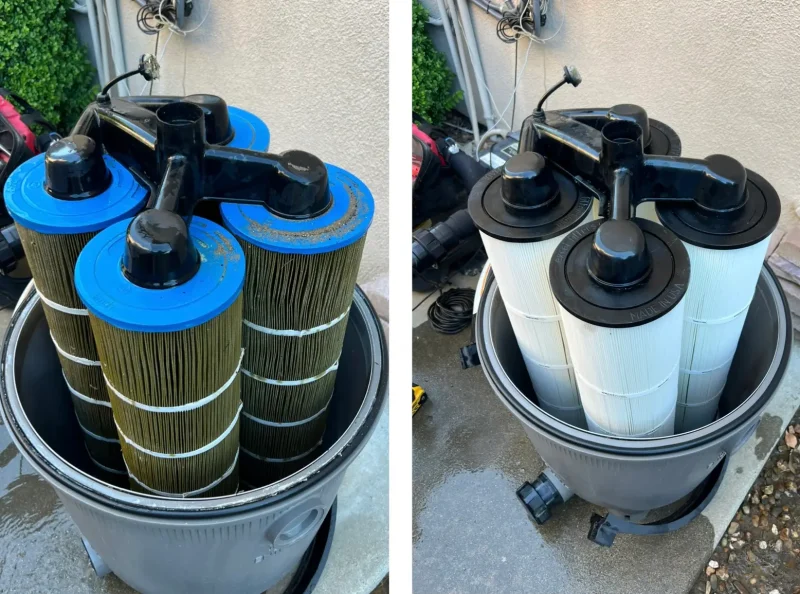
Signs It's Time to Replace Your Pool Filter
A filter rarely dies all at once. It slides, and the signs show up on the pressure gauge and in the water long before the tank fails. These are the ones we look at when deciding between a cleaning, a repair and a pool filter replacement.
Pressure That Stays High After a Cleaning
Every filter has a clean starting pressure, the gauge reading right after a backwash or a cleaning. As the media loads up, the pressure climbs and the flow drops. You backwash sand and DE filters at about 8 to 10 psi above that starting point, and clean cartridges at about 10 psi above it.
The warning sign is a gauge that won’t come back down. If the pressure stays high right after a thorough clean, or the time between cleanings keeps shrinking, oils or minerals have plugged the media and won’t let go. A chemical soak sometimes brings it back. On an old filter, it often doesn’t.
Water That Won't Clear Up
Cloudy water has plenty of causes, and most of them aren’t the filter. Short run times, algae and poor water balance all cloud a pool. But when the chemistry checks out, the pump runs long enough and the water still looks dull, the filter is letting fine particles through. A torn cartridge, a damaged grid or a broken lateral will all do it.
You can check clarity yourself. Standing on the deck, you should be able to see the main drain clearly. If you can’t, the water isn’t clear enough to swim in safely.
Cracks, Leaks and Parts Nobody Makes
A cracked or warped tank, a lid that won’t hold pressure or a leak at the body seam means replacement. You don’t patch those on a vessel that sits under pump pressure for hours every day.
Age counts too. Our pumps run most of the year, so filter tanks here are often due around 8 to 12 years. Parts decide it more often than age, though. Once the manufacturer stops making grids, laterals or a tank band for your model, a small repair turns into a hunt, and replacing usually costs less than chasing parts.
Cartridge, Sand or DE: Which Filter to Install
All three types do the same job. They differ in how fine they filter, how you clean them, how much water they use and how much room they take on the pad.
| Filter | How it’s cleaned | Design flow per sq ft | Worth knowing |
|---|---|---|---|
| Cartridge | Hose off and soak, no backwash | 0.375 to 1.0 gpm | About half the pad space, most sensitive to high flow |
| Sand | Backwash to waste | 5 to 20 gpm, 15 typical | Cheapest to buy, coarsest filtration |
| DE | Backwash, then recoat the grids | 2.0 gpm | Finest filtration, most upkeep |
Cartridge Filters
Cartridge is what we fit on most pool filter installations around here. There’s no backwash, so you don’t dump a few hundred gallons of water, or salty runoff, onto the yard each time you clean it. A cartridge filter also needs about half the floor space of a sand or DE system that moves the same water, which counts on a crowded pad.
Cleaning means pulling the elements, hosing them off and soaking them in a filter cleaner once oils build up. Use the degreaser before any acid cleaner, because acid can lock oils into the fabric. Many owners keep a spare set of cartridges, so the pool keeps running while the dirty set soaks.
The catch is flow. High water velocity hurts cartridges more than any other media. Push too much water through one and debris gets driven deep into the pleats, where cleaning won’t reach it.
Sand Filters
Sand is the cheapest to buy and the simplest to run. Water flows down through a bed of fine silica sand, and most of the filtering happens in the top few inches. As the bed loads up, the gaps between grains shrink, so a sand filter actually catches its finest particles late in the cycle, just before a backwash.
That’s why you backwash a sand filter by the gauge, not the calendar. Backwashing on a fixed schedule never lets the bed tighten up, and the water slowly loses its sparkle. The sand itself lasts for years before it needs one of our sand changes.
DE Filters
DE, or diatomaceous earth, filters the finest of the three. The powder coats fabric grids in a thin cake, about 1/16 to 1/8 inch thick, and that cake traps particles smaller than sand or cartridge media can hold. It suits owners who want the clearest possible water and don’t mind extra work.
And the work is real. After each backwash, fresh powder goes back in, usually about 2 ounces per square foot of grid, or whatever the filter’s label calls for. Don’t breathe the dust, keep the bag away from the pump motor, and never wash spent DE into a storm drain or a canal.
Backwash Water Is Also a Water Change
Backwashing has a side effect most people miss. Running a sand or DE filter through a backwash sends pool water to waste, and fresh water tops the pool back up. That’s a small, planned dilution, and it quietly carries off dissolved solids and built up stabilizer.
A cartridge pool never gets that. Total dissolved solids should stay within 1,500 ppm of where the pool started, and stabilizer keeps climbing if you use trichlor. So a cartridge pool eventually needs a partial drain on purpose. We still recommend cartridge for most pools here. We’d just rather you hear about the drain from us now than from a test kit later.
How We Size a Pool Filter Installation
Filter size isn’t a matter of taste. On every pool filter installation, it comes from three numbers: the filter area, the flow rate through it and the filter media rate, which is the most water a square foot of media can take. Filter area equals flow rate divided by media rate.
Start With the Pump's Top Flow
Turnover sets the floor. Six hours is the turnover most pool codes set for swimming pools, meaning the system pushes a full pool’s worth of water through the filter in six hours. For a 15,000 gallon pool, that’s 15,000 divided by 6 hours, then by 60 minutes, or about 42 gallons a minute.
The filter has to handle more than that, though. It has to cope with the most water the pump can push, so we size the filter to the pump’s maximum flow rate. Most pumps going in around here now are variable speed, so that means the flow at top speed, not the slow overnight setting.
Converting Flow Into Square Feet
Each media type carries its own rating. Cartridge handles 0.375 to 1.0 gallons a minute per square foot, DE handles 2.0, and high-rate sand handles 5 to 20, with 15 the usual design figure. Divide the pump’s top flow by that rate and you get the smallest filter that will do the job.
Say a pump moves 60 gallons a minute at full speed. At the conservative cartridge rate, that’s 160 square feet of cartridge. A DE filter would need 30 square feet of grid. Sand would need about 4 square feet of bed, and since sand area is the circle across the top of the bed, a 30 inch tank gives you about 4.9.
That’s why cartridges sell in hundreds of square feet and sand tanks in single digits. A 425 square foot cartridge isn’t nearly 90 times better than a 4.9 square foot sand filter. The data label lists the filter area, so you can check any quote against your pump.
What an Undersized Filter Does
Run more water through a filter than its media can take, and the damage happens where you can’t see it. In sand, dirt goes deep into the bed, backwashing stops clearing it, and water can channel straight through unfiltered. In a cartridge, the flow pushes dirt, minerals and oils into and through the element. On DE, it forces powder and oils into the grid cloth, which raises the pressure and shortens grid life.
From the deck it looks simpler. The pressure runs high, the filter clogs fast and needs constant cleaning, and the pump works harder the whole time. None of that improves with age.
Is a Bigger Filter Always Better?
On a cartridge, going one size up is close to free. You pay a bit more and give up some pad space, and in return the pressure stays lower and the cleanings come further apart.
Sand and DE are different. A sand bed needs about 15 gallons a minute per square foot during backwash to lift and scrub the sand, so a tank that’s too big for the pump never comes fully clean. On DE, it’s the water flow that holds the powder on the grids. With too little flow, the coating can fall off. So we match those two to the pump and leave the rounding up to cartridges.
Don’t fix it from the other end, either. Swapping in a bigger pump to suit an old filter can push more water than the drain covers, the piping and the filter can safely take. That’s a pool pump installation conversation, and we’d have it before you buy anything.
What Happens on Pool Filter Installation Day
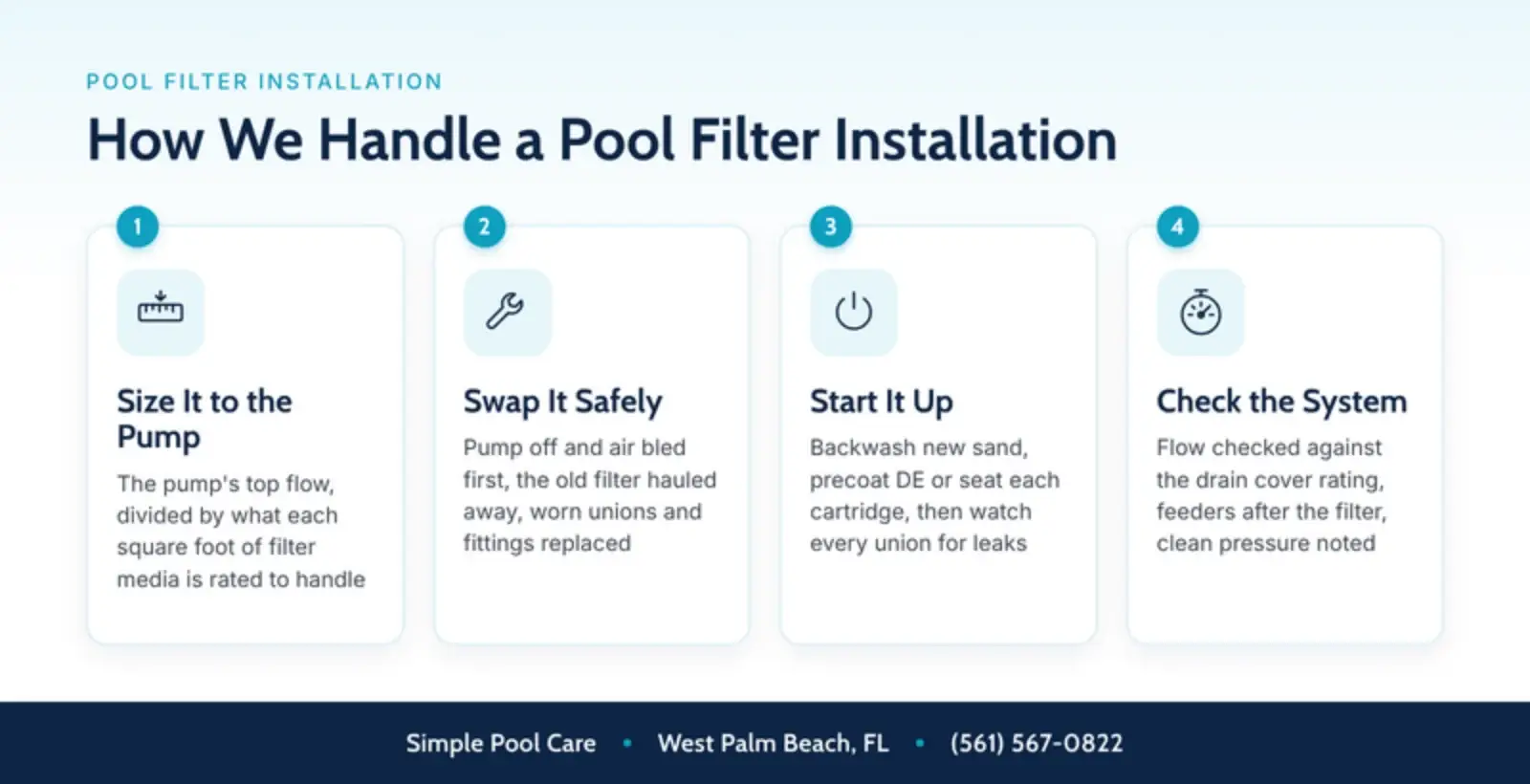
We usually finish a straight swap onto existing plumbing the same day. Repiping a pad or moving equipment takes longer, and we’ll tell you how long before we start. Either way, every pool filter installation follows the same four steps.
Shutting Down and Bleeding the Pressure
A pressure filter works under real force, and opening one the wrong way can blow a lid or clamp off hard enough to seriously hurt someone. So we switch the pump off and open the air relief valve before anyone touches a clamp or a valve handle. If you ever service your own filter, do it in that order every time.
Removing the Old Unit and Plumbing the New One
We take the old filter out and haul it away, then replace worn unions and fittings rather than reusing tired ones. The new filter goes on level, plumbed square to the pump and heater, with the valve placed where backwashing or cleaning is easy to reach.
We also check where your chemicals enter the system. Chlorinators and feeders belong after the filter and the heater. Feed chemicals in ahead of them and filter cycles get shorter, while the equipment they pass through can corrode.
Start-Up for Each Filter Type
We backwash a new sand bed several times at start-up to flush out the fines, the dust left over from processing the sand. If they stay in, oils stick to them and form mud balls. A new DE filter gets its first precoat of powder. On a cartridge, we check that each element sits on the center pipe, because an element that’s off center lets water slip past it unfiltered.
Then we check the lid O-ring, prime the pump, bleed the air out and run the system while we watch every union for leaks.
Checking Flow and the Starting Pressure
A new filter changes the resistance in the system, so the flow changes too. After any filter or heater replacement, we check the flow so the drain covers never see more than their rating. Drain covers carry a maximum flow rating because too much suction at the drain is an entrapment risk.
Last, we read the gauge on clean media and show you the number. You’ll measure every future cleaning against that clean starting pressure, so it’s worth writing down. Then we walk you through caring for the filter, so it lasts and the warranty stays intact.
Fitting a New Filter Into Your Equipment Pad
A filter never works alone. It sits between the pump and everything downstream, so we check how it fits the rest of the pad before we quote a pool filter installation.
Pad Space and Clearance
Plenty of Palm Beach County pads sit in a narrow side yard against a fence, with a heater and a salt cell already on them. On a tight pad, footprint stops being a preference and decides the filter. You also need room above the tank to lift the lid and pull the elements or grids, plus room around it to get a wrench on the unions.
Pump, Heater, Salt Cell and Controls
Matching the filter to the pump matters most on cartridge, since high flow is what wears cartridges out early. If you’ve been buying new cartridges every year, look at the pump before you look at the cartridge brand.
Heaters care about the filter too. A dirty or undersized filter cuts the flow, and low flow can make a heater cycle on and off before the water reaches temperature. If a heater is on your list, our pool heater installation page covers sizing it. A salt system or pool automation has to work with the new filter as well, so we plan the whole pad together.
Filter Brands We Install
We install filters from Pentair, Hayward and Jandy, including the Pentair Clean & Clear and FNS Plus lines and the Hayward SwimClear and ProGrid lines. We’re factory trained on Hayward, Pentair, Jandy and Zodiac, and every pool filter installation follows the manufacturer’s guidelines so the warranty stays protected. We’ll also tell you honestly when a mid range unit is plenty for your pool.
What Pool Filter Installation Costs
A pool filter installation usually runs $300 to $1,000 in our area, filter included. Where yours lands depends on the filter type and size, whether the plumbing or valve needs changing, and how easy the pad is to work on.
Sand is usually the cheapest to buy, while cartridge and DE cost more up front, and bigger filters cost more than smaller ones. Bolting a new filter onto sound plumbing is also a smaller job than rebuilding a tired pad. That’s why we quote after we’ve seen it.
Think about running costs as well. Cartridges need new elements once they stop cleaning up, sand needs changing every several years, and DE uses fresh powder after every backwash.
And if a repair will do, we’ll say so. Filter repairs usually cost $100 to $500, and there’s no sense replacing a tank with years left in it because one part failed. The quote is free either way.
Pool Filter Replacement as Part of Your Pool Care
A new filter stays at its best with steady care. Our weekly pool service includes filter cleaning twice a year, and we watch the pressure gauge on every visit, so we catch a loaded filter early.
Pool filter installation sits alongside our pump, heater and light installs on the pool equipment installations side of the business, and it all falls under our pool service in West Palm Beach. To get started, request a quote online or phone (561) 567-0822. We’ll look at the pad before we put a number on it.
Pool Filter Installation FAQs
Here’s what homeowners ask us most before replacing a filter. Don’t see yours? Call (561) 567-0822.
Cost, Sizing and Choosing an Installer
Most pool filter installations in West Palm Beach run $300 to $1,000, filter included. The price depends on the filter type and size, any plumbing or valve changes, and how easy the pad is to work on. Simple Pool Care quotes free after looking at your equipment.
Size the filter to your pump's maximum flow rate, divided by the media's rated flow per square foot. Cartridge handles 0.375 to 1.0 gpm per square foot, DE 2.0 and high-rate sand 5 to 20. So a pump moving 60 gallons a minute needs about 160 square feet of cartridge.
For most pools here, a large cartridge filter. It needs no backwash, saves water and takes about half the pad space of sand or DE. DE gives the clearest water but takes the most upkeep. Sand costs the least and runs simply, though it filters the coarsest.
Simple Pool Care usually finishes a straight swap onto existing plumbing the same day. Repiping the pad takes longer, and you get the timeline before work starts. Start-up is part of the job: backwashing new sand, precoating DE or seating cartridges, then checking for leaks and flow.
Simple Pool Care is a licensed, insured, owner-operated West Palm Beach company rated 5.0 on Google. We're factory trained on Hayward, Pentair, Jandy and Zodiac, size each filter to your pump's top flow, and install to the manufacturer's spec, which keeps the warranty valid.
Replacing, Upgrading and Living With a New Filter
Replace it when the tank cracks or leaks, the pressure stays high right after a thorough cleaning, or parts are no longer made for your model. Filter tanks here are often due around 8 to 12 years. A torn cartridge or one bad grid usually means a repair instead.
Only if the pump is failing or mismatched. The filter has to handle the pump's top flow, so we size the two together. Don't fit a bigger pump to suit an old filter, because the extra flow can exceed what the drain covers and piping can safely take.
Yes. A cartridge saves the water you'd lose to backwashing and needs about half the floor space of a sand system. Size it to the pump's top flow, because high flow hurts cartridges more than any other media. Without backwash dilution, the pool will eventually need a partial drain.
Only if the filter is the cause. Short pump run times, algae and poor water balance also cloud a pool, so check those first. If the chemistry and run time check out and the water still won't clear, a torn element, damaged grid or broken lateral is likely to blame.
Yes, now and then. Backwashing a sand or DE filter swaps some pool water for fresh, which dilutes dissolved solids and stabilizer. A cartridge filter never does that. Once dissolved solids reach about 1,500 ppm above where the pool started, a partial drain and refill is due.
