
Pool Pump Installation in West Palm Beach, FL
Pool pump installation in West Palm Beach, sized to your pool and wired to code. Most pool pump replacements now mean a variable speed pump, which runs quieter and costs far less to run.

Pool Pump Replacement Sized to Your Pool
Most pump calls we get come down to two things. The old one quit, or the power bill finally got someone’s attention. In July a dead pump gets urgent fast, because water that isn’t moving through the filter can start to turn within a couple of days.
Either way, a pool pump replacement is the best chance you’ll get to fix what the last install got wrong. If the old pump was too big for the plumbing, wired on an undersized circuit or never bonded, this is the day to sort it out.
Since July 2021, federal efficiency rules mean most replacement pumps for inground pools are variable speed. That works in your favor. A variable speed pump can run slow and long, so it filters the same water on far less electricity. It’s also much quieter at the pad.
We size the pump to your pool, not to the label on the old one. Then we plumb it, wire it to code, bond it, program the speeds and show you how it runs. We install Pentair, Hayward and Jandy pumps, and we’re factory trained on all three, plus Zodiac.
Not every noisy pump needs replacing, though. If it’s a capacitor or a worn seal, pool pump repair usually costs far less. We’ll tell you which one makes sense before you spend anything.
Why Pumps Wear Out Faster in South Florida
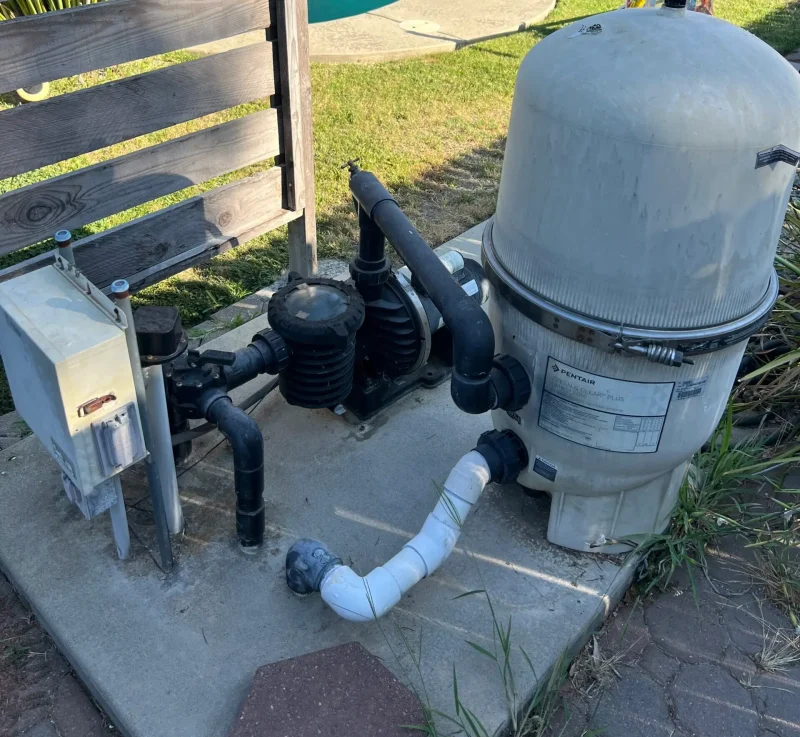
Up north, a pool pump gets the winter off. Here it runs every day of the year, often eight to twelve hours a day in summer. That makes it the biggest power draw on most equipment pads, and usually the first thing on the pad to wear out.
Heat is the main enemy. Pool motors can handle hot air around them, up to about 122 degrees. Even so, heat slowly breaks down the insulation in the motor windings. The hotter a motor runs, the faster that happens. So a motor boxed into a tight corner, or under a cover that traps its own hot air, dies early.
Then there’s what gets into the motor. Most pool motors pull outside air through the housing to cool themselves. Grass clippings and dust clog those vents. Chlorine or acid stored next to the pump gives off fumes that corrode the motor from the inside. Near the coast, salt air does the same to clamps and wiring.
Signs It's Time for a Pool Pump Replacement
Age is the first clue. Around here, a pump is often due somewhere between 7 and 10 years old, and sooner if it lives in salt air or full sun.
Noise is the second. A pump that has started to grind or screech is usually telling you the bearings are going. A pump that sounds like it’s gargling gravel is often starved for water, which is called cavitation. Cavitation can come from a clogged basket or an air leak, so we rule those out first. Left running that way, a pump can wreck itself and the motor.
Then there are the obvious ones. Water dripping from between the motor and the pump body, a breaker that keeps tripping, or a motor that hums and won’t start. And if you still run the single-speed pump the pool was built with, your power bill is a sign too.
Repair or replace comes down to age and the part. A start capacitor is about $150 with labor, and a motor or shaft seal runs $250 to $600. On a pump a few years old, that’s money well spent, and our pool pump repair page covers those fixes. On an old single-speed that needs a new motor, putting the money toward a variable speed pump usually makes more sense. If it’s a close call, you’ll see the price of both.
Variable Speed Pool Pump Installation
If your single-speed pump dies today, its replacement will almost certainly be variable speed, so variable speed pool pump installation is now the normal job. The federal efficiency standards that kicked in during July 2021 changed what’s on the shelf for most inground pools. The upside is real, though. For most West Palm Beach pools, a variable speed pump saves about $600 to $1,200 a year on electricity.
The savings come from running slower for longer. The default should be the lowest speed that does the job, with high speed saved for short tasks. Some states write exactly that into their efficiency rules. Running at low speed overnight, while nobody is swimming, is where most of the money gets saved.
Different Speeds for Different Jobs
A variable speed pump doesn’t run one speed all day. We set a low speed for everyday filtering, then higher speeds for the jobs that need more water. Vacuuming, spa jets, waterfalls and solar heating all need extra flow while they run.
The heater is the one people forget. A gas heater or heat pump has a pressure or flow switch that shuts it off when the water moves too slowly. So if the pump sits at its lowest speed when the heater calls for heat, you get a cold pool and no error you can see. We set a heating speed that keeps that switch happy, and we check the salt cell’s flow needs too.
Quieter at the Pad
At low speed, a variable speed pump is quiet enough that most people forget it’s running. That matters if the equipment pad sits under a bedroom window or right by the neighbor’s fence.
How We Size a Pump Before Any Pool Pump Installation
The right pump is the one that moves enough water through your filter, against your plumbing’s resistance, on the least power. Here’s how we work that out before we quote a pool pump installation.
Start With Flow, Not Horsepower
Turnover is the time it takes the pump to push the pool’s full volume of water through the filter. Codes for commercial pools set it at six hours, and we use the same yardstick to size a home pump. The math is simple: gallons divided by turnover hours, divided by 60, gives the gallons per minute the pump has to deliver. A 20,000 gallon pool on a six-hour turnover needs about 56 GPM.
One turnover isn’t enough to clean the water, because filtered water keeps mixing back into the rest. After one pass, about 37 percent of the water still hasn’t been through the filter. After two it’s 14 percent, after three it’s 5 percent, and after four it’s about 2 percent. That’s why run time and flow both matter.
| Pool size | Flow for a 6-hour turnover | Flow for an 8-hour turnover |
| 10,000 gallons | about 28 GPM | about 21 GPM |
| 15,000 gallons | about 42 GPM | about 31 GPM |
| 20,000 gallons | about 56 GPM | about 42 GPM |
| 25,000 gallons | about 69 GPM | about 52 GPM |
| 30,000 gallons | about 83 GPM | about 63 GPM |
Total Dynamic Head, Measured at the Pad
Every part of the system pushes back on the water. The pipe, each elbow and fitting, the filter, the heater and the return fittings all add resistance. Added together, that’s called total dynamic head, and it’s measured in feet.
With a clean filter, we read the vacuum gauge on the suction side and the pressure gauge after the pump. Inches of vacuum times 1.133 gives the suction head. Pressure in psi times 2.31 gives the pressure head. Add the two and you have the system’s real operating head. For example, 15 psi and 5 inches of vacuum works out to about 40 feet.
That number goes onto the pump’s performance curve, which shows how much flow a given pump delivers at that head. We also write it down. If the reading drifts later on, it can point to a worn impeller or filter media that’s due for replacement.
Why a Bigger Pump Backfires
For the same pipe size, doubling the flow roughly quadruples the friction loss. Push twice the water through the same pipe and the pump fights about four times the resistance, and you pay for every bit of it.
Too much flow is also a safety problem. Your drain covers are anti-entrapment covers rated for a maximum flow, and your filter and piping have limits too. A pump bigger than the system was built for can push past them, and an oversized motor raises the risk of suction entrapment at the drain. Too small is a problem too, because it won’t give you enough flow to keep the water clean.
Your filter pays for it as well. Cartridge filters handle high water speed worse than sand or DE. Push too much flow through one and dirt and oils get driven into the pleats and back out into the pool. Some of it never rinses out. ENERGY STAR makes the same point in its guide to whether bigger pool pumps are better.
The plumbing matters too. Large pipe with as few elbows as possible is the efficient layout, and once the pipe is in the ground, you can’t really change it. At the pad, though, we can. If the pad is a maze of tight fittings, installation day is the cheapest day to fix it.
Horsepower Labels and WEF
Don’t use the old pump’s horsepower as the target. Before 2021, pool motor horsepower ratings weren’t standardized, so two motors with the same number on the label could do very different work. What matters is the motor’s total horsepower, which is the nameplate horsepower times its service factor.
To compare two pumps on paper, look at the Weighted Energy Factor, or WEF. It works like miles per gallon, so higher is better. If we recommend a pump with a smaller label than the one you have, that’s usually the right call.
Pool Pump Installation Day, Step by Step
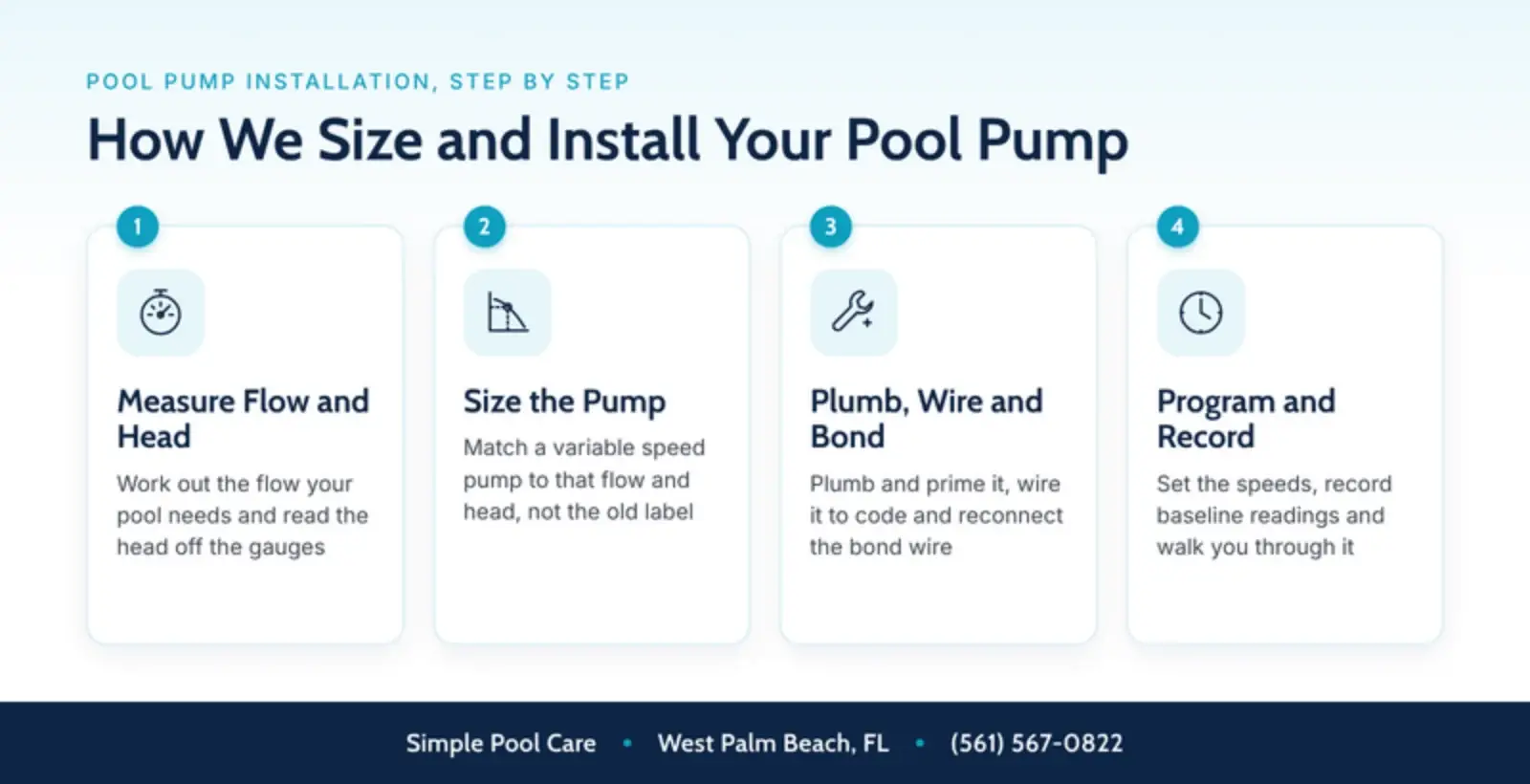
A pool pump installation onto existing plumbing usually takes a day, and it runs in four stages.
Plumbing and Priming
Most home equipment pads sit above the pool’s water level, so the pump has to be self-priming. That means it can pull water up from the pool and re-prime itself using the water in its own housing.
The suction side is where we take the most care. An air leak there lets the pump suck air instead of water, and that starves the impeller. The pump’s pitch changes when that happens, and a pump left to cavitate can do serious damage to both the pump and the motor. So we seal every union and fitting, check the lid O-ring, then prime the pump and watch the basket for bubbles.
Getting the Wiring and Bond Right
Electrical work around a pool should only be done by licensed people, and we pull any required permit. Most pool motors can run on two voltages, so the terminals have to match what the circuit supplies. Wire that’s too small or too long drops the voltage, and low voltage makes a motor run hot and fail early.
Then comes the bond. The National Electrical Code requires the pump motor and other metal parts of the circulation equipment to be bonded. A solid copper wire ties them to the pool’s steel, ladders, rails and lights. That keeps everything a swimmer can touch at the same electrical potential. The catch is that an unbonded pump runs perfectly, so nothing tells you it’s missing. We reconnect the bond on every install, and if the old one was damaged, we’ll tell you.
Where the Motor Sits
The motor needs to breathe, so we set it where air can move around it. Keep mulch and hedge clippings off the vents, and store pool chemicals somewhere else. If water pools around the pad after a storm, it’s worth raising the pump. A shade cover helps in full sun, but only if hot air can escape.
Programming and Your Baseline
On a variable speed pump, we set the speeds and schedules, then connect it to your pool automation if you have it. After that, we record the clean-filter pressure and vacuum readings, plus the operating head, so you have a baseline. It’s also worth snapping a photo of the motor nameplate, because it makes the right parts easy to find years from now. Finally, we walk you through running it.
Pump Brands We Install
We install Pentair pumps like the IntelliFlo and SuperFlo VS, Hayward pumps like the TriStar VS and Super Pump VS, and Jandy variable speed pumps. Our techs hold factory training from Hayward, Pentair, Jandy and Zodiac. Every pool pump installation goes in to manufacturer spec, so your warranty stays valid. And we’ll point you to the model that fits your pool and your budget.
Pool Pump Installation Across Palm Beach County
Our pool pump installation work covers Jupiter to Boynton Beach, and a few things change from town to town.
On Palm Beach island and in Juno Beach, pool pumps live in salt air. It eats at motor housings and electrical parts faster, so a cover that breathes and a clean pad matter more there.
For pool pumps in Palm Beach Gardens and North Palm Beach, check where the pad sits. A pump boxed in behind a hedge or against a wall runs hot, so we look at airflow and access before we pick a model.
Still running the original single-speed pool pump in West Palm Beach? That’s where a variable speed pump pays back fastest.
What Pool Pump Installation Costs
Installed, a variable speed pump here usually comes to $1,500 to $2,800. The quote for a pool pump installation is free, and it lists the pump, the labor and any electrical or plumbing work separately.
What moves the number is the pump model and size, and whether the plumbing at the pad needs rework. The circuit, the bond and any automation hookup can add to it too. A swap onto good plumbing costs less than a pad that needs repiping.
Against that, most West Palm Beach pools save about $600 to $1,200 a year on electricity after switching from an old single-speed pump. And if the pump only needs a part, we’ll tell you, because a $150 capacitor beats a new pump every time.
Options That Fit Your Pool and Your Pad
Not every pool needs the same pump. A small screened pool with no spa can run on a modest pump at low speed. On the other hand, a pool with a spa, a waterfall and a heater needs one that can step up when those come on.
A new pump also works best with the rest of the pad set up around it. Pool automation keeps the speed schedules running without anyone touching a timer. A pool heater installation needs flow the pump can actually deliver, and a pool filter installation should match the pump’s flow.
Pool pump installation is one part of our pool equipment installation services. After it’s in, weekly pool service keeps a new pump clean and running. It all falls under our pool service in West Palm Beach. Request a quote or call (561) 567-0822. We’ll look at the pad before we put a number on it.
Pool Pump Installation FAQs
Homeowners usually ask us these before they swap out a pool pump. Don’t see yours? Call (561) 567-0822.
Cost, Timing and Choosing an Installer
A variable speed pump typically costs $1,500 to $2,800 installed in West Palm Beach. The price moves with the pump size, any plumbing or electrical changes and automation hookup. Simple Pool Care gives a free quote once we've seen the pad, and if the old pump only needs a part, we'll say so.
A straight swap onto existing plumbing usually takes one day. Repiping the pad, upgrading the circuit or tying the pump into automation can add time. The pool doesn't need draining, and we prime the new pump, set its speeds and walk you through it before we leave.
Replace it when it's 7 to 10 years old, grinding, or an old single-speed that needs a new motor. A newer pump with a failed capacitor, about $150 with labor, or a leaking seal is usually worth fixing. Switching to variable speed also cuts the power bill.
Yes, you should use one. A pump install involves wiring, a code-required bond to the pool's metal parts and sometimes a permit. Simple Pool Care is licensed and insured, pulls any required permit and reconnects the bond on every install. An unbonded pump runs fine and shows no warning signs.
Yes. Simple Pool Care is owner-operated out of West Palm Beach, fully licensed and insured, and rated 5.0 on Google. Our techs hold factory training from Hayward, Pentair, Jandy and Zodiac, and every pump gets sized to the pool's flow and plumbing. The quote is free.
Variable Speed Pumps and Sizing
For most inground pools, yes in practice. The federal efficiency standards in force since July 2021 mean most replacement pumps sold for inground pools are variable speed. So when an old single-speed pump fails, you'll almost certainly end up with a variable speed pump, and it costs far less to run.
For most pools here, yes. It runs slow and long for daily filtering, which uses far less electricity than a single-speed pump at full speed. For most West Palm Beach pools, that saves about $600 to $1,200 a year. It's also much quieter at the equipment pad.
One that delivers your pool's flow against its resistance. Divide the gallons by the turnover hours and by 60 to get the flow. A 20,000 gallon pool on a six-hour turnover needs about 56 GPM. Then we match that to your plumbing's total dynamic head.
Usually, yes, but check before you buy. The filter has a maximum flow rating, and the heater needs enough flow to keep its pressure switch on. Your automation also has to support the pump's brand. Simple Pool Care checks all three and sets the pump's speeds to suit them.
Long and slow. Most home pools here need eight to twelve hours of run time a day in summer. A variable speed pump can stay on longer at low speed for less money. One turnover leaves about 37 percent of the water unfiltered, so more run time means cleaner water.
