
Pool Heater Repair in West Palm Beach, FL
Pool heater repair in West Palm Beach for gas heaters, heat pumps and electric units. We check the water flow first, find the actual fault and quote the repair before any work starts.

Gas Heater and Pool Heat Pump Repair, Diagnosed First
The first cool front rolls in, you switch the heater on for the evening, and the water stays cold. That’s usually when people find out something is wrong, because a heater can sit idle for most of the summer here.
We repair gas and propane heaters, heat pumps and electric spa heaters, including combo units that heat both the pool and the spa. We work on Hayward, Pentair, Jandy, Raypak and Zodiac, and our factory training covers Hayward, Pentair, Jandy and Zodiac.
Every call starts with the water, not the heater. A dirty filter, a closed valve or a pump losing prime can starve a heater of flow, and it shuts itself off to stay safe. Plenty of “broken” heaters turn out to be flow problems, which makes them some of the cheapest fixes we do.
When the heater itself has failed, the cause around here is usually scale in the heat exchanger or corrosion from salt air. We find which part failed and why, then give you the price before we touch it. Most pool heater repair jobs land between $200 and $800.
Heater work sits alongside pumps, filters and spas in our repair work. So if something else on the pad is dragging the heater down, we’ll catch it on the same visit. That matters more than it sounds, because a heater fixed on a pad with a failing pump won’t stay fixed for long. Call (561) 567-0822 to book.
Why Pool Heaters Stop Heating in South Florida
A heater on a South Florida pad lives a different life from one up north. It may sit for months, then run hard through every cold front of the winter. Meanwhile, the water running through it is hard and the air around it carries salt. Most failures we see trace back to one of five things.
Low Water Flow Comes First
A heater needs a steady stream of water before it will fire. A pressure switch inside watches that flow. When the flow drops, the switch opens and the heater shuts down to protect the heat exchanger. To the owner, that looks like a dead heater.
The usual causes are simple. A loaded filter, a half-closed valve, a packed pump basket or an external bypass out of adjustment will all do it. Reversed water connections and a pressure switch out of adjustment cause the same symptom. So we read the filter gauge and walk the plumbing before we open the heater. Often the fix is a pool filter cleaning or a pool pump repair, and the heat comes right back.
Scale Inside the Heat Exchanger
Calcium behaves backwards. Most minerals dissolve more easily in warm water, but calcium carbonate gets less soluble as the temperature rises. The metal surfaces inside a heater run hotter than the pool, so that’s where scale forms first.
Our fill water is mineral heavy, so scale and salt-air corrosion are the two failures we find most. Scale insulates the tubes, and the heater burns more fuel for less heat. As it thickens, it narrows the passages and cuts the flow, which trips the pressure switch. High pH, high alkalinity and high calcium all push the water toward scaling. Once calcium hardness climbs past about 500 ppm, pH and alkalinity have to be held lower to keep scale out of the heater.
Corrosion From Low pH and Salt Air
The opposite problem is water that’s too aggressive. Most heat exchangers are made of a copper alloy, and water with low pH, low alkalinity or low calcium slowly dissolves it. That copper has to go somewhere. It can show up as a blue-green stain on the pool surface, which is a sign the heater is being eaten from the inside.
Outside the cabinet, salt air does its own damage. On coastal pads, it goes after the wiring, sensors and control boards. Still, a corroded board or sensor can often be swapped on a heater that’s otherwise sound. So have it looked at before you shop for a new one.
Chemicals Fed Ahead of the Heater
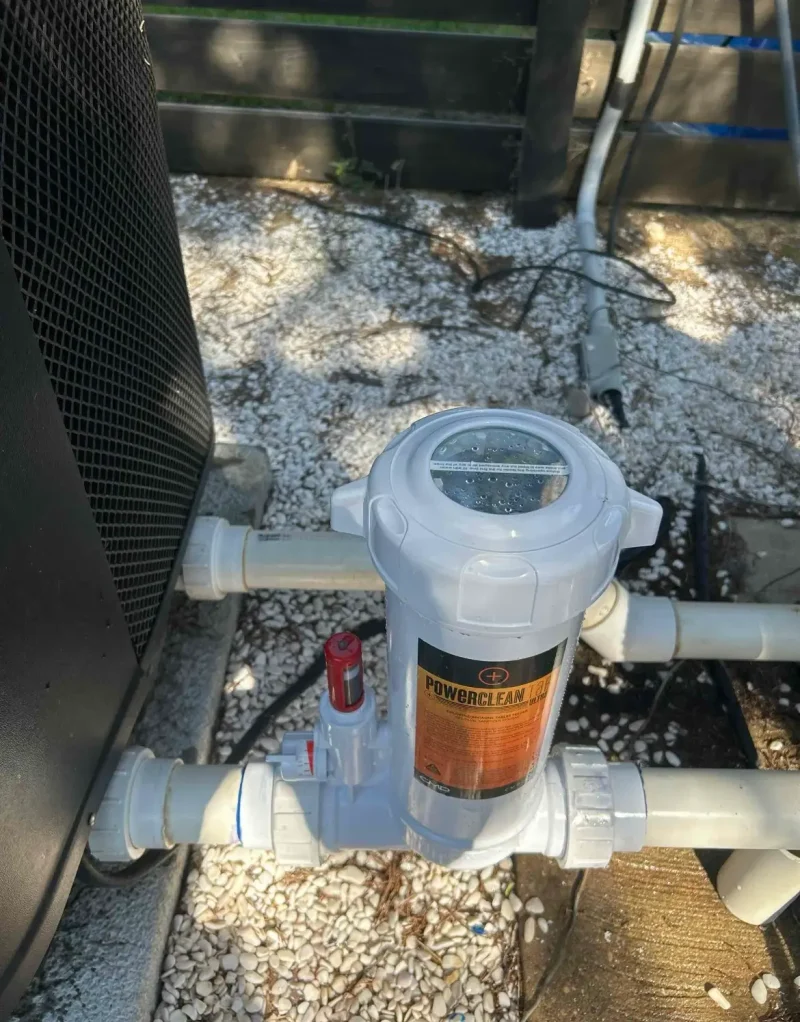
How the pad is plumbed matters too. A puck feeder or chlorinator belongs after the heater in the line, with a check valve between them. Without that valve, concentrated chlorine can drift back into the heater when the pump shuts off, and it corrodes the heat exchanger. There should also be a check valve between the filter and the heater, so hot water can’t back up into the filter. Both are worth checking on any pad with a heater.
Lizards in the Cabinet, Water on the Pilot
Lizards, frogs and insects like a warm cabinet. They crawl in, block airflow and sometimes short out a control board. On gas heaters, a sprinkler aimed at the unit or a roofline dumping rain on it can blow the pilot out again and again. That one is easy to fix and easy to misdiagnose.
Storm season adds one more. If a heater has been under water, don’t run it. Any control or gas valve part that was flooded needs a qualified technician to inspect and replace it before the heater fires again.
Pool Heater Repair by Heater Type
Each kind of heater fails in its own way, so pool heater repair starts with knowing what’s on your pad. If you’re not sure which type you have, Pentair’s pool heater guide shows the differences.
Gas and Propane Heaters
Gas heaters light one of two ways. Older millivolt models keep a standing pilot burning, and a thermocouple turns its heat into a small current that opens the gas valve. Electronic ignition models spark the pilot only when the heater calls for heat. Either way, the burner chamber can reach close to 1,100°F, so these parts take a beating.
Typical gas repairs are igniters, flame sensors, gas valves, pressure switches, high limit switches and control boards. Black soot on top of the heater or a warped, buckled cabinet points to low gas pressure, poor air supply or a venting problem. Resetting the heater won’t fix any of those, so they need a technician.
One safety note on propane. Unlike natural gas, propane is heavier than air. If it fails to light, it settles in the bottom of the heater instead of drifting off, and a delayed ignition can be violent. If you smell gas, turn the heater off and call us. Don’t keep pressing the button.
Pool Heat Pump Repair
A heat pump doesn’t burn anything. It pulls heat out of the outside air with a refrigerant loop and a compressor, then moves that heat into the pool water. You only pay for the electricity to run the compressor and the fan.
That’s why air temperature matters so much. The colder the air, the less heat there is to pull, and most units struggle once it drops toward 50 degrees. On the coldest nights here, a heat pump that seems weak may be working exactly as designed.
Real heat pump failures are usually a capacitor, a fan motor, a dirty or blocked coil, a refrigerant leak or a compressor. Pool heat pump repair also means checking the water side, because the same flow and scale problems that stop a gas heater will stop a heat pump.
Electric and Spa Heaters
Electric resistance heaters are common on spas and small pools. They cost a lot to run and heat slowly, and their elements and thermostats are the usual repairs. Spa water runs hotter, so scale builds faster on those elements. If the heater sits on a hot tub, our spa heater repair covers it alongside jets, pumps and controls.
Pool Heater Troubleshooting Before You Call
Some heater problems take five minutes to rule out. This table matches the common symptoms to their usual causes, and the checks below show what’s safe to try yourself.
| Symptom | Usual cause |
|---|---|
| Won’t fire at all | Low flow, a closed valve, gas supply off, thermostat set low |
| Shuts off before the water warms | Dirty filter, bypass out of adjustment, pressure switch or thermostat |
| Pilot keeps going out | Sprinklers, roof runoff or wind hitting the heater |
| Water under the heater only while it runs | Condensation, a missing bypass or too much flow |
| Water under the heater all the time | Heat exchanger leak, often from low pH |
| Black soot or warped panels | Low gas pressure, poor air supply or venting |
| Heat pump runs, water stays cool | Cold air, a dirty coil, low flow or a refrigerant leak |
If the Heater Won't Fire
Start with the obvious. Is the system switch on, and is the thermostat set above the water temperature? Is the pump running? Next, check that the gas supply valve and every filter and plumbing valve are open. If the heater clicks or sparks but won’t light, stop there and call a technician.
If It Shuts Off Before the Water Warms Up
A heater that cycles on and off is usually short of water. Check the filter pressure, open any half-closed valves and empty the pump basket. If the flow looks right and it still cycles, the pressure switch or thermostat may be out of calibration, and that’s a job for us.
If There's Water Under the Heater
Water under a heater scares people, because everyone has heard that a cracked heat exchanger is expensive. Sometimes it is. But if the water only shows up while the burner is lit, it’s usually condensation. A gas heater sweats when it heats very cold water, and it stops once the pool warms up.
A missing or damaged bypass, or too much water pushed through by an oversized pump, causes the same thing. By contrast, a real heat exchanger leak drips whether the heater is running or not, and low pH is the usual reason. So note when the water appears. That one detail narrows things down before we arrive.
When to Shut It Off
Turn the heater off and call if you smell gas, see soot or scorching, or the heater has been under water. If it overheats or the gas won’t shut off, close the manual gas valve to the heater. Keep things off the top of the unit as well, because the vent and the top get hot enough to burn.
Our Pool Heater Repair Process
Every pool heater repair call follows the same order, so the repair goes after whatever caused the fault in the first place.
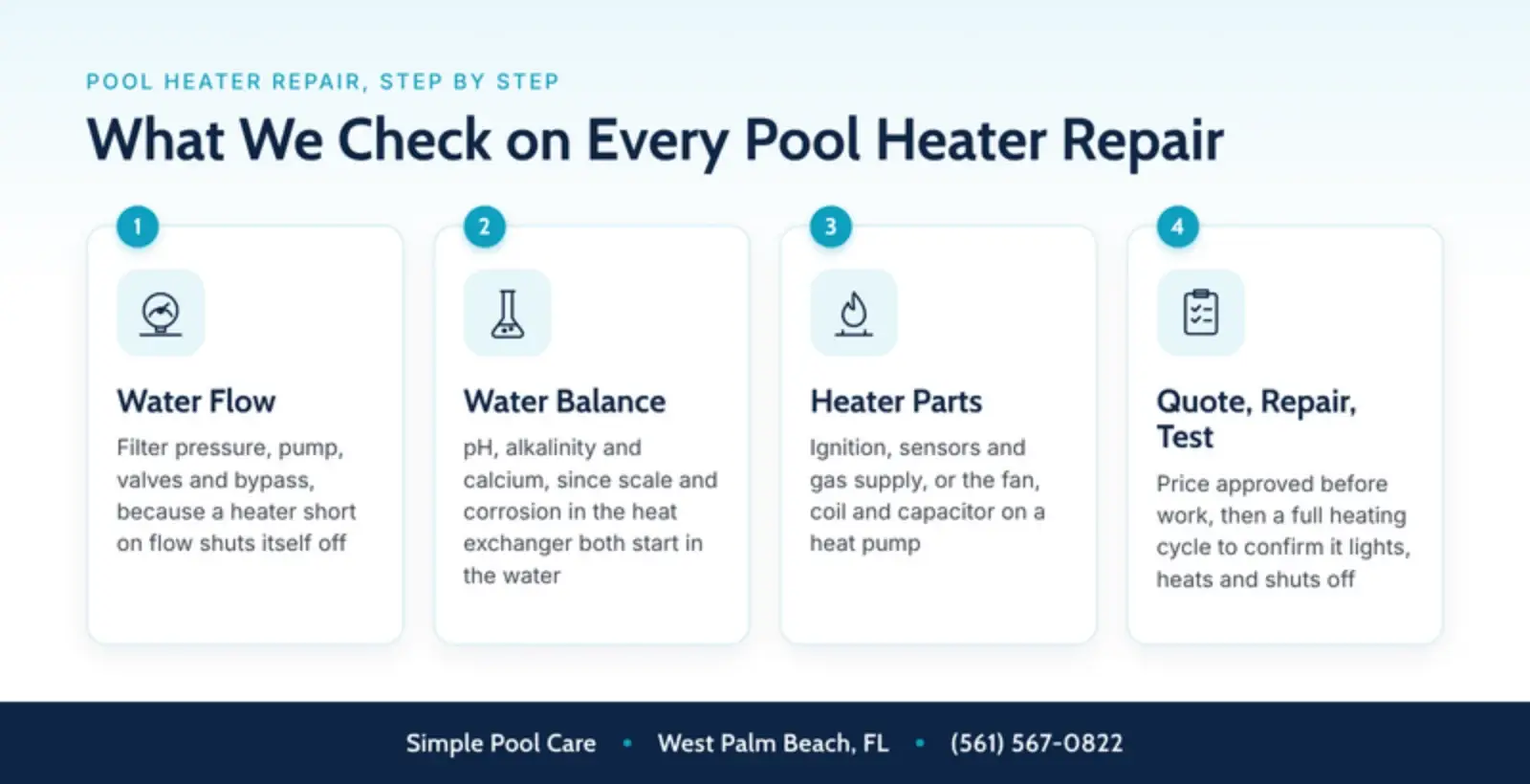
We check the flow and the water first. That means filter pressure, valves, bypass and pump, then pH, alkalinity and calcium. If the water is causing the failure, a new part won’t last.
Then we test the heater itself. On gas units, that means ignition, sensors, switches and the gas supply. On heat pumps, it means the fan, coil, capacitor and refrigerant side. We also look for corrosion, scale, soot and anything living in the cabinet.
You get the price before we start. We explain what failed and why, and you approve the repair first. After the fix, we run the heater through a full cycle to make sure it lights, holds temperature and shuts off when it should.
Repair or Replace Your Pool Heater?
If the heater is only a few years old, repairing it almost always makes sense. But if it’s well over a decade old, the heat exchanger is failing, or you’re paying for a repair every season, a new unit may cost less over time. For context, a new gas heater typically runs $2,000 to $4,000 installed and a heat pump $3,000 to $7,500. If you go that way, we handle pool heater replacement too, sized to your pool and spa.
If you’re weighing a heat pump against electric, one number settles it. It’s called the coefficient of performance, or COP, and it’s the heat you get out divided by the electricity you put in. A typical heat pump runs a COP of 3 to 8. A straight electric heater is 1. So a heat pump delivers three to eight times the heat for the same power, which is why we rarely suggest swapping a working heat pump for electric.
Keeping a Repaired Heater Running
Most heater breakdowns we get called for were preventable. A yearly tune-up, usually $100 to $200, catches scale, weak parts and airflow problems before a cold night does. The bigger factor is the water. Keep pH at 7.4 to 7.6, alkalinity at 80 to 120 ppm, calcium at 200 to 400 ppm and the saturation index between -0.3 and +0.3. In that range, the water neither scales the heat exchanger nor eats it.
Weekly pool service keeps that balance in check, and it keeps the filter clean so the heater never runs short of flow. Keep sprinklers pointed away from the unit and the top of the cabinet clear, too.
Then there’s the heat itself. Evaporation causes about half of all heat loss from a pool. In the worst case, an uncovered pool can lose as much as half of its temperature rise, while a cover cuts that to 15 to 25 percent. Over a season, a cover can lower heating costs by 50 to 70 percent. No repair we make will save you more.
Set the temperature sensibly as well. Around 82 degrees suits most recreational swimming, and a spa should never go above 104. Every degree past what you need adds to the bill.
Pool Heater Repair in Boynton Beach and Along the Coast
We handle pool heater repair from Jupiter down to Boynton Beach. Everything on this page applies in Boynton Beach and Lake Worth Beach just as it does in West Palm Beach. For the rest of what we do down there, see our pool service in Boynton Beach page.
Near the water, salt air is the bigger enemy. On pads from Palm Beach and Singer Island up through Riviera Beach and Juno Beach, we pay closest attention to wiring, boards and cabinet hardware. Further inland, in Palm Beach Gardens and west of I-95, salt matters less, and the scale and flow problems above are the bigger risk.
What Pool Heater Repair Costs
Most pool heater repair jobs here run between $200 and $800. Where yours lands depends on what failed.
Small parts like a capacitor, sensor or thermostat sit at the low end. A fan motor or control board falls in the middle. On the high side, a gas heat exchanger or a heat pump compressor costs more. At that point, we’ll tell you whether repair or replacement is the better use of your money.
Before any of that, a diagnostic visit typically runs $100 to $250. It tells you the real problem and the real price before any work happens, and nothing goes ahead until you approve it.
Check what a quote includes when you compare. A cheap part that doesn’t fix the flow or the water balance usually means a second call later.
Heater Repair Alongside Your Regular Pool Care
Heaters rarely fail on their own. A worn pump, a loaded filter or water that has drifted out of balance is often part of the story. That’s why we look at the whole pad. That’s also why heater work sits next to pool filter repair in our pool repairs.
Heaters are just one piece of the pool service in West Palm Beach we run, from weekly visits to new equipment. To book, call (561) 567-0822 or request a quote. We’ll see the heater before we put a number on it.
Pool Heater Repair FAQs
These are the heater questions we hear most from homeowners. Don’t see yours? Call (561) 567-0822.
Cost, Repairs and Choosing a Company
Most pool heater repairs from Simple Pool Care run $200 to $800, depending on the part. Capacitors, sensors and thermostats sit at the low end, while a heat exchanger or compressor costs more. A diagnostic visit is typically $100 to $250, and you approve the price before work starts.
Repair usually makes sense on a heater that's only a few years old. Replacement starts to win when it's well over a decade old, the heat exchanger is failing or it needs work every season. A new gas heater runs about $2,000 to $4,000 installed, and a heat pump $3,000 to $7,500.
Yes. Simple Pool Care repairs heat pumps, natural gas and propane heaters, and electric spa heaters, including combo units that heat a pool and a spa. We work on Hayward, Pentair, Jandy, Raypak and Zodiac, and our factory training covers Hayward, Pentair, Jandy and Zodiac.
Yes. Simple Pool Care repairs pool heaters across Boynton Beach and Lake Worth Beach, and through the rest of our area from Jupiter down. The process is the same there: we check flow and water balance first, test the heater, then quote the repair before any work starts.
Simple Pool Care is an owner-run West Palm Beach company. We're licensed and insured, with a Google rating of 5.0. We check the flow and water chemistry before blaming the heater, which often saves an expensive part. You get the price up front, and every repair ends with a full heating cycle test.
Heater Problems and Troubleshooting
Low water flow is the most common cause. A dirty filter, closed valve or weak pump starves the heater, and its pressure switch shuts it down. After that, scale building up in the heat exchanger and corrosion from salt air account for most failures here, then ignition parts, sensors and refrigerant leaks.
A heater that cycles off before the water warms up is usually short of flow. Check for a dirty filter, a closed valve, a full pump basket or a bypass out of adjustment. If the flow is fine, the pressure switch or thermostat may be out of calibration.
Not always. If water appears only while the burner is lit, it's usually condensation from heating very cold water, and it stops as the pool warms. A damaged bypass or an oversized pump can do the same. A real heat exchanger leak drips all the time, usually from low pH.
Usually the air is too cold or the water isn't moving. A heat pump pulls heat from the outside air, so its output drops as the air cools, and most units struggle near 50 degrees. Low flow, a dirty coil or a refrigerant leak cause most of the rest.
Yes. Calcium gets less soluble as water heats up, so hard water leaves scale inside the heat exchanger, cutting efficiency and flow. Salt air corrodes wiring, sensors and control boards on coastal pads. Keeping pH at 7.4 to 7.6 and calcium at 200 to 400 ppm protects the inside.
