
Pool Tile Cleaning in West Palm Beach, FL
Pool tile cleaning in West Palm Beach, with pool calcium removal that lifts the white line off your waterline without scratching the glaze. We check the grout and quote the job before we start.

Pool Calcium Removal That Leaves the Glaze Intact
That white line around your pool is calcium carbonate scale, not dirt. Once it hardens, a brush and a bottle from the pool store won’t shift it. That’s why most people give up and learn to live with it.
Pool tile cleaning is the part of our pool cleaning work that deals with that line. We lower the water a few inches, take the scale off with fine blasting media and leave the glazed face of the tile alone. The grout gets checked too, because that’s where algae likes to start.
Most of the scale we see here comes from the water itself. Heat drives off water, the calcium stays behind, and a pool running on the scaling side lays down a little more every week. So we’ll also tell you why yours formed and which readings to watch, so it comes back slower.
Every job is quoted after we’ve seen the pool. The price depends on how long the tile line is, how thick the scale has built up and what the tile is made of. Coming out to look costs nothing.
If the plaster below the tile is stained or scaled as well, that’s a pool acid wash, which is a different job. Loose or cracked tiles fall under tile repair, which we handle ourselves. Either way, we’ll tell you honestly which one your pool needs.
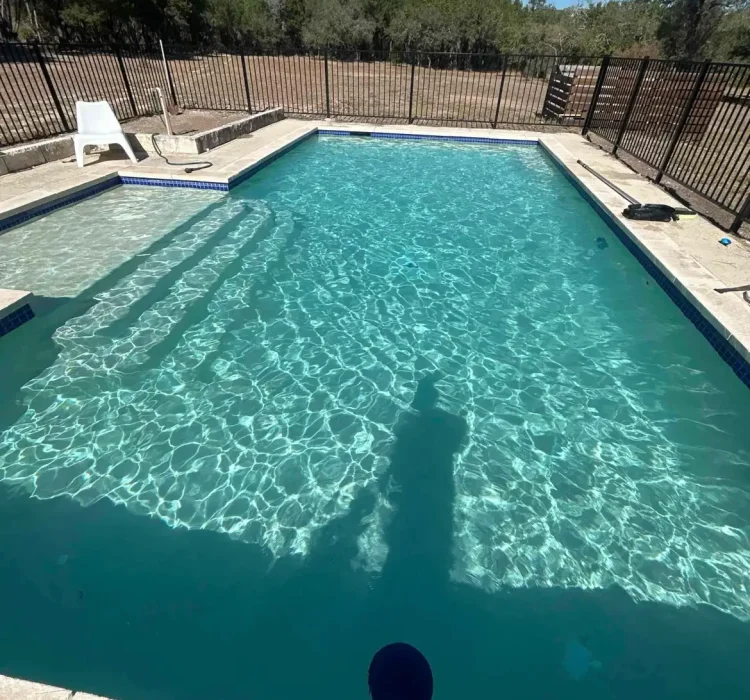
What the White Line on Your Pool Tile Really Is
Most of what builds up on a waterline is one of three things: calcium scale, a scum line or a stain. From the deck they look alike. But each one has a different cause and comes off a different way, so telling them apart is the first thing we do.
Calcium Scale
Scale is calcium carbonate, the same mineral as chalk and limestone. Pool water can only hold so much of it. Push the water past that point and the calcium drops out as a hard, crusty white deposit. In fact, water hardness itself is measured as calcium carbonate, as the USGS explains.
It forms fastest wherever water evaporates or heats up. At the waterline, splashes and ripples leave a thin film on the tile that dries in the sun, and each film leaves a little more mineral behind. Warm water also holds less calcium than cool water, so a Florida summer pushes it out of solution faster.
Fresh scale is white and chalky. Because its surface is rough, though, it traps dirt over time and turns gray or brown. People often assume that’s a different problem. Usually it’s the same calcium with a few years of grime set into it.
The Scum Line
A scum line is the greasy band of sunscreen, body oil, cosmetics and dirt that collects at the waterline. It forms the same way scale does. Water splashes onto the tile, dries and leaves residue just above the surface. Once it starts, it keeps growing, because the film attracts more of the same from the water.
In hard or unbalanced water, a scum line is often mostly scale underneath. That’s why brushing the waterline matters so much. It stops the oily layer from building into something that needs blasting.
Stains That Aren't Scale
If you can see color but can’t feel a crust, it’s probably a stain. Iron and manganese leave reddish brown marks, while copper leaves blue green ones. Leaves and other plant debris leave dark tannin stains, which chlorine can often bleach out. Copper combined with high stabilizer can even stain plaster purple.
Blasting won’t fix a metal problem. The source has to be found first, whether that’s the fill water, a corroding heater or low pH eating at metal parts. Otherwise, new stains form as fast as the old ones come off. Stains also get harder to remove the longer they sit, so it pays to look at them early.
Why the Grout Matters
Grout is cement, so it’s porous where the glazed tile isn’t. It soaks up oils from the scum line, and that oily residue feeds algae. That’s why algae tends to take hold in the grout between waterline tiles first. And when the water turns corrosive, tile line grout is one of the first things it attacks.
Why Scrubbing and Strong Acid Make Tile Worse
Most homeowners try a few things before they call us. Some of them work on a light film. Others leave the tile in worse shape than the scale did.
The Glaze Is What Protects the Tile
Pool tile has a glazed, non-porous face. That glaze is what keeps oils and minerals from soaking into the tile, so anything used on it has to be non-abrasive. Steel brushes, scouring pads, pumice stones and wire wheels all scratch it.
Once the glaze is scratched, the tile stays rougher for good. A rough surface holds dirt and gives new scale more to grip, so the line comes back faster than before. So a bad cleaning costs you twice: once now, and again every time the line comes back. Rough scale is hard on swimmers too, since it can scrape skin.
Acid, Pressure Washers and Store Cleaners
Scale removers are often mildly acidic, and on a light, fresh film they can do the job. If the line is thin and still chalky, you may not need us at all. Strong acid is another story. Muriatic acid scrubbed straight onto the tile line attacks the grout, which is cement and gives way long before the tile does. You end up with clean tile and soft, eroded grout.
Pressure washers built for driveways can crack tile, blow out grout lines and chip the coping. And if you buy a tile cleaner off the shelf, read the label first. It should be non-abrasive, made for pools, low foaming and free of phosphates. Phosphate is algae food, and household cleaners that contain it can actually make the scum line worse.
How Our Pool Tile Cleaning Works
Every pool calcium removal job follows the same steps, whatever the tile is made of. Here’s how a visit runs.
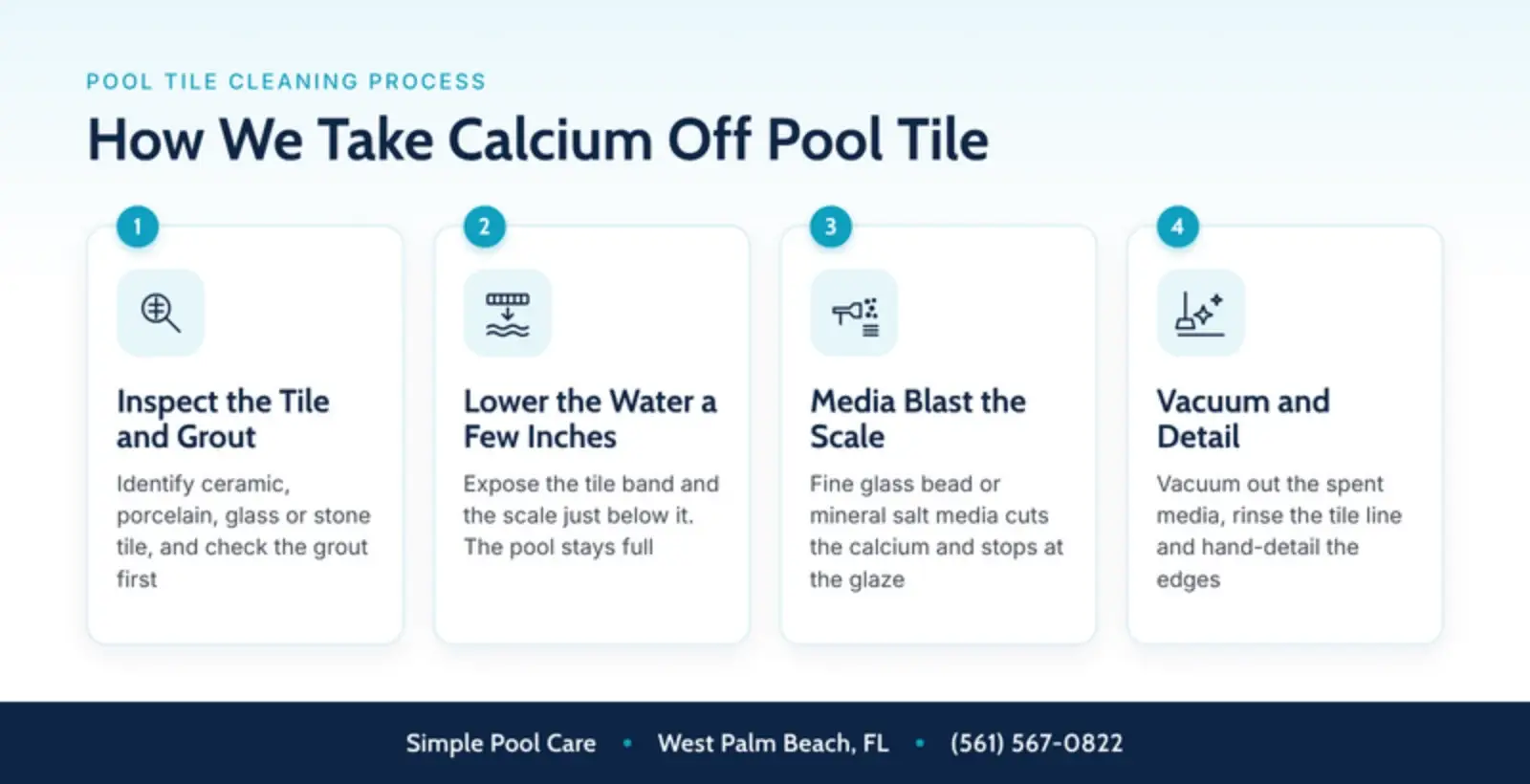
Inspect the Tile and Grout
First, we identify the tile material, because ceramic, porcelain, glass and natural stone don’t take the same media or the same pressure. Glass mosaic is the least forgiving. We also check for grout that has already failed, since blasting will find it, and we tell you about it before we start.
Lower the Water a Few Inches
Next, the water comes down far enough to expose the tile band and a little below it. Scale forms under the visible line too. Stopping at what you can see leaves a shadow that shows up the moment the pool refills.
Draining is a much bigger decision here. Florida’s water table sits high, and groundwater pushing up under an empty shell can lift a pool out of the ground. Tile work only needs the level down a few inches, so the pool stays full.
Media Blast the Scale
Then we blast the scale with fine glass bead or mineral salt media, at a controlled pressure set for pool tile. It cuts the calcium and stops at the glaze. Softer surfaces like travertine and natural stone get lighter media and lower pressure, and glass mosaic gets the lightest touch of all.
Rinse, Vacuum and Detail
Spent media settles on the floor, so we vacuum it out and rinse the tile line. After that, we hand-detail the edges and any raised features. The water can look a little hazy for a short while afterward, but it clears as the filter runs.
Refilling changes the chemistry, because the fill water brings its own calcium and alkalinity. So test the water once the level is back up, or let your regular technician check it on the next visit.
Seal the Tile, If You Want
A sealant on freshly cleaned tile can slow the next buildup. It’s most worth it on spillways and water features, since those scale the fastest.
Tile Types We Clean
We clean ceramic, porcelain, glass mosaic and natural stone waterlines, including travertine and decorative bands. That covers inground concrete pools, raised walls, spillways and attached spas. Each material behaves a little differently under blasting, which is why the inspection always comes first.
How to Keep Calcium Off Pool Tile
Scale is a water chemistry problem before it’s a cleaning problem. A pool held in balance can go a long time between cleanings. One running on the scaling side builds the line back up, no matter how well it was cleaned.
Hold the Saturation Index in Range
The saturation index combines five readings into one number: pH, total alkalinity, calcium hardness, water temperature and total dissolved solids. It tells you whether the water will dissolve calcium or deposit it. Zero is ideal, and anywhere from -0.3 to +0.3 counts as balanced.
Above +0.3, the water is scale forming, and the tile line, heater and plumbing start collecting calcium. Below -0.3, it turns corrosive and dissolves calcium out of grout and plaster instead. Neither is good for tile. If you adjust it yourself, go in order: total alkalinity first, then pH, then calcium hardness.
One catch is stabilizer. Cyanuric acid inflates the alkalinity reading, so divide the stabilizer number by three and subtract it from the alkalinity before you work out the index.
Hard Fill Water and Calcium Hardness
Calcium hardness belongs between 200 and 400 ppm. Water drawn from underground aquifers usually carries more calcium than surface water, and every top-up after evaporation adds more. Calcium hypochlorite shock adds calcium too, and it pushes pH up at the same time.
Lowering hardness is hard work. It generally means draining part of the water and refilling with softer water. So in practice, we hold pH and alkalinity a little lower to keep the index balanced. Past 500 ppm that takes real care, and near 1,000 ppm the water becomes almost impossible to keep in balance.
Scale Inhibitors and Sequestering Agents
Scale inhibitors are made for exactly this problem. They interfere with calcium carbonate crystals as they form, which helps keep the calcium in the water instead of on your tile. Related products, called sequestering or chelating agents, tie up iron and copper so they don’t stain.
They help, though they won’t do the job alone. Some break down into phosphate over time, which feeds algae. So they still need balanced water and a steady chlorine level behind them.
Brush the Waterline Every Week
Regular brushing at the waterline stops a scum line before it gets a start, and it’s the cheapest prevention there is. Use a nylon brush and a non-abrasive, phosphate-free tile cleaner. Our weekly pool service brushes the tile line on every visit and keeps the water balanced, which is most of what stops scale from coming back.
Spas, Spillways and Heaters Scale First
Raised spas, spillways, fountains and sheer descents scale before the rest of the pool. Moving water evaporates faster, and hot water pushes calcium out of solution. A spa running near 104°F tips toward scaling sooner than the pool does, so spa water needs its own attention, which is what spa cleaning covers.
The same chemistry works where you can’t see it. Heat exchangers scale up and lose efficiency, scale in the plumbing cuts flow, and filter media can calcify. That’s one more reason filter cleaning and balanced water go together.
Which Job Your Tile Needs
The white line, a stained floor and a loose tile are three different jobs. Here’s how we tell them apart.
| What you see | The job |
| White or gray crust on the tile band | Pool tile cleaning, quoted after we see it |
| Stains or scale on the plaster below the tile | Acid wash, $300 to $700, plus $150 to $250 if draining is needed |
| Loose, cracked or missing tiles | Tile repair, done in-house and quoted first |
| Rough, worn plaster across the pool | Resurfacing, which we refer to a specialist |
How Often Pool Tile Cleaning Is Needed
Every twelve to eighteen months suits most pools in West Palm Beach and Palm Beach County. Plan on it sooner if you have a raised spa, spillway, fountain or sheer descent, heavy summer use, or water that runs on the scaling side of the index.
If the line keeps coming back inside a year, look at the water balance before you book more blasting. Fixing the balance costs less than paying for the cleaning twice as often.
What Pool Tile Cleaning Costs
We don’t quote pool tile cleaning over the phone, because two pools of the same size can need very different amounts of work. The price comes down to how long the tile line is, how thick the scale has built up and what the tile is made of. Raised features and spillways add time.
We come out, look at the tile and give you a number before any work starts. Coming to look costs nothing, and the price you’re quoted is the price on the invoice.
If the scale has spread below the tile onto the plaster, we’ll say so. An acid wash runs $300 to $700, plus $150 to $250 if draining is needed, and we won’t sell you both when one will do.
Pool Tile Cleaning With the Rest of Your Pool Care
Tile cleaning sits alongside weekly visits, filter cleaning and spa cleaning in our pool cleaning services. Most customers only need it every year or so.
Beyond cleaning, our pool service in West Palm Beach covers repairs and new equipment too. Send us a photo of your waterline, and we can usually tell you what you’re dealing with before we come out.
Request a quote or call (561) 567-0822. We’ll look at the tile before we put a number on it.
Pool Tile Cleaning FAQs
Calcium, scale and tile questions we answer most often. Don’t see yours? Call (561) 567-0822.
Cost, Scheduling and Choosing a Company
Simple Pool Care quotes pool tile cleaning after seeing the pool, and the visit to look is free. The price depends on how long the tile line is, how heavy the scale is and what the tile is made of. The price we quote is the price you pay.
No. For pool tile cleaning, we lower the water a few inches, just enough to expose the tile band and the scale below it. The pool stays full. Draining is a bigger decision in Florida, because a high water table can push an empty pool shell up out of the ground.
Most pools in West Palm Beach need pool tile cleaning every twelve to eighteen months. Raised spas, spillways and fountains scale sooner, because moving water evaporates faster. If the white line returns within a year, the water balance is the real problem, and fixing it costs less than cleaning twice as often.
Not when the media and pressure match the tile. Simple Pool Care identifies the tile first, then uses fine glass bead or mineral salt media set for pool tile, which cuts the calcium and stops at the glaze. Glass mosaic and natural stone get lighter media and lower pressure.
Simple Pool Care is a licensed, insured, owner-operated company in West Palm Beach with a 5.0 Google rating. We check the tile and grout before blasting, quote before we start and explain why the scale formed, so it comes back slower. If the plaster needs an acid wash instead, we'll tell you.
Calcium, Scale and Stains
It's calcium carbonate scale. Water evaporates at the waterline and leaves its calcium behind, and water pushed past its balance point drops out more as a hard white crust. Older scale turns gray or brown because its rough surface traps dirt. Sunscreen and body oils add a greasy scum line on top.
Light, fresh scale can come off with a non-abrasive, mildly acidic scale remover made for pools. Hard or older scale needs media blasting, which lifts the calcium without scratching the glaze. Avoid steel brushes, pumice and wire wheels, because scratched tile scales faster afterward.
Vinegar can soften a light film above the waterline, but it's too weak for hardened scale. Muriatic acid dissolves calcium, but it also eats into the grout, which is cement and gives way before the tile does. That leaves clean tile with soft grout, so we don't recommend it for DIY tile work.
Keep the saturation index between -0.3 and +0.3 by adjusting total alkalinity, pH and calcium hardness, in that order. Brush the waterline every week with a phosphate-free cleaner, and consider a scale inhibitor. Simple Pool Care's weekly service does the brushing and balancing on every visit.
Heat and evaporation. Florida pools lose a lot of water to the sun, and every top-up adds calcium while the old calcium stays behind. Warm water also holds less calcium in solution. Add high pH or alkalinity, or calcium hypochlorite shock, and the water tips toward scaling quickly.
