
Pool Filter Cleaning in West Palm Beach, FL
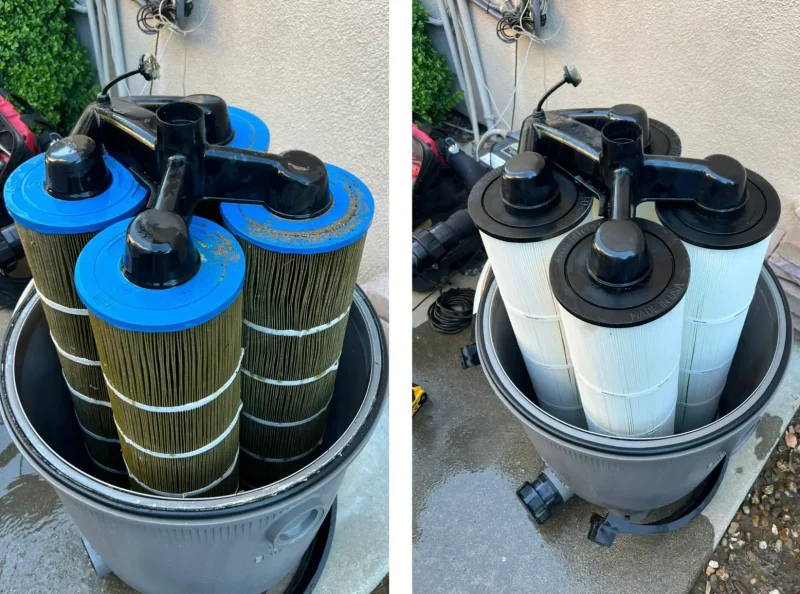
Cartridge, sand and DE filters, taken apart and cleaned properly rather than hosed down.

A filter that nobody has opened in two years will cost you a pump long before it costs you clarity. The motor is working harder every week to push water through something that is no longer letting much through.
We clean cartridge, sand and DE filters properly, which means taking the housing apart rather than rinsing something off. If we find a cracked manifold, a torn grid or a perished O-ring while it is open, we will tell you before we put it back together.
Book Pool Filter Cleaning in West Palm Beach
When Your Filter Actually Needs Cleaning
Reading the Pressure Gauge
There is a number for this, and most homeowners have never been told it.
When your filter pressure sits 8 to 10 psi above its clean starting pressure, it needs cleaning. Not when the water goes cloudy. By then it has been struggling for weeks.
The catch is knowing your clean starting pressure. Write it on the tank with a marker next time the filter is serviced. Without that baseline the gauge tells you almost nothing, which is why most people ignore it.
Two readings worth understanding:
High pressure with good flow means the filter is loaded and needs cleaning. Normal, expected, fixable.
Low pressure with a full pump basket is the opposite problem. Something is restricting the suction side before the pump, and cleaning the filter will not fix it. If you are also seeing air bubbles in the pump basket you have a suction leak, and running it that way will eventually take out the pump seal. That is a filter repair, not a cleaning.
The Three Filter Types and What They Do
Cartridge. Pleated media in a cylinder, filtering down to roughly 10 to 25 microns. No backwashing, which means no water wasted every time it is cleaned. That matters here where you are already topping the pool up against evaporation. The elements are replaceable rather than permanent, and hard water shortens their life considerably.
Sand. Cheapest to run and the coarsest, filtering to around 25 microns once the bed has loaded up a little. Cleaned by backwashing, which reverses the flow and lifts the sand so trapped material flushes out. Sand does not wear out from filtering. What kills it is oil and mineral coating the grains until they clump into what the trade calls mud balls, and water starts channeling straight through instead of filtering across the bed. Most beds want replacing somewhere between five and fifteen years depending on how hard they have worked.
DE. The finest filtration available on a residential pool, down to the 2 to 6 micron range. Diatomaceous earth coats fabric-covered grids and the powder is what does the filtering. It gets backwashed and then re-coated with fresh powder, because the old cake goes out with the dirt. Quantity matters either way: too little leaves the fabric exposed to oils and debris, too much causes the cake on adjacent grids to bridge together.
One thing worth knowing if you handle DE yourself. It is crystalline silica, microscopically sharp, and the dust is a genuine respiratory hazard. Supplier labels carry breathing-protection warnings for a reason, and OSHA treats crystalline silica as a regulated hazard. It also travels, and it has been known to get into pump motor windings and shorten their life.
What Our Filter Cleaning Includes
Open the housing and take it apart. Grids, cartridges, manifolds and internals all come out.
Every element gets cleaned individually. Where there is calcium or heavy oil we soak rather than pressure-blast, in the right order, because that is what actually gets it out without wrecking the media.
Everything is inspected while it is apart. Cracked manifolds, torn grids, worn O-rings and tank integrity. That is the part a rinse-and-go never catches.
Reassemble, and on a DE filter recharge with the correct powder quantity for your grid area. Restart, confirm flow and pressure, and note the new clean starting pressure so you have a baseline to measure against.
You get a report of what we found and what we did.
Why Cleaning a Cartridge Yourself Usually Goes Wrong
Plenty of people hose their own cartridges off, and for light seasonal dirt that is fine. Where it goes wrong is real buildup, because the order of operations matters and almost nobody knows it.
A dirty cartridge usually has two different problems on it: oils and greases from sunscreen and body lotion, and mineral scale from our hard water. Those need two different cleaners, and the degreaser has to go first.
If you hit an oily cartridge with acid before you have degreased it, the acid sets the oil into the pleats. Permanently. The element still looks clean and it never filters properly again, and you end up buying a new one convinced it just wore out.
That is the single most common way a good cartridge gets ruined, and it is why we soak rather than blast.
While it is open we also check the O-ring, which people never think about. A perished O-ring lets water out or, worse, lets air in, and air in the system is how you end up chasing a problem that looks like everything except what it actually is.
How Often, and What It Costs
Most pools here want a professional clean every three to six months. What moves it: how much tree cover you have, whether the pool is screened, how heavily it gets used, and how many storms have been through.
If you are on a weekly service plan with us, filter cleaning twice a year is already included.
Standalone cleans are quoted on filter type and size, because a four-grid DE filter and a single cartridge are genuinely different jobs. Call (561) 567-0822 and we will tell you the number before we start.
And if the element is at the end of its life we will say so rather than charging you to clean something that needs replacing. There is a point where cleaning stops helping.
We clean filters across West Palm Beach and Palm Beach County. Book a filter cleaning or call (561) 567-0822.
We Are Experts With:




Your Trusted Pool Service Partner
It’s easy to get started with Simple Pool Care
Trusted by 100+ homes throughout West Palm Beach and neighboring cities.
We treat our customers like family, which is why we crafted our Pool Service plans to service our customers with the utmost professional service so you can enjoy your pool worry free.
Why West Palm Beach Homeowners Choose Us
Ten years in Palm Beach County and more than a hundred pools behind us. Licensed and insured, factory trained on Hayward, Pentair, Jandy and Zodiac, and a 5.0 rating across 21 Google reviews.
Same technician on your pool every week. No contracts.
Over 10 years of experience in the pool service industry spanning across 2 counties.
Servicing over 100+ customers a year while maintaining a 5 star rating from our clients.
When you choose Simple Pool Care, you have a friend in the industry you can trust.
We are available day and night for our customers. We take your business seriously.
Frequently Asked Questions
The questions we get asked most. If yours is not here, call (561) 567-0822.
When the pressure gauge reads 8 to 10 psi above its clean starting pressure. That is the actual trigger, not cloudy water. Write your clean starting pressure on the tank after each service so the gauge means something. One caution: high pressure with good flow means a dirty filter, but low pressure with a full pump basket is a suction side restriction instead, and cleaning will not fix that.
Every three to six months for most pools here. It depends on tree cover, whether the pool is screened, how much it gets used and how many storms have come through. Filter cleaning twice a year is included in our weekly service plans.
Cartridge filters use pleated media, filter to roughly 10 to 25 microns and need no backwashing, so they waste no water. Sand filters are the cheapest to run and the coarsest at around 25 microns, cleaned by backwashing. DE filters are the finest at 2 to 6 microns, using diatomaceous earth on fabric grids, and get re-coated with fresh powder after every backwash.
For light dirt, yes. Where it goes wrong is heavy buildup, because a dirty cartridge has both oils and mineral scale on it and those need two different cleaners in the right order. The degreaser must go first. If you use acid on an oily cartridge before degreasing it, the acid sets the oil into the pleats permanently, and the element never filters properly again. That is the most common way a good cartridge gets ruined.
It needs respect. DE is crystalline silica, microscopically sharp, and the dust carries a respiratory hazard serious enough that supplier labels require breathing protection. It also travels easily and can find its way into pump motor windings and shorten their life. Worth leaving to someone with the right equipment.
